


A Tainan man who survived a heart attack said on Friday that he would sue the Ministry of Health and Welfare for not making a mobile electrocardiography (ECG) app available for Apple Watch Series 4.
The tech worker, surnamed Lee (李), said he would file a civil lawsuit for damages and an administrative suit for negligence if the ministry does not change its regulations, which he said resulted in the app being disabled in Taiwan.
Lee said that he bought the smartwatch from a friend in the US in March, a month before the ministry banned the app on the grounds that it would turn the smartwatch into an unapproved medical device.
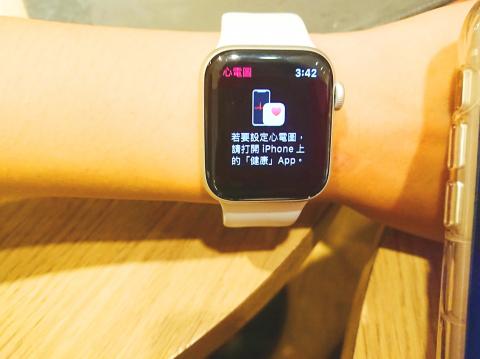
Photo: Hung Jui-chin, Taipei Times
The smartwatch cost him about NT$140,000 and he had bought it specifically for the heart monitoring app, as he was feeling unwell and was worried about his well-being, because his family has a history of heart disease, he said.
When he sought medical help at the time, doctors misdiagnosed him with acid reflux, Lee said, adding that his heart condition could have been discovered had the app been available in Taiwan.
The misdiagnosis wasted time that could have been used to prevent the heart attack, he said.
“The ministry’s decision in April, which was ill-advised, removed an app that is crucially important to people with heart conditions,” Lee said.
Instead of standing in the way of progress, the government should embrace technology and allow the use of electronic devices for medical purposes, as long as they are used to supplement doctors and not to replace them, he said.
People with heart conditions have long urged the government to allow ECG apps on smartwatches, but to no avail, which is why he is using the lawsuits to pressure the government, Lee said.
Food and Drug Administration official Lin Hsin-hui (林欣慧) said that Apple decides whether to make heart monitoring apps available in regional markets.
“When the US Food and Drug Administration approved Apple to release its ECG app, we sent an inquiry to the Taiwan branch of Apple and it said: ‘Due to considerations of global business strategy, there are no plans to release the ECG app in Taiwan at this time,’” Lin said.
There are many approved heart monitoring devices for household use and they are widely available on the commercial market, she added.
Tainan Municipal An-Nan Hospital deputy superintendent Lin Sheng-che (林聖哲) said that smartwatches are no substitute for doctors, because it takes medical professionals to review and interpret ECG readings.
However, wearable devices with ECG apps could be a valuable early detection tool for the average person, who is not necessarily alert to chest tightness, arrhythmia or other symptoms of heart conditions, he said.
“The government should consider allowing such apps to be released,” he said.
Taipei Medical University Hospital cardiologist Huang Chun-yao (黃群耀) said that the heart rate is one of the many physiological data monitored by medical ECG devices, adding that the capabilities of wearable heart monitoring devices is “uncertain.”
Democratic Progressive Party Legislator Chen Ting-fei (陳亭妃) said she would ask the ministry to weigh the opinions of experts and the public on the matter, but added that it is appropriate for regulators to be attentive to risks when evaluating medical devices.

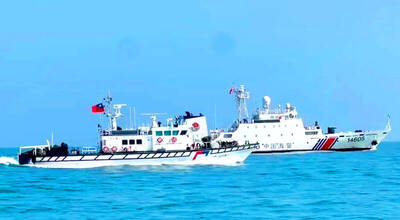
The military has spotted two Chinese warships operating in waters near Penghu County in the Taiwan Strait and sent its own naval and air forces to monitor the vessels, the Ministry of National Defense (MND) said. Beijing sends warships and warplanes into the waters and skies around Taiwan on an almost daily basis, drawing condemnation from Taipei. While the ministry offers daily updates on the locations of Chinese military aircraft, it only rarely gives details of where Chinese warships are operating, generally only when it detects aircraft carriers, as happened last week. A Chinese destroyer and a frigate entered waters to the southwest
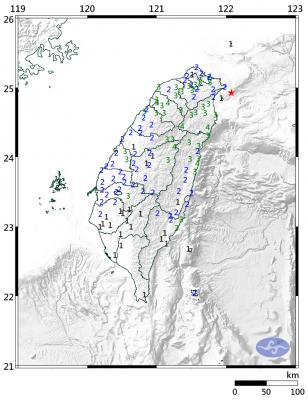
A magnitude 6.1 earthquake struck off the coast of Yilan County at 8:39pm tonight, the Central Weather Administration (CWA) said, with no immediate reports of damage or injuries. The epicenter was 38.7km east-northeast of Yilan County Hall at a focal depth of 98.3km, the CWA’s Seismological Center said. The quake’s maximum intensity, which gauges the actual physical effect of a seismic event, was a level 4 on Taiwan’s 7-tier intensity scale, the center said. That intensity level was recorded in Yilan County’s Nanao Township (南澳), Hsinchu County’s Guansi Township (關西), Nantou County’s Hehuanshan (合歡山) and Hualien County’s Yanliao (鹽寮). An intensity of 3 was
Instead of focusing solely on the threat of a full-scale military invasion, the US and its allies must prepare for a potential Chinese “quarantine” of Taiwan enforced through customs inspections, Stanford University Hoover fellow Eyck Freymann said in a Foreign Affairs article published on Wednesday. China could use various “gray zone” tactics in “reconfiguring the regional and ultimately the global economic order without a war,” said Freymann, who is also a nonresident research fellow at the US Naval War College. China might seize control of Taiwan’s links to the outside world by requiring all flights and ships entering or leaving Taiwan
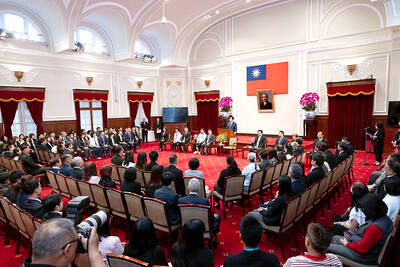
The next minimum wage hike is expected to exceed NT$30,000, President William Lai (賴清德) said yesterday during an award ceremony honoring “model workers,” including migrant workers, at the Presidential Office ahead of Workers’ Day today. Lai said he wished to thank the awardees on behalf of the nation and extend his most sincere respect for their hard work, on which Taiwan’s prosperity has been built. Lai specifically thanked 10 migrant workers selected for the award, saying that although they left their home countries to further their own goals, their efforts have benefited Taiwan as well. The nation’s industrial sector and small businesses lay


 RSS
RSS