


More than 100 tour bus operators and drivers yesterday rallied outside the Ministry of Transportation and Communications in Taipei to protest a government policy requiring them to install a GPS device on their vehicles, which they said is designed to monitor their location and could compromise their operational safety.
Lee Shih-chia (李式嘉), chairman of the New Taipei City Touring-bus Craft Union for Drivers, said they are not against having GPS installed in their vehicles.
However, they oppose the Directorate-General of Highways (DGH) using GPS to collect evidence of traffic violations, he said, adding that those who refuse to be monitored would receive demerits in their performance evaluations.
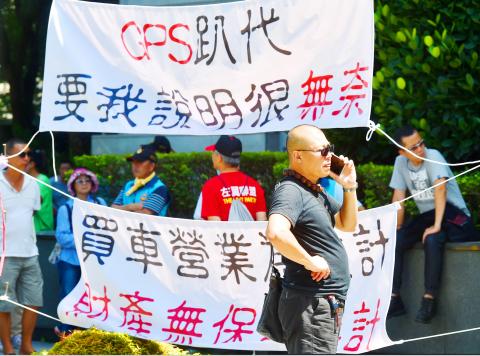
Photo: Tu Chien-jung, Taipei Times
The agency had originally said that the devices would be used to only collect “big data,” but they are now being used to collect all sorts of information, even drivers’ work hours, Lee said.
Unlike public transportation systems, which should be strictly regulated by the government, tour bus drivers only transport people who hire them, Lee added.
The government should help improve the work environment for tour bus operators, rather than using GPS to harass them, he said.
A GPS device transmits signals through satellites and its accuracy can be affected by the signal strength and weather conditions, Lee said.
This would compromise the system’s ability to ascertain if a bus is traveling on an overpass or a road, measure a vehicle’s speed and send signals reliably, he said, adding that all these situations would trigger signal abnormalities.
“However, DGH officials monitoring the tour buses lack the experience to know the cause of these abnormalities. They ask the drivers to offer an explanation whenever there is a signal abnormality, but they forget that tour bus drivers are using the system as well,” he said.
The DGH oversees motor vehicles, drivers and roads, and it should be focusing on the bigger picture rather than minute details, Lee said, adding that it should let tour bus companies handle issues related to GPS.
The government should stipulate regulations to require tour bus owners to use actual times when registering their buses, he added.
The ministry said that the abnormalities reported by GPS devices are handled in three stages:
First, tour bus operators should monitor the changes themselves, which do not happen every day, and second, officials at motor vehicle offices should rule out some of the deviations if they are determined to be false alarms, it added.
Third, the DGH would be the ultimate overseer of the problems, the ministry said.
Chinese Nationalist Party (KMT) Legislator Chen Shueh-sheng (陳雪生) is to hold a public hearing on cooperatives formed by tour bus operators in the next legislative session, it said, adding that the issues about the GPS requirement can be discussed at the hearing.
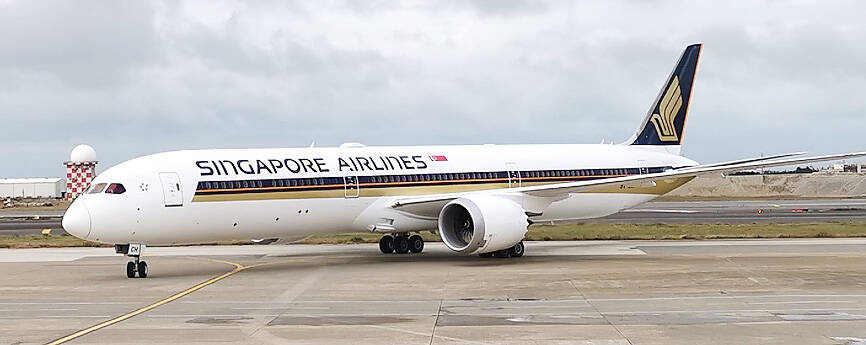
INCREASED CAPACITY: The flights on Mondays, Wednesdays, Fridays and Sundays would leave Singapore in the morning and Taipei in the afternoon Singapore Airlines is adding four supplementary flights to Taipei per week until May to meet increased tourist and business travel demand, the carrier said on Friday. The addition would raise the number of weekly flights it operates to Taipei to 18, Singapore Airlines Taiwan general manager Timothy Ouyang (歐陽漢源) said. The airline has recorded a steady rise in tourist and business travel to and from Taipei, and aims to provide more flexible travel arrangements for passengers, said Ouyang, who assumed the post in July last year. From now until Saturday next week, four additional flights would depart from Singapore on Monday, Wednesday, Friday
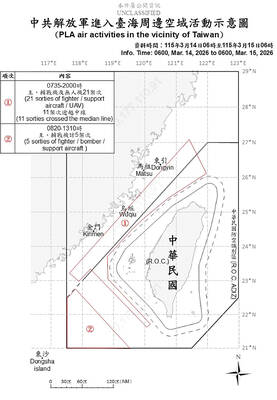
The Ministry of National Defense yesterday reported the return of large-scale Chinese air force activities after their unexplained absence for more than two weeks, which had prompted speculation regarding Beijing’s motives. China usually sends fighter jets, drones and other military aircraft around the nation on a daily basis. Interruptions to such routine are generally caused by bad weather. The Ministry of National Defense said it had detected 26 Chinese military aircraft in the Taiwan Strait over the previous 24 hours. It last reported that many aircraft on Feb. 25, when it spotted 30 aircraft, saying Beijing was carrying out another “joint combat

Taiwan successfully defended its women’s 540 kilogram title and won its first-ever men’s 640 kg title at the 2026 World Indoor Tug of War Championships in Taipei yesterday. In the women’s event, Taiwan’s eight-person squad reached the final following a round-robin preliminary round and semifinals featuring teams from Ukraine, Japan, Thailand, Vietnam, the Basque Country and South Korea. In the finals, they swept the Basque team 2-0, giving the team composed mainly of National Taiwan Normal University students and graduates its second championship in a row, and its fourth in five years. Team captain
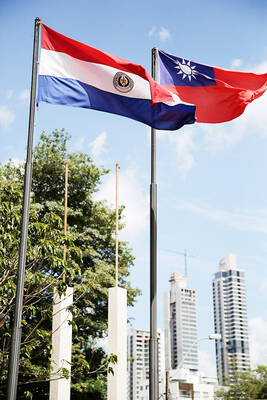
When Paraguayan opposition lawmaker Leidy Galeano returned from an all-expenses-paid tour of six Chinese cities late last year, she was convinced Paraguay risked missing out on major economic gains by sticking with longtime ally Taipei over Beijing — a message that participants on the trip heard repeatedly from Chinese officials. “Everything I saw there, I wanted for my country,” said Galeano, a member of the newly-formed Yo Creo party whose senior figures have spoken favorably about China. This trip and others like it — which people familiar with the visits said were at the invitation of the Chinese consulate in Sao Paulo


 RSS
RSS