


When Paraguayan opposition lawmaker Leidy Galeano returned from an all-expenses-paid tour of six Chinese cities late last year, she was convinced Paraguay risked missing out on major economic gains by sticking with longtime ally Taipei over Beijing — a message that participants on the trip heard repeatedly from Chinese officials.
“Everything I saw there, I wanted for my country,” said Galeano, a member of the newly-formed Yo Creo party whose senior figures have spoken favorably about China.
This trip and others like it — which people familiar with the visits said were at the invitation of the Chinese consulate in Sao Paulo — offered lavish banquets, stays at luxury hotels and tours of the Great Wall.
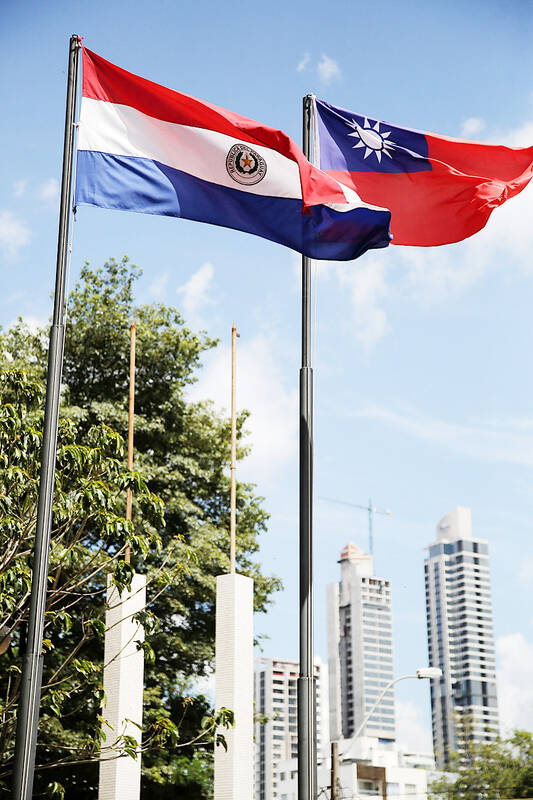
Photo: Reuters
It is part of what Paraguayan lawmakers said they saw as a coordinated effort to draw the country away from democratically governed Taiwan.
With about 6.4 million people, landlocked Paraguay is a tiny player on the world stage, but it is Taiwan’s last diplomatic ally in South America.
A switch by Paraguay, one of 12 countries in the world that still recognize Taiwan, would give Beijing a symbolic win in its campaign to isolate Taipei.
Its efforts are also a sign of China’s intent to cement its influence in Latin America, where US President Donald Trump is determined to be the pre-eminent superpower.
With more than two years left in his term, Paraguayan President Santiago Pena’s government has little incentive to shift a Taiwan policy that has long anchored its foreign relations.
Beyond that, analysts said the outlook is less clear, with succession battles potentially splintering the ruling Colorado Party or pushing them into alliances with opposition groups historically more open to recognizing Beijing.
Pena has publicly reaffirmed support for Taipei.
“All the Latin American countries that switched from Taiwan to China and fell into the arms of the promise of the Chinese dream — every single one of them is worse off than Paraguay,” he said.
The Paraguayan Ministry of Foreign Affairs said the country’s relations with Taiwan “are founded on principles and values of freedom, democracy, human rights and the rule of law.”
China’s growing engagement is colliding with stepped-up efforts by Taipei and Washington to hold the line.
Paraguay signed a defense pact with the US in January, joined Trump’s “Board of Peace” and participated in a White House critical minerals summit earlier this year. Washington also lifted sanctions on former Paraguayan president Horacio Cartes, who was previously targeted over alleged corruption and is a mentor to Pena.
Interviews with half a dozen participants — including three lawmakers and three journalists who joined the trips — and a review of travel itineraries showed the charm offensive by China in Paraguay has picked up in the past year.
At least 19 Paraguayan lawmakers, five journalists and a rising opposition presidential contender have visited China since late 2023, with a sharp acceleration last year and more trips planned for this month, Reuters said.
The Chinese Ministry of Foreign Affairs said “siding with Taiwan authorities holds no future,” and that a growing number of Paraguayans across different sectors believe establishing diplomatic ties with Beijing would serve the “fundamental and long-term interests” of both countries.
It denied any lobbying effort, saying people-to-people exchanges were a “two-way effort” that “do not require anyone to lobby for them.”
Taiwan’s Ministry of Foreign Affairs said Beijing was attempting to “poach” its allies and that it was “actively working to maintain ties with all of Taiwan’s diplomatic partners.”
A spokesperson for the US embassy in Asuncion said Washington hoped Paraguayans on official Chinese-guided tours “understand the degree of information manipulation” inherent in them.
Beijing’s outreach to Paraguay follows a pattern seen across the region. Panama, the Dominican Republic, El Salvador, Nicaragua and Honduras all switched recognition after sustained Chinese lobbying, and promises of trade and infrastructure.
Paraguayan opposition lawmaker Roya Torres said Chinese officials used her trip in October last year to showcase advanced healthcare services and technology, taking her through treatment centers and high-speed rail stations while hinting that trade and investment could flow faster if Asuncion switched recognition to Beijing.
The contrast with home deepened her fear that Paraguay was “running out of time” — a message Chinese officials delivered to her repeatedly — and risked being left behind in cutting-edge medical equipment and access to China’s market if it maintained ties with Taipei, she said.
Liberal Party Deputy Billy Vaesken, who spent 15 days in China in late 2024 alongside two ruling Colorado Party lawmakers, said he is advocating deeper ties with Beijing.
“We must not miss our chance,” he said, pointing to potential Chinese investment in local infrastructure.
Reuters requested interviews with at least half a dozen Colorado Party members, all of whom declined to comment on trips they made to China.
Several other prominent opposition members who participated in visits also declined to discuss them.
In Paraguay, the debate is increasingly economic. Its main exports are soy and beef, but it cannot sell directly to China, because Beijing refuses to trade with countries that recognize Taipei. Instead, shipments move through Argentina and Brazil, cutting into profits. At the same time, Chinese goods are pouring into Paraguay, with imports topping US$6 billion last year — a record, data showed.
Taipei has helped fund projects including the parliament building and a new university campus under construction, but a report by local research center CADEP found that Paraguay’s ties with Taiwan have delivered only modest economic gains.
Public sentiment might also be shifting: A recent poll by consultancy Metro showed rising support for establishing relations with China.
Metro declined to comment on who commissioned the survey.
Officials at Taiwan’s embassy in Asuncion said they, too, are lobbying to counter China through TV appearances and inviting lawmakers from the ruling Colorado Party to Taiwan.
Still, Beijing’s approach appears to be gaining traction with some.
“More people in parliament are already looking toward mainland China,” said Vaesken, who plans to return to China this year. “Before long, Taiwan will end up like Hong Kong — it will become part of China, be annexed and Paraguayans will be left with nothing.”

NATIONAL SECURITY: Authorities are working to confirm the identities of the military personnel involved and investigating possible illegal conduct and regulatory violations Authorities are probing possible national security implications after Kinmen police and immigration officers on Sunday found a Chinese woman allegedly posing as a tourist while engaging in prostitution involving more than 10 military personnel. The woman, surnamed Chen (陳), has since been deported, authorities said, adding that investigators are still working to confirm the identities of those implicated, as the records only listed code names and aliases. The case stemmed from a report received by the Kinmen District Prosecutors’ Office on Friday last week from the Jinhu Precinct of the Kinmen County Police Bureau. On Sunday, police, along with the National Immigration

GLOBALGIVING: ‘ Caving to external pressure is not acceptable for an organization that has cultivated justice reform and human rights for 30 years,’ one NGO said A slew of non-government organizations (NGOs) have withdrawn from the GlobalGiving fundraising platform after it announced it would use “Chinese Taipei” instead of “Taiwan” from next month. The Taiwan Good Rice Association wrote on Facebook on Friday that it was informed on April 28 via a teleconference call of the change, which was made because the platform wanted to operate in China. Taiwan Good Rice is to terminate all cooperative relationships with GlobalGiving in response to the platform’s “unilateral and non-negotiable” decision to remove references to Taiwan, the NGO said. “Taiwan is in the official name of Taiwan Good Rice Association and the

HEAVY WEATHER: Typhoon Jangmi is due to crash straight into the Ryukyus as airlines look to shift flights to larger aircraft or cancel flights to Okinawa entirely Taiwan’s international air carriers announced flight adjustments over the weekend as Typhoon Jangmi is forecast to hit the Ryukyu Islands today and tomorrow. The Central Weather Administration (CWA) upgraded Jangmi from a tropical storm to a typhoon at 8am yesterday, with the eye located 580km south of Naha city. It was moving north at 19kph. Today, China Airlines’ CI-120, CI-121, CI-122 and CI-123 flights between Taoyuan and Naha, Okinawa, have been canceled as well as CI-132 and CI-133 between Kaohsiung and Naha. EVA Air’s BR-112, BR-113, BR-186 and BR-185 flights between Taoyuan and Naha are also canceled. Low-cost carrier Tigerair Taiwan canceled IT-230,

REASONS FOR TRAVEL: An assistant professor said that proposed amendments to penalize drivers if they used drugs overseas would not deter people from traveling People who operate a motor vehicle under the influence of marijuana would have their driver’s license revoked, even if they used the substance while overseas, the Ministry of Transportation and Communications said yesterday, citing proposed amendments to the Road Traffic Management and Penalty Act (道路交通管理處罰條例). The amendments would also authorize the government to revoke the licenses of people determined to have used Category 1 or Category 2 narcotics, even if they were not operating a vehicle while under the influence of drugs, as well as ban them from taking the license test for three years, the ministry said. People aged 18 or


 RSS
RSS