


Taiwanese should construct their own history, instead of relying on China’s historical point of view, Dutch writer Lambert van der Aalsvoort said at a book signing on Friday in Taipei, as he launched a new monograph on history in Taiwan from the 17th to 19th century.
The Chinese-language book is titled Anecdotes About Formosa: Western People’s First Encounter With Taiwan During the 1622-1895 Period (福爾摩沙拾遺:歐美的台灣初體驗1622-1895), published by Rhythms Monthly (經典雜誌).
It includes valuable historical documents and photographs, as well as Van der Aalsvoort’s interviews with descendants of Western figures who had a seminal influence on Taiwan’s development.
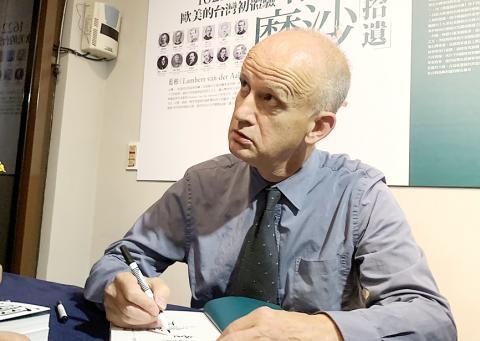
Photo: CNA
It is his second book on Taiwan, after Leaf in the Wind (風中之葉:福爾摩沙見聞錄), which was translated into Chinese and published in 2002 by Rhythms Monthly.
At the book signing, Van der Aalsvoort said that while writing the book, he found it troubling that many historical documents were written from the viewpoint of China.
“If a place’s history is hollowed out at the root, people living in the land will have difficulty forming a national identity,” he said.
As his work refers to many Western studies on Taiwan during the period, he concluded that Taiwan’s history is not shaped by a “single color,” but features colors across the spectrum, Van der Aalsvoort said.
He said that he hoped the book would help Taiwanese affirm their national identity, construct their own history and allow the island’s beauty to shine again — like how it appeared in the eyes of Western visitors centuries ago.
Leaf in the Wind was a surprise hit, with more than 17,000 copies sold, Rhythms Monthly editor-in-chief Wang Chih-hong (王志宏) said.
Most historical documents on Taiwan are in Chinese, but some Western documents, such as documents in Van der Aalsvoort’s book, might have been produced even earlier and include less-discussed accounts about Aborigines in earlier Taiwan, SMC Publishing Inc (南天書局) founder Wei Te-wen (魏德文) said.

Considering that most countries issue more than five denominations of banknotes, the central bank has decided to redesign all five denominations, the bank said as it prepares for the first major overhaul of the banknotes in more than 24 years. Central bank Governor Yang Chin-lung (楊金龍) is expected to report to the Legislative Yuan today on the bank’s operations and the redesign’s progress. The bank in a report sent to the legislature ahead of today’s meeting said it had commissioned a survey on the public’s preferences. Survey results showed that NT$100 and NT$1,000 banknotes are the most commonly used, while NT$200 and NT$2,000

The Centers for Disease Control (CDC) yesterday reported the first case of a new COVID-19 subvariant — BA.3.2 — in a 10-year-old Singaporean girl who had a fever upon arrival in Taiwan and tested positive for the disease. The girl left Taiwan on March 20 and the case did not have a direct impact on the local community, it said. The WHO added the BA.3.2 strain to its list of Variants Under Monitoring in December last year, but this was the first imported case of the COVID-19 variant in Taiwan, CDC Deputy Director-General Lin Ming-cheng (林明誠) said. The girl arrived in Taiwan on

South Korea is planning to revise its controversial electronic arrival card, a step Taiwanese officials said prompted them to hold off on planned retaliatory measures, a South Korean media report said yesterday. A Yonhap News Agency report said that the South Korean Ministry of Foreign Affairs is planning to remove the “previous departure place” and “next destination” fields from its e-arrival card system. The plan, reached after interagency consultations, is under review and aims to simplify entry procedures and align the electronic form with the paper version, a South Korean ministry official said. The fields — which appeared only on the electronic form

The Ministry of Foreign Affairs (MOFA) is suspending retaliation measures against South Korea that were set to take effect tomorrow, after Seoul said it is updating its e-arrival system, MOFA said today. The measures were to be a new round of retaliation after Taiwan on March 1 changed South Korea's designation on government-issued alien resident certificates held by South Korean nationals to "South Korea” from the "Republic of Korea," the country’s official name. The move came after months of protests to Seoul over its listing of Taiwan as "China (Taiwan)" in dropdown menus on its new online immigration entry system. MOFA last week


 RSS
RSS