


Hepatitis B and C are the main risk factors of liver cancer in Taiwan, but about 30 percent of people diagnosed with the diseases do not receive proper treatment, the Health Promotion Administration (HPA) said.
Liver cancer is the second leading cause of cancer deaths in the nation, accounting for about 13,000 deaths each year, it said.
According to the HPA’s 2016 cancer registration data, approximately 11,000 people were diagnosed with liver cancer that year, and about 80 percent among them had hepatitis B or C.
However, as people with liver disease often do not experience symptoms, many cases are not detected until the diseases progress to later stages, the HPA said.
A survey by the HPA showed that about 30 percent of people with hepatitis B or C do not get follow-up treatment, while 56.2 percent said they do not think treatment is necessary because they do not experience symptoms and 15.7 percent said they did not know that seeing a doctor was necessary.
More than 50 percent of people with hepatitis C develop chronic hepatitis C and about 20 percent develop cirrhosis, with 3 to 5 percent of those with cirrhosis diagnosed with liver cancer every year, the HPA said.
HPA Director-General Wang Ying-wei (王英偉) said hepatitis B and C infection risk factors include sharing needles or personal hygiene items, and unsafe sex, while a healthy diet, regular exercise and not drinking alcohol to excess are avoidance factors.
The National Health Insurance Committee on Friday announced that while it has relaxed eligibility for government-funded hepatitis C oral medication, the Ministry of Health and Welfare last month told it that there was not enough funding.
To achieve the goal of eliminating hepatitis C by 2025, the committee said it has agreed that about NT$1.9 billion (US$61.1 million) can be appropriated from a budget surplus allocated for three other items to fund the hepatitis C medication.
Separately, free hepatitis B and C screenings were offered at the Taipei Confucius Temple (台北市孔廟) yesterday. The event was organized by local branches of Rotary International’s 3523 District and the Liver Disease Prevention and Treatment Research Foundation.
Taipei Mayor Ko Wen-je (柯文哲) said at the event that liver disease was once called the “national disease,” as 16 to 18 percent of the population were carriers of hepatitis B before the central government implemented a universal hepatitis B vaccination program in 1984.
The government should establish a liver disease screening registry to make more efficient use of medical resources and prevent repeated or missed screenings, Ko said.
Foundation chairperson Yang Pei-ming (楊培銘) said that there is medication to treat hepatitis B and C, so the goal should be to raise public awareness about liver disease screenings and proper treatment in the early stages.
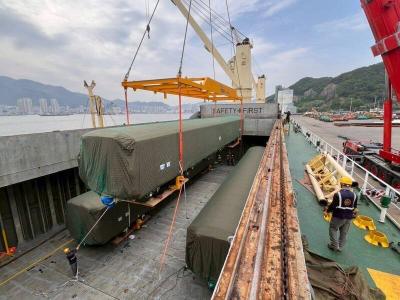
The first of 10 new high-capacity trains purchased from South Korea’s Hyundai Rotem arrived at the Port of Taipei yesterday to meet the demands of an expanding metro network, Taipei Rapid Transit Corp (TRTC) said yesterday. The train completed a three-day, 1,200km voyage from the Port of Masan in South Korea, the company said. Costing NT$590 million (US$18.79 million) each, the new six-carriage trains feature a redesigned interior based on "human-centric" transportation concepts, TRTC said. The design utilizes continuous longitudinal seating to widen the aisles and optimize passenger flow, while also upgrading passenger information displays and driving control systems for a more comfortable
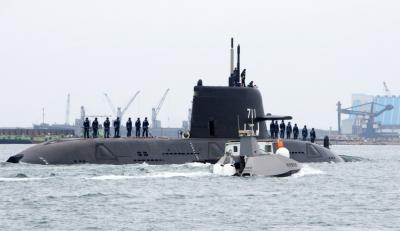
Taiwan's first indigenous defense submarine, the SS-711 Hai Kun (海鯤, or Narwhal), departed for its 13th sea trial at 7am today, marking its seventh submerged test, with delivery to the navy scheduled for July. The outing also marked its first sea deployment since President William Lai (賴清德) boarded the submarine for an inspection on March 19, drawing a crowd of military enthusiasts who gathered to show support. The submarine this morning departed port accompanied by CSBC Corp’s Endeavor Manta (奮進魔鬼魚號) uncrewed surface vessel and a navy M109 assault boat. Amid public interest in key milestones such as torpedo-launching operations and overnight submerged trials,
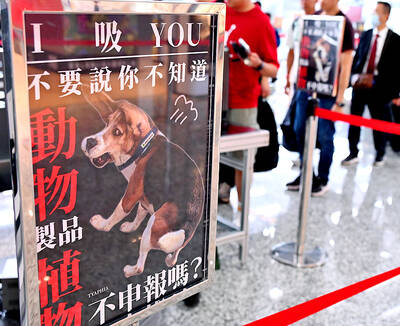
Quarantine awareness posters at Taiwan Taoyuan International Airport have gone viral for their use of wordplay. Issued by the airport branch of the Animal and Plant Health Inspection Agency, the posters feature sniffer dogs making a range of facial expressions, paired with advisory messages built around homophones. “We update the messages for holidays and campaign needs, periodically refreshing materials to attract people’s attention,” quarantine officials said. “The aim is to use the dogs’ appeal to draw focus to quarantine regulations.” A Japanese traveler visiting Taiwan has posted a photo on X of a poster showing a quarantine dog with a

Taiwan’s coffee community has launched a “one-person-one-e-mail” campaign, calling for people to send a protest-e-mail to the World Coffee Championships (WCC) urging it to redesignate Taiwanese competitors as from “Taiwan,” rather than “Chinese Taipei.” The call followed sudden action last week after the WCC changed all references to Taiwanese competitors from “Taiwan” to “Chinese Taipei,” including recent World Latte Art champion Bala (林紹興), who won the World Latte Art Championship in San Diego earlier this month. When Bala received the trophy, he was referred to as representing Taiwan, as well as in the announcement on the WCC’s Web site, until it


 RSS
RSS