


Former Taipei City police department commissioner Huang Sheng-yung (黃昇勇) was acquitted yesterday over his role in a bloody crackdown to disperse protesters during the 2014 Sunflower movement, but lawmakers and victims vowed they would appeal, and said the decision condoned “state violence.”
The Taipei District Court, cleared Huang of attempted homicide and actions causing bodily harm, among other offenses, on the grounds that he was performing his professional duty and upholding the law.
The judges based their decision on Article 21, Item 1 of the Criminal Code, which states that “conduct performed in accordance with the law or order is not punishable.”
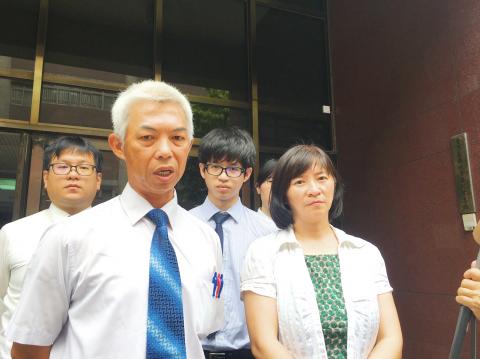
Photo: Chang We-chuan, Taipei Times
Huang instructed the riot police to remove the demonstrators who took part in the occupation of the Executive Yuan compound from the evening of March 23, 2014, to the early hours of the next morning, which he was reportedly ordered to do by then-premier Jiang Yi-huah (江宜樺) and then-National Police Agency (NPA) director-general Wang Cho-chiun (王卓鈞).
Many protesters were injured, some seriously, as NPA officers in riot gear, wielding batons and shields, removed the crowd.
Forty-two people injured by police, including then-Taiwan Solidarity Union legislator Chou Ni-an (周倪安), filed a class-action lawsuit against top officials for their roles in the incident.
After learning of the ruling, Chou said she was disappointed in the justice system, and vowed to launch an appeal.
“Violent means and excessive force were used against the sit-in protesters at the Executive Yuan … the officers did not adhere to the regulations in the Police Power Exercise Act (警察職權行使法). That was why so many people were injured that night,” Chou said.
“I saw some people who were already injured and down on the ground, crying out loud and urging the police to stop, but the police kept on bludgeoning them,” Chou said. “The police’s actions were unlawful and immoral. I cannot accept the ruling and will appeal.”
Chou was hit on the head and was hospitalized for several weeks, she said, adding that the NPA and Executive Yuan repeatedly turned down her requests to review the footage of the incident and information gathered by the police.
“The government’s administrative bureaucrats are also responsible ... as they denied us access to videotapes and important evidence, which made our lawsuit very difficult to pursue,” Chou said. “The Democratic Progressive Party government helped to cover up the case, as it did not initiate a judicial probe into the incident, while most of the police officials involved have received promotions... So where is the transitional justice in this case?”
“It has been a long and difficult road for people to pursue justice against state violence ... the court used judicial procedure and legal maneuvering to delay the process and shut out some of the plaintiffs,” the Judicial Reform Foundation said in a statement.
“We regret Huang’s acquittal, as it means he has not been held responsible for the violence on that night. We believe that the court let down the victims in this case, and has let down Taiwanese society and those who fought for freedom and democracy,” it said.

Taiwanese can file complaints with the Tourism Administration to report travel agencies if their activities caused termination of a person’s citizenship, Mainland Affairs Council Minister Chiu Chui-cheng (邱垂正) said yesterday, after a podcaster highlighted a case in which a person’s citizenship was canceled for receiving a single-use Chinese passport to enter Russia. The council is aware of incidents in which people who signed up through Chinese travel agencies for tours of Russia were told they could obtain Russian visas and fast-track border clearance, Chiu told reporters on the sidelines of an event in Taipei. However, the travel agencies actually applied

New measures aimed at making Taiwan more attractive to foreign professionals came into effect this month, the National Development Council said yesterday. Among the changes, international students at Taiwanese universities would be able to work in Taiwan without a work permit in the two years after they graduate, explainer materials provided by the council said. In addition, foreign nationals who graduated from one of the world’s top 200 universities within the past five years can also apply for a two-year open work permit. Previously, those graduates would have needed to apply for a work permit using point-based criteria or have a Taiwanese company
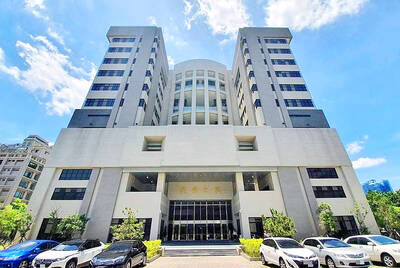
The Shilin District Prosecutors’ Office yesterday indicted two Taiwanese and issued a wanted notice for Pete Liu (劉作虎), founder of Shenzhen-based smartphone manufacturer OnePlus Technology Co (萬普拉斯科技), for allegedly contravening the Act Governing Relations Between the People of the Taiwan Area and the Mainland Area (臺灣地區與大陸地區人民關係條例) by poaching 70 engineers in Taiwan. Liu allegedly traveled to Taiwan at the end of 2014 and met with a Taiwanese man surnamed Lin (林) to discuss establishing a mobile software research and development (R&D) team in Taiwan, prosecutors said. Without approval from the government, Lin, following Liu’s instructions, recruited more than 70 software

Taiwanese singer Jay Chou (周杰倫) plans to take to the courts of the Australian Open for the first time as a competitor in the high-stakes 1 Point Slam. The Australian Open yesterday afternoon announced the news on its official Instagram account, welcoming Chou — who celebrates his 47th birthday on Sunday — to the star-studded lineup of the tournament’s signature warm-up event. “From being the King of Mandarin Pop filling stadiums with his music to being Kato from The Green Hornet and now shifting focus to being a dedicated tennis player — welcome @jaychou to the 1 Point Slam and #AusOpen,” the


 RSS
RSS