


Officials seized 20 illegal animal snares and three ivory products in Taipei and Kaohsiung in a two-week nationwide sweep, the Forestry Bureau said yesterday, adding that the sale of all ivory products would be banned from January next year.
A task force comprised of officials from the bureau, local governments and the National Police Agency from July 1 to Sunday inspected 447 stores selling animals, wild foods, hardware and agricultural equipment.
Officials looked for illegally hunted or traded animals after the bureau on Jan. 9 revised its list of protected land species, bureau Conservation Division Director Hsia Jung-sheng (夏榮生) said.
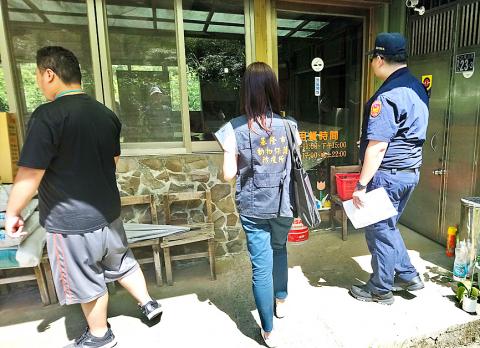
Photo: Chien Hui-ju, Taipei Times, courtesy of the Forestry Bureau
Officials also cracked down on the unlawful use of snares, she said.
Several stores in Taipei and Kaohsiung were found to be illegally selling snares, the bureau said.
The Animal Protection Act (動物保護法) bans the production, sales, exhibition, and import and export of animal snares without government approval. Those who contravene the law could face a fine of NT$15,000 to NT$75,000 (US$483 and US$2,414).
Using snares to catch wild animals is also prohibited, unless they are used by farmers to catch animals that are damaging crops or by Aborigines hunting animals for traditional rituals, Hsia said, adding that both groups have to obtain prior government approval.
Those convicted of illegally using snares could face a prison term of six months to five years or a fine of NT$200,000 to NT$1 million under the Wildlife Conservation Act (野生動物保育法), the bureau said.
The number of snares removed by forest rangers dropped from 3,099 in 2011 to 299 last year, bureau data showed.
A store in Taipei was found to be illegally selling three ivory products not listed by the bureau, which in 1995 compiled an inventory of 220,000 ivory products in stock that can be sold until the end of this year, Hsia said.
As of January, the sale of all ivory products — regardless of whether they are included in the list or not — would be banned, she said.
Those who illegally sell ivory products would face a jail term of six months to five years and a fine of NT$300,000 and NT$1.5 million, she added.
Officials also discovered a bird shop in Keelung that sold a Japanese white-eye, and an aquarium in Taipei that kept a protected pitted-shelled turtle, Hsia said.
Three Taipei residents were found to be keeping protected yellow-margined box turtles and a yellow pond turtle without registration, she said.
Many cases of illegal treatment of wildlife were reported by members of the public, showing that general awareness about animal conservation has improved, Hsia added.

The Centers for Disease Control (CDC) yesterday reported the first case of a new COVID-19 subvariant — BA.3.2 — in a 10-year-old Singaporean girl who had a fever upon arrival in Taiwan and tested positive for the disease. The girl left Taiwan on March 20 and the case did not have a direct impact on the local community, it said. The WHO added the BA.3.2 strain to its list of Variants Under Monitoring in December last year, but this was the first imported case of the COVID-19 variant in Taiwan, CDC Deputy Director-General Lin Ming-cheng (林明誠) said. The girl arrived in Taiwan on

South Korea is planning to revise its controversial electronic arrival card, a step Taiwanese officials said prompted them to hold off on planned retaliatory measures, a South Korean media report said yesterday. A Yonhap News Agency report said that the South Korean Ministry of Foreign Affairs is planning to remove the “previous departure place” and “next destination” fields from its e-arrival card system. The plan, reached after interagency consultations, is under review and aims to simplify entry procedures and align the electronic form with the paper version, a South Korean ministry official said. The fields — which appeared only on the electronic form

The Ministry of Foreign Affairs (MOFA) is suspending retaliation measures against South Korea that were set to take effect tomorrow, after Seoul said it is updating its e-arrival system, MOFA said today. The measures were to be a new round of retaliation after Taiwan on March 1 changed South Korea's designation on government-issued alien resident certificates held by South Korean nationals to "South Korea” from the "Republic of Korea," the country’s official name. The move came after months of protests to Seoul over its listing of Taiwan as "China (Taiwan)" in dropdown menus on its new online immigration entry system. MOFA last week

A bipartisan group of US senators has introduced a bill to enhance cooperation with Taiwan on drone development and to reduce reliance on supply chains linked to China. The proposed Blue Skies for Taiwan Act of 2026 was introduced by Republican US senators Ted Cruz and John Curtis, and Democratic US senators Jeff Merkley and Andy Kim. The legislation seeks to ease constraints on Taiwan-US cooperation in uncrewed aerial systems (UAS), including dependence on China-sourced components, limited access to capital and regulatory barriers under US export controls, a news release issued by Cruz on Wednesday said. The bill would establish a "Blue UAS


 RSS
RSS