


The government is still evaluating all possible routes for the high-speed rail’s extension from Kaohsiung to Pingtung, Minister of Transportation and Communications Lin Chia-lung (林佳龍) said yesterday, adding that people should not focus on supply and demand and overlook other possible benefits.
The ministry previously conducted feasibility research for two possible high-speed rail extension routes to Pingtung, with one beginning at the high-speed rail system’s train depot in Kaohsiung’s Yanchao District (燕巢) and the other at Kaohsiung’s Zuoying District (左營).
Both routes would have ended in Pingtung’s Liukuaicuo (六塊厝), and would have cost NT$75.6 billion and NT$61.9 billion (US$2.44 billion and US$2 billion), respectively.
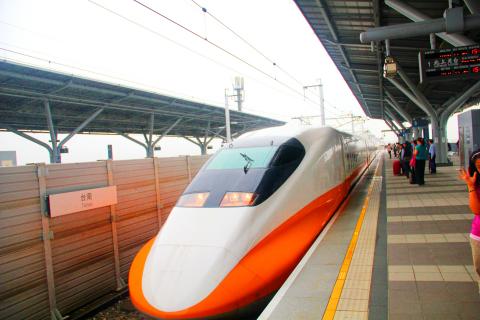
Photo: Cheng Wei-chi, Taipei Times
However, the two proposed routes were in April rejected by experts on a review committee as it would take more than 30 years to recover the costs after either one of the extension routes were completed.
The committee also said that the ministry should take national spatial planning into consideration when proposing routes.
The ministry then proposed two new routes, with one going to from Zuoying to Taiwan Railway Administration’s (TRA) Pingtung Station via the TRA’s Kaohsiung Station and the other going from Zuoying to Pingtung’s Chaozhou Station via Kaohsiung International Airport.
The Railway Bureau estimated that the construction for either one of the two new routes would cost more than NT$100 billion, which was much higher than the two previously proposed routes.
“The nation has a high-speed rail system along the west coast, and we hope to develop an express railway service along the east coast. We are studying whether we should use the high-speed rail or the TRA’s train system to connect the two systems in the north or in the south,” Lin said.
The ministry’s evaluation would not only look at the cost of construction, but would also look at how the railway systems facilitate land development and other economic activities, he said, adding that it is working to integrate the TRA railway system, high-speed rail, mass rapid transit system and light rail systems.
In addition to the high-speed rail extension from Kaohsiung to Pingtung, the bureau said that it is also studying the possibility of extending the high-speed rail from Nangang to Yilan.
The bureau does not have a preference for any one of the four possible Kaohsiung-Pingtung extension lines, bureau Deputy Director-General Yang Cheng-chun (楊正君) said, adding that it still lacks a lot of information about the two new proposed routes.
If it is ascertained that the bureau should start assessing the possibility of building any of the new routes, it would need to spend another six to 12 months collecting data and conducting feasibility research, Yang said.
However, it is likely that the bureau would begin evaluating the possibility of having the extension line built from Zuoying to the TRA’s Pingtung Station via the TRA’s Kaohsiung Station, Yang said, adding that it would be similar to the route from Banciao to Nangang via Taipei Railway Station.
The route from Zuoying to Pingtung’s Chaozhou Station via Kaohsiung International Airport would be the most challenging one to build, as it would require extensive expropriation of properties belonging to private citizens, Yang said, adding that the estimated cost of building this route would top NT$150 billion.

Considering that most countries issue more than five denominations of banknotes, the central bank has decided to redesign all five denominations, the bank said as it prepares for the first major overhaul of the banknotes in more than 24 years. Central bank Governor Yang Chin-lung (楊金龍) is expected to report to the Legislative Yuan today on the bank’s operations and the redesign’s progress. The bank in a report sent to the legislature ahead of today’s meeting said it had commissioned a survey on the public’s preferences. Survey results showed that NT$100 and NT$1,000 banknotes are the most commonly used, while NT$200 and NT$2,000

The Centers for Disease Control (CDC) yesterday reported the first case of a new COVID-19 subvariant — BA.3.2 — in a 10-year-old Singaporean girl who had a fever upon arrival in Taiwan and tested positive for the disease. The girl left Taiwan on March 20 and the case did not have a direct impact on the local community, it said. The WHO added the BA.3.2 strain to its list of Variants Under Monitoring in December last year, but this was the first imported case of the COVID-19 variant in Taiwan, CDC Deputy Director-General Lin Ming-cheng (林明誠) said. The girl arrived in Taiwan on

South Korea is planning to revise its controversial electronic arrival card, a step Taiwanese officials said prompted them to hold off on planned retaliatory measures, a South Korean media report said yesterday. A Yonhap News Agency report said that the South Korean Ministry of Foreign Affairs is planning to remove the “previous departure place” and “next destination” fields from its e-arrival card system. The plan, reached after interagency consultations, is under review and aims to simplify entry procedures and align the electronic form with the paper version, a South Korean ministry official said. The fields — which appeared only on the electronic form

The Ministry of Foreign Affairs (MOFA) is suspending retaliation measures against South Korea that were set to take effect tomorrow, after Seoul said it is updating its e-arrival system, MOFA said today. The measures were to be a new round of retaliation after Taiwan on March 1 changed South Korea's designation on government-issued alien resident certificates held by South Korean nationals to "South Korea” from the "Republic of Korea," the country’s official name. The move came after months of protests to Seoul over its listing of Taiwan as "China (Taiwan)" in dropdown menus on its new online immigration entry system. MOFA last week


 RSS
RSS