


The Food and Drug Administration (FDA) on Tuesday ordered five cosmetic products off the shelves nationwide as a precaution after US and Canadian authorities warned that they could potentially contain asbestos.
The agency said in a statement that it received an international warning from the US Food and Drug Administration and Health Canada saying that specific batches of Claire’s Eyeshadows (Lot No. 08/17), Claire’s Compact Powder (Lot No. 07/15), Claire’s Contour Palette (Lot No. 04/17), JoJo Siwa Makeup Set (Batch/Lot No. S180109) and City Color Cosmetics Contour Effects Palette 2 Contour, Bronze, Highlight (Batch No. S1603002/PD-C1179) were suspected of containing asbestos.
It has ordered stores to stop selling the products and remove them from shelves, the agency said, adding that local health departments have also been instructed to step up inspections in their jurisdictions.
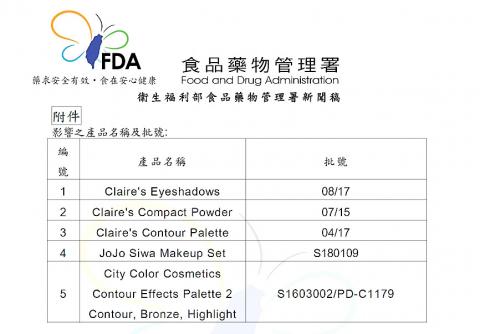
Photo: Wu Liang-yi, Taipei Times
People in possession of these products should stop using them immediately and should not purchase them from overseas via online or other retailers, it said.
The agency said that all five products were manufactured in Taiwan, but the reported manufacturer in Tainan denied producing them.
The manufacturer said it did not produce the JoJo Siwa Makeup Set.
It said it received orders for the other four products, but it commissioned a Chinese cosmetics company to produce them, officials from Tainan’s Public Health Bureau said after visiting the company’s plant yesterday, adding that the products were sold to distributors in Europe and North America.
The products’ ingredients meet inspection standards in Asia, but standards in China are different from those in Europe and North America, the officials said.
The suspected products’ production ended in 2017, but they are yet to expire and are circulating on the market, they said.
They could not find any samples of the suspected products available for inspection at the plant, the officials added.
Under the Cosmetic Hygiene and Safety Act (化妝品衛生安全管理法), cosmetics companies whose products are found to contain banned ingredients could be fined NT$20,000 to NT$5 million (US$642 to US$160,462), with the possibility of consecutive fines, the agency said.
Severe breaches may be punished by a suspension of business operations for up to 12 months; the revocation the offending firm’s registration, or that of its business or factories; or the revocation of the registration or license of the products involved, it said.
Inhaling asbestos fibers could lead to serious conditions, such as asbestosis, lung cancer or mesothelioma, the Environmental Protection Administration has said.
The WHO’s International Agency for Research on Cancer has classified all forms of asbestos as Group 1 carcinogens, meaning that they are carcinogenic to humans.
In related news, in a weekly report published in April, the FDA said that sharing cosmetic products could expose users to risk of infections.
Dermatology clinics frequently receive patients who have developed infections as a result of sharing cosmetic products, it said.
Some patients used other people’s products for convenience or out of curiosity, while others became exposed to bacteria or viruses after trying on samples at beauty stores, the FDA said.
When people share cosmetic products, they are also sharing the pathogenic microbes that are hiding inside them, it said, adding that in-store product testers are especially likely to breed pathogens.
Infections caused by sharing makeup products can be bacterial, fungal, parasitic or viral in nature, the FDA said.
People who share lip products are at risk of developing inflammation, herpes simplex virus 1, fungal infections, skin diseases and respiratory or gastrointestinal tract infections, it said.
Sharing eye makeup products could lead to pink eye, inflammation of the eyelids or trachoma, it added.
Using facial products on sensitive skin or on open wounds or when the immune system is weak could result in allergic contact dermatitis, various forms of folliculitis or flat warts caused by the human papillomavirus, it said.
The FDA urged people not to borrow or lend cosmetic products, or to test reusable items at stores.
Before trying samples packaged for individual use, people should check the product’s expiration date, it said, adding that they should not test the product if its colors are uneven or if they see a layer of oil separated from the rest of the product.
Additional reporting by CNA

The first of 10 new high-capacity trains purchased from South Korea’s Hyundai Rotem arrived at the Port of Taipei yesterday to meet the demands of an expanding metro network, Taipei Rapid Transit Corp (TRTC) said yesterday. The train completed a three-day, 1,200km voyage from the Port of Masan in South Korea, the company said. Costing NT$590 million (US$18.79 million) each, the new six-carriage trains feature a redesigned interior based on "human-centric" transportation concepts, TRTC said. The design utilizes continuous longitudinal seating to widen the aisles and optimize passenger flow, while also upgrading passenger information displays and driving control systems for a more comfortable
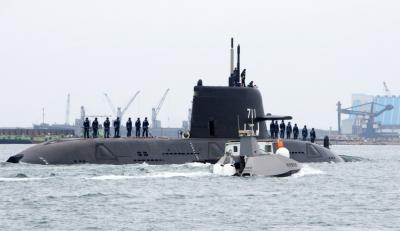
Taiwan's first indigenous defense submarine, the SS-711 Hai Kun (海鯤, or Narwhal), departed for its 13th sea trial at 7am today, marking its seventh submerged test, with delivery to the navy scheduled for July. The outing also marked its first sea deployment since President William Lai (賴清德) boarded the submarine for an inspection on March 19, drawing a crowd of military enthusiasts who gathered to show support. The submarine this morning departed port accompanied by CSBC Corp’s Endeavor Manta (奮進魔鬼魚號) uncrewed surface vessel and a navy M109 assault boat. Amid public interest in key milestones such as torpedo-launching operations and overnight submerged trials,
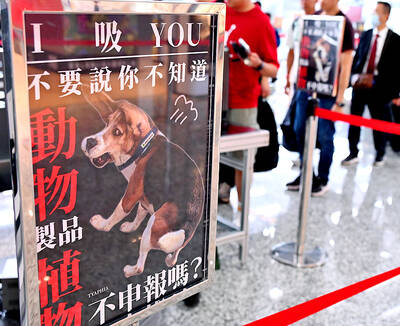
Quarantine awareness posters at Taiwan Taoyuan International Airport have gone viral for their use of wordplay. Issued by the airport branch of the Animal and Plant Health Inspection Agency, the posters feature sniffer dogs making a range of facial expressions, paired with advisory messages built around homophones. “We update the messages for holidays and campaign needs, periodically refreshing materials to attract people’s attention,” quarantine officials said. “The aim is to use the dogs’ appeal to draw focus to quarantine regulations.” A Japanese traveler visiting Taiwan has posted a photo on X of a poster showing a quarantine dog with a
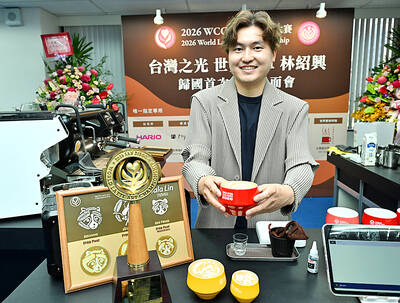
Taiwan’s coffee community has launched a “one-person-one-e-mail” campaign, calling for people to send a protest-e-mail to the World Coffee Championships (WCC) urging it to redesignate Taiwanese competitors as from “Taiwan,” rather than “Chinese Taipei.” The call followed sudden action last week after the WCC changed all references to Taiwanese competitors from “Taiwan” to “Chinese Taipei,” including recent World Latte Art champion Bala (林紹興), who won the World Latte Art Championship in San Diego earlier this month. When Bala received the trophy, he was referred to as representing Taiwan, as well as in the announcement on the WCC’s Web site, until it


 RSS
RSS