


Academics working as full-time teachers at Chinese universities from next month will not be recruited by Academia Sinica in line with the law, the academy said yesterday.
In an official document announcing the policy on June 6, the academy said that starting from next month, Taiwanese working as full-time teachers at Chinese universities cannot serve as part-time researchers, former Academia Sinica researcher Liu Kung-chung (劉孔中) wrote in an op-ed published by the Chinese-language China Times yesterday.
While the academy says its policy is in line with the Act Governing Relations Between the People of the Taiwan Area and the Mainland Area (臺灣地區與大陸地區人民關係條例), it is misinterpreting the law by saying that all Chinese universities are overseen by the Chinese Ministry of Education, Liu wrote.
Liu questioned why the academy is “attempting to sever ties with Taiwanese academics working in China” and asked whether its new policy is to “serve President Tsai Ing-wen (蔡英文) administration’s scheme to further restrict cross-strait interaction.”
Liu demanded that Academia Sinica President James Liao (廖俊智) “clarify his position.”
The academy later yesterday confirmed that it issued such a document, saying that it has checked with the Mainland Affairs Council, which confirmed that Taiwanese cannot take up posts under the Chinese Ministry of Education or government agencies at any level.
The academy encourages academic exchanges with reciprocal terms, but such exchanges are not tantamount to holding two or more posts concurrently, it said, denying Liu’s accusation that its policy is political.
Given that employment of researchers is mainly handled by the management of individual institutes, the academy has informed all of its institutes of the policy that is to take effect next month, it added.
Previously a part-time research fellow at Academia Sinica’s Institutum Iurisprudentiae, Liu teaches at Renmin University’s Law School and tendered his resignation from Academia Sinica last month before his tenure was due to end this month, the institute said.
The academy approved his resignation on Wednesday last week, it added.
Asked for comments on the matter, several academy members refrained from revealing their positions.
The US has also tightened controls over Chinese academics, especially those involved in the Recruitment Program of Global Experts, an academy member said on condition of anonymity, advising researchers to pay more attention to cross-strait exchanges.

LOUD AND PROUD Taiwan might have taken a drubbing against Australia and Japan, but you might not know it from the enthusiasm and numbers of the fans Taiwan might not be expected to win the World Baseball Classic (WBC) but their fans are making their presence felt in Tokyo, with tens of thousands decked out in the team’s blue, blowing horns and singing songs. Taiwanese fans have packed out the Tokyo Dome for all three of their games so far and even threatened to drown out home team supporters when their team played Japan on Friday. They blew trumpets, chanted for their favorite players and had their own cheerleading squad who dance on a stage during the game. The team struggled to match that exuberance on the field, with
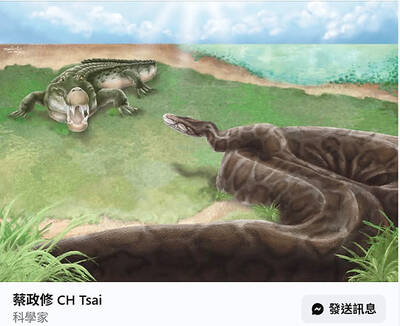
Taiwanese paleontologists have discovered fossil evidence that pythons up to 4m long inhabited Taiwan during the Pleistocene epoch, reporting their findings in the international scientific journal Historical Biology. National Taiwan University (NTU) Institute of Ecology and Evolutionary Biology associate professor Tsai Cheng-hsiu (蔡政修) led the team that discovered the largest snake fossil ever found in Taiwan. The single trunk vertebra was discovered in Tainan at the Chiting Formation, dated to between 400,000 and 800,000 years ago in the Middle Pleistocene, the paper said. The area also produced Taiwan’s first avian fossil, as well as crocodile, mammoth, saber-toothed cat and rhinoceros fossils, it said. Discoveries

Taiwanese paleontologists have discovered fossil evidence that pythons up to 4m long inhabited Taiwan during the Pleistocene epoch, reporting their findings in the international scientific journal Historical Biology. National Taiwan University (NTU) Institute of Ecology and Evolutionary Biology associate professor Tsai Cheng-hsiu (蔡政修) led the team that discovered the largest snake fossil ever found in Taiwan. A single trunk vertebra was discovered in Tainan at the Chiting Formation, dated to between 800,000 to 400,000 years ago in the Middle Pleistocene, the paper said. The area also produced Taiwan’s first avian fossil, as well as crocodile, mammoth, sabre-toothed cat and rhinoceros fossils, it said. Discoveries
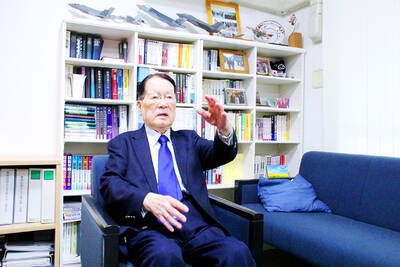
Whether Japan would help defend Taiwan in case of a cross-strait conflict would depend on the US and the extent to which Japan would be allowed to act under the US-Japan Security Treaty, former Japanese minister of defense Satoshi Morimoto said. As China has not given up on the idea of invading Taiwan by force, to what extent Japan could support US military action would hinge on Washington’s intention and its negotiation with Tokyo, Morimoto said in an interview with the Liberty Times (sister paper of the Taipei Times) yesterday. There has to be sufficient mutual recognition of how Japan could provide


 RSS
RSS