


The top two contenders in the Chinese Nationalist Party’s (KMT) presidential primary on Tuesday pledged to improve strained cross-strait relations and boost the economy if elected.
Speaking during a televised forum of KMT candidates, Kaohsiung Mayor Han Kuo-yu (韓國瑜) said that cordial relations across the Taiwan Strait are crucial to the Republic of China’s survival.
Most Taiwanese support maintaining the “status quo” rather than proclaiming independence or unifying with China, Han added.
If elected president, he would promote cross-strait peace and push for the two sides to sign a cross-strait trade-in-goods agreement to boost Taiwan’s economy, which has been sluggish under the Democratic Progressive Party (DPP) government, Han said.
Former Hon Hai Precision Industry Co chairman Terry Gou (郭台銘) said at the forum that he is known for his success in managing a business and his skill as an executive.
Accusing President Tsai Ing-wen’s (蔡英文) administration of doing little to boost the economy, Gou said he is confident that, with his 40 years of experience in international trade and business management, he could revive the economy.
To achieve his goal, Gou — one of Taiwan’s richest people — said that cross-strait peace is the foundation needed for stability and prosperity between Taiwan and China, adding that he would uphold the “1992 consensus” to reduce cross-strait tensions.
The so-called “1992 consensus,” a term that former Mainland Affairs Council chairman Su Chi (蘇起) in 2006 admitted making up in 2000, refers to a tacit understanding between the KMT and the Chinese government that both sides of the Strait acknowledge that there is “one China,” with each side having its own interpretation of what “China” means.
Beijing has been taking a hardline stance toward Tsai’s administration, which has refused to accept China’s condition for continuing good relations: acknowledging the “1992 consensus” and that “China” is the People’s Republic of China, with Taiwan as a part of it.
Tuesday’s TV forum also featured former New Taipei mayor Eric Chu (朱立倫), former Taipei County Commissioner Chou Hsi-wei (周錫瑋) and National Taiwan University political science professor Chang Ya-chung (張亞中).
Chu emphasized the importance of upholding democracy, saying that Taiwan should voice support for Hong Kongers protesting an extradition law that would allow the territory to extradite suspected criminals to China.
Regarding national defense, Chu said that purchasing weapons is not enough, adding that the morale of the military and a balance between cross-strait relations and Taiwan-US ties are also critical.
Party unity is what matters most if the KMT is to win back the government next year, Chu said.
Signing a cross-strait treaty would ensure peace between China and Taiwan, Chang said, adding that any agreement should state that Taiwan and China would never threaten each other with force and would permit both sides to participate in international organizations.
Chou said the first thing that he would do as president would be to reverse “anti-constitutional laws” passed by DPP legislators, such as pension reform bills and amendments to the National Security Act (國家安全法).
The second thing would be to negotiate with China, the US and Japan, Chou said, adding that he would urge the US not to intervene in Taiwan’s national affairs, including not selling the nation “useless F-16 fighter jets.”
Tuesday’s forum in Kaohsiung was the first of three planned by the KMT. The candidates outlined their plans for constitutional politics, diplomacy, cross-strait affairs and national security.
At the second forum — scheduled for Saturday in Taichung — the contenders are to address youth issues, society, culture and education.
At the final forum — scheduled for Wednesday next week in Taipei — they are to address economic affairs, finance, the environment and energy issues.
The KMT is to conduct public opinion polls from July 8 to 14, with the results to be announced on July 15. The party’s Central Standing Committee plans to reveal the KMT presidential candidate on July 17.
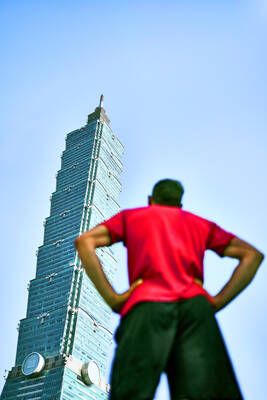
US climber Alex Honnold is to attempt to scale Taipei 101 without a rope and harness in a live Netflix special on Jan. 24, the streaming platform announced on Wednesday. Accounting for the time difference, the two-hour broadcast of Honnold’s climb, called Skyscraper Live, is to air on Jan. 23 in the US, Netflix said in a statement. Honnold, 40, was the first person ever to free solo climb the 900m El Capitan rock formation in Yosemite National Park — a feat that was recorded and later made into the 2018 documentary film Free Solo. Netflix previewed Skyscraper Live in October, after videos
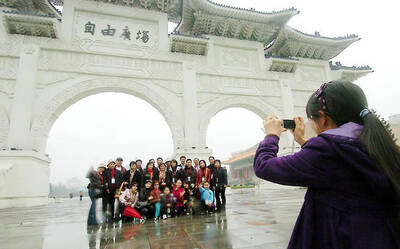
NUMBERS IMBALANCE: More than 4 million Taiwanese have visited China this year, while only about half a million Chinese have visited here Beijing has yet to respond to Taiwan’s requests for negotiation over matters related to the recovery of cross-strait tourism, the Tourism Administration said yesterday. Taiwan’s tourism authority issued the statement after Chinese-language daily the China Times reported yesterday that the government’s policy of banning group tours to China does not stop Taiwanese from visiting the country. As of October, more than 4.2 million had traveled to China this year, exceeding last year. Beijing estimated the number of Taiwanese tourists in China could reach 4.5 million this year. By contrast, only 500,000 Chinese tourists are expected in Taiwan, the report said. The report
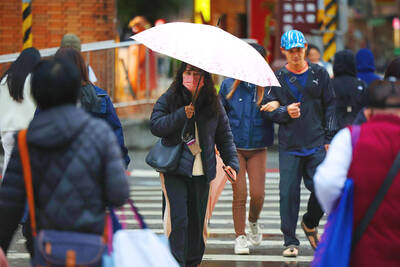
Temperatures are forecast to drop steadily as a continental cold air mass moves across Taiwan, with some areas also likely to see heavy rainfall, the Central Weather Administration (CWA) said. From today through early tomorrow, a cold air mass would keep temperatures low across central and northern Taiwan, and the eastern half of Taiwan proper, with isolated brief showers forecast along Keelung’s north coast, Taipei and New Taipei City’s mountainous areas and eastern Taiwan, it said. Lows of 11°C to 15°C are forecast in central and northern Taiwan, Yilan County, and the outlying Kinmen and Lienchiang (Matsu) counties, and 14°C to 17°C
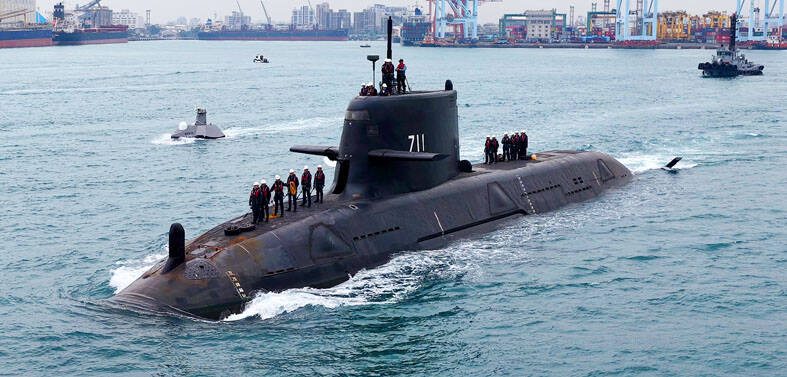
STEERING FAILURE: The first boat of its class is experiencing teething issues as it readies for acceptance by the navy, according to a recent story about rudder failure The Hai Kun (海鯤), the nation’s first locally built submarine, allegedly suffered a total failure of stern hydraulic systems during the second round of sea acceptance trials on June 26, and sailors were forced to manually operate the X-rudder to turn the submarine and return to port, news Web site Mirror Daily reported yesterday. The report said that tugboats following the Hai Kun assisted the submarine in avoiding collisions with other ships due to the X-rudder malfunctioning. At the time of the report, the submarine had completed its trials and was scheduled to begin diving and surfacing tests in shallow areas. The X-rudder,


 RSS
RSS