


An X-ray analysis of an imperial inscription at the Tainan Confucius Temple revealed an older inscription beneath the surface of the 200-year-old artifact, Tainan Cultural Affairs Bureau officials and academics said yesterday.
I-Kuan Tao College professor of conservation science Lin Ren-chen (林仁政) told a news conference that he was scanning the temple’s inscribed boards as part of routine repairs when a second inscription was identified on the one with an emperor’s dedication that hangs over the main hall.
The surface inscription “shengxie shizong” (聖協時中) is what emperor Daoguang (道光) used to mark his ascension to the throne in 1820, but the older inscription beneath it, which reads “tianheng baozhao” (天衡保軸), belonged to his predecessor, Jiaqing (嘉慶), Lin said.
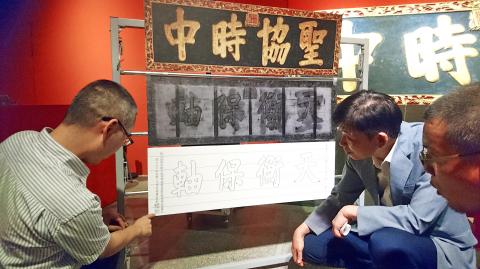
Photo: Liu Wan-chun, Taipei Times
The four-character moral exhortations are used to date the items because they were commissioned by emperors to mark special occasions that were events of record, he said.
Records show that an official named Mi Qiyu (糜奇瑜), who was in charge of the military garrison and the Confucius Temple in Taiwan, gave the artifact to the temple in 1812 and it was probably overwritten, Lin said.
X-ray images of the board showed that workers had applied a layer of ash to smooth out the original inscription and glued a new slogan over it, he said.
“Reusing inscribed boards was not unheard of in the Qing Dynasty,” he said.
When Qing emperors commissioned boards, their calligraphy would have been taken to the temples for local craftspeople to replicate and carve, Cultural Affairs Bureau Director-General Yeh Tse-shan (葉澤山) said.
Because of their large size, inscribed boards were not easy or cheap to make in Taiwan, which might be why this one was reused, Yeh said.
A local official who decided to cut corners or Daoguang himself, who was known for being frugal, might have made the decision, he said.
Beijing could eventually see a full amphibious invasion of Taiwan as the only "prudent" way to bring about unification, the US Department of Defense said in a newly released annual report to Congress. The Pentagon's "Annual Report to Congress: Military and Security Developments Involving the People's Republic of China 2025," was in many ways similar to last year’s report but reorganized the analysis of the options China has to take over Taiwan. Generally, according to the report, Chinese leaders view the People's Liberation Army's (PLA) capabilities for a Taiwan campaign as improving, but they remain uncertain about its readiness to successfully seize

Taiwan is getting a day off on Christmas for the first time in 25 years. The change comes after opposition parties passed a law earlier this year to add or restore five public holidays, including Constitution Day, which falls on today, Dec. 25. The day marks the 1947 adoption of the constitution of the Republic of China, as the government in Taipei is formally known. Back then the Chinese Nationalist Party (KMT) governed China from Nanjing. When the KMT, now an opposition party in Taiwan, passed the legislation on holidays, it said that they would help “commemorate the history of national development.” That

Taiwan has overtaken South Korea this year in per capita income for the first time in 23 years, IMF data showed. Per capita income is a nation’s GDP divided by the total population, used to compare average wealth levels across countries. Taiwan also beat Japan this year on per capita income, after surpassing it for the first time last year, US magazine Newsweek reported yesterday. Across Asia, Taiwan ranked fourth for per capita income at US$37,827 this year due to sustained economic growth, the report said. In the top three spots were Singapore, Macau and Hong Kong, it said. South
HORROR STORIES: One victim recounted not realizing they had been stabbed and seeing people bleeding, while another recalled breaking down in tears after fleeing A man on Friday died after he tried to fight the knife-wielding suspect who went on a stabbing spree near two of Taipei’s busiest metro stations, Taipei Mayor Chiang Wan-an (蔣萬安) said. The 57-year-old man, identified by his family name, Yu (余), encountered the suspect at Exit M7 of Taipei Main Station and immediately tried to stop him, but was fatally wounded and later died, Chiang said, calling the incident “heartbreaking.” Yu’s family would receive at least NT$5 million (US$158,584) in compensation through the Taipei Rapid Transit Corp’s (TRTC) insurance coverage, he said after convening an emergency security response meeting yesterday morning. National


 RSS
RSS