


Long-term exposure to a combination of PM2.5 — particulate matter smaller than 2.5 micrometers — and ultraviolet (UV) rays could cause allergies and irregular growths in the eyes, a Hsinchu County ophthalmologist said on Sunday.
PM2.5 makes unprotected eyes more susceptible to chronic inflammation, especially in people with allergic conditions, China Medical University Hsinchu Hospital ophthalmology department director Chen Ying-shan (陳瑩山) said.
Similarly, UV rays could lead to vasculitis of the sclera, or inflammation of the blood vessels in the white of the eye, he said.
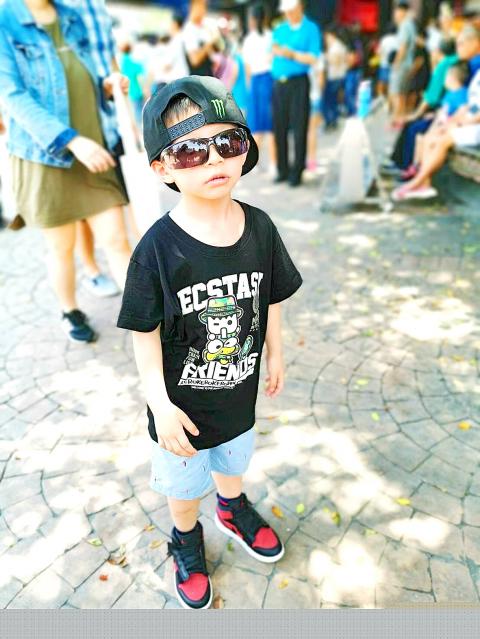
Photo: Huang Mei-chu, Taipei Times
When a person experiences repeated eye inflammation or red eyes, the tissues in their sclera could thicken and they could develop scleroderma, which is similar to skin hardening with repeated friction, Chen said.
If scleroderma is not properly treated and spreads to the pupil, it could grow into polyps and have irreversible effects on vision, he said.
There has been about a 30 percent increase in such cases over the past three years, with the number of patients in central and southern Taiwan being five times that of in the north, he said.
While scleroderma occurs in women about three times more often than men, more men see their conditions worsen into polyps, Chen said.
These rates could be caused by southern regions of the nation receiving more sunlight and women being more proactive than men when it comes to seeking medical attention, he said.
The number of women aged about 30 with scleroderma has increased over the past few years due to the use contact lenses, circle lenses and other beauty products, Chen said.
People with symptoms should wear sunglasses while outdoors and avoid wearing contact lenses, he said.
Wearing full-coverage sunglasses when PM2.5 levels are high is like wearing a “mask” over the eyes, as they can prevent airborne particulate matter from entering the conjunctiva, which can cause allergic reactions and inflammation, while also blocking UV rays, Chen said.
Chen advised people with pollen allergies to carry eye drops prescribed by a doctor at all times.
People can also freeze wet towels and carry them in insulated bags to use them as ice packs to alleviate symptoms of allergic reactions, such as redness or swelling, he said.
Wet wipes or cold beverage cans can also serve the same purpose, Chen said.
People should eat more green vegetables and eggs to protect the eyes, he said.
Green vegetables are “experts” in protecting against sunlight, while the high levels of lutein, zeaxanthin and zinc in egg yolks benefit the eyes and are easily absorbed by the body, he added.

Considering that most countries issue more than five denominations of banknotes, the central bank has decided to redesign all five denominations, the bank said as it prepares for the first major overhaul of the banknotes in more than 24 years. Central bank Governor Yang Chin-lung (楊金龍) is expected to report to the Legislative Yuan today on the bank’s operations and the redesign’s progress. The bank in a report sent to the legislature ahead of today’s meeting said it had commissioned a survey on the public’s preferences. Survey results showed that NT$100 and NT$1,000 banknotes are the most commonly used, while NT$200 and NT$2,000

The Centers for Disease Control (CDC) yesterday reported the first case of a new COVID-19 subvariant — BA.3.2 — in a 10-year-old Singaporean girl who had a fever upon arrival in Taiwan and tested positive for the disease. The girl left Taiwan on March 20 and the case did not have a direct impact on the local community, it said. The WHO added the BA.3.2 strain to its list of Variants Under Monitoring in December last year, but this was the first imported case of the COVID-19 variant in Taiwan, CDC Deputy Director-General Lin Ming-cheng (林明誠) said. The girl arrived in Taiwan on

South Korea is planning to revise its controversial electronic arrival card, a step Taiwanese officials said prompted them to hold off on planned retaliatory measures, a South Korean media report said yesterday. A Yonhap News Agency report said that the South Korean Ministry of Foreign Affairs is planning to remove the “previous departure place” and “next destination” fields from its e-arrival card system. The plan, reached after interagency consultations, is under review and aims to simplify entry procedures and align the electronic form with the paper version, a South Korean ministry official said. The fields — which appeared only on the electronic form

The Ministry of Foreign Affairs (MOFA) is suspending retaliation measures against South Korea that were set to take effect tomorrow, after Seoul said it is updating its e-arrival system, MOFA said today. The measures were to be a new round of retaliation after Taiwan on March 1 changed South Korea's designation on government-issued alien resident certificates held by South Korean nationals to "South Korea” from the "Republic of Korea," the country’s official name. The move came after months of protests to Seoul over its listing of Taiwan as "China (Taiwan)" in dropdown menus on its new online immigration entry system. MOFA last week


 RSS
RSS