


Starting July 1, passengers using smart cards must swipe twice when taking public buses in Taipei and New Taipei City, the Taipei Public Transportation Office said yesterday.
The decision was made to avoid confusion about whether passengers should swipe the card when getting on or off the bus, the office said.
The policy is to be implemented in two phases. In the first phase, which is to begin on July 1 and last for six months, passengers who swipe twice can join a prize lottery.
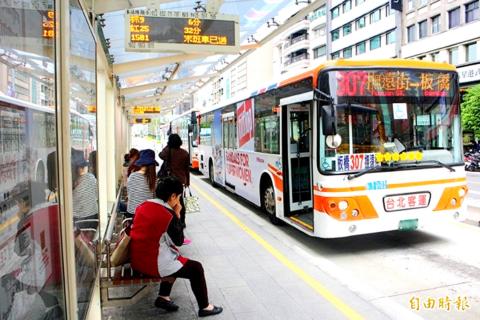
Photo: Taipei Times
The second phase is to begin on Feb. 1 next year. Passengers who forget to swipe their card twice would not be eligible for a discount when they transfer from bus to Taipei’s MRT metropolitan railway system or YouBike within an hour.
Bus fares would not change with the implementation of the new policy, the office said
For example, NT$15 would be deducted from the card on the first swipe when a passenger gets on the bus, but no fee would be deducted when the card is swiped again when the passenger leaves the bus.
For two-section fares, two NT$15 fares would be charged as is the current practice.
Separately, the Taipei Department of Transportation yesterday said it has applied for compulsory enforcement measures against Singapore-based stationless bicycle-sharing system oBike for the more than NT$7.33 million (US$233,291) it owes the city government for towing and keeping bikes that were illegally parked.
As of Monday, a total of 5,714 oBikes had been removed from the streets, the department said.
Department and legal officials on Wednesday last week confirmed that the company ceased all operations in Taipei last month and its office was emptied, so it has requested enforcement measures to deal with the case.
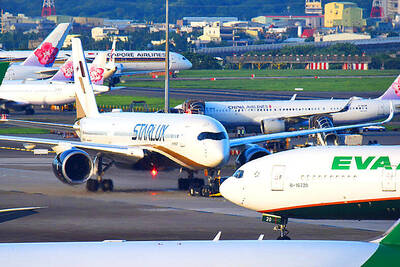
Trips for more than 100,000 international and domestic air travelers could be disrupted as China launches a military exercise around Taiwan today, Taiwan’s Civil Aviation Administration (CAA) said yesterday. The exercise could affect nearly 900 flights scheduled to enter the Taipei Flight Information Region (FIR) during the exercise window, it added. A notice issued by the Chinese Civil Aviation Administration showed there would be seven temporary zones around the Taiwan Strait which would be used for live-fire exercises, lasting from 8am to 6pm today. All aircraft are prohibited from entering during exercise, it says. Taipei FIR has 14 international air routes and
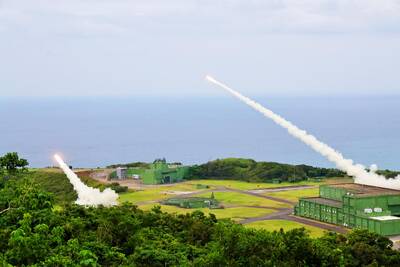
Taiwan lacks effective and cost-efficient armaments to intercept rockets, making the planned “T-Dome” interception system necessary, two experts said on Tuesday. The concerns were raised after China’s military fired two waves of rockets during live-fire drills around Taiwan on Tuesday, part of two-day exercises code-named “Justice Mission 2025.” The first wave involved 17 rockets launched at 9am from Pingtan in China’s Fujian Province, according to Lieutenant General Hsieh Jih-sheng (謝日升) of the Office of the Deputy Chief of the General Staff for Intelligence at the Ministry of National Defense. Those rockets landed 70 nautical miles (129.6km) northeast of Keelung without flying over Taiwan,
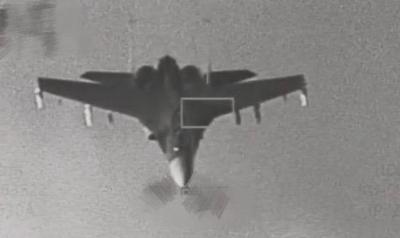
The Ministry of National Defense (MND) today released images of the military tracking China’s People's Liberation Army (PLA) movements during the latest round of Chinese drills around Taiwan. The PLA began "Justice Mission 2025" drills today, carrying out live-fire drills, simulated strikes on land and maritime targets, and exercises to blockade the nation's main ports. The exercises are to continue tomorrow, with the PLA announcing sea and air space restrictions for five zones around Taiwan for 10 hours starting from 8:30am. The ministry today released images showing a Chinese J-16 fighter jet tracked by a F-16V Block 20 jet and the
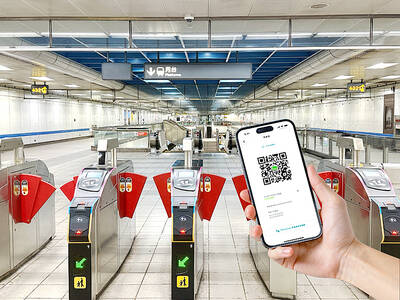
City buses in Taipei and New Taipei City, as well as the Taipei MRT, would on Saturday begin accepting QR code payments from five electronic payment providers, the Taipei Department of Transportation said yesterday. The new option would allow passengers to use the “transportation QR code” feature from EasyWallet, iPass Money, iCash Pay, Jkopay or PXPay Plus. Passengers should open their preferred electronic payment app, select the “transportation code” — not the regular payment code — unlock it, and scan the code at ticket readers or gates, General Planning Division Director-General Liu Kuo-chu (劉國著) said. People should move through the


 RSS
RSS