


Of the 250,000 people that take the scooter driver’s license test each year, more than half incorrectly answer questions about how to drive safely when a vehicle is positioned to the front and right of them, the Directorate-General of Highways (DGH) said yesterday.
Since 2015, when more than 1,000 questions were added to the exam database, the passing rate has dropped to less than 81 percent, the agency said.
After simulated scenarios were added on May 1, 2016, the rate dropped even lower, with only 68.91 percent of test takers passing, a record low for the nation, it said.
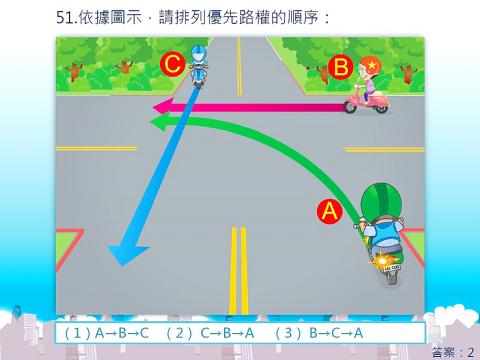
Photo courtesy of the Taoyuan Motor Vehicles Office
Examinees performed better on the questions added last year, with a more than 70 percent pass rate from December last year to April, it said, adding that the pass rate had fallen to 68.9 percent in November last year.
Although scenarios on paper allow test takers to understand the road situations that they might face, all examinees from September would need to do practice tests that would show their ability to perceive motorcycle hazards, the agency said.
The motorcycle hazard test platform requires examinees to watch videos and respond to events they consider dangerous, it said.
The top incorrectly answered questions from November last year to the end of last month included the distance that a rider should maintain from the inner tire of a large vehicle making a turn, which of three scooters coming from opposite directions has the right of way at a two-way intersection without signals or lights, the safest braking method for descending a hill and who has the right of way when a rider and an oncoming vehicle are turning into the same lane, the agency said.
With more than 13.8 million scooters nationwide, Taiwan has the highest scooter density in Asia, but, according to the National Police Administration, the top three infractions by scooter drivers are not yielding to traffic, inappropriate turns, and running traffic lights or not observing turn signals.
The agency said that last year it introduced more than 60 questions to simulate conditions related to right of way, turning, dangerous driving, inappropriate behavior, switching lanes and defensive driving.
It said it hoped that the questions would ensure that future drivers have the necessary attitudes and habits to perceive hazards and avoid accidents.

LOUD AND PROUD Taiwan might have taken a drubbing against Australia and Japan, but you might not know it from the enthusiasm and numbers of the fans Taiwan might not be expected to win the World Baseball Classic (WBC) but their fans are making their presence felt in Tokyo, with tens of thousands decked out in the team’s blue, blowing horns and singing songs. Taiwanese fans have packed out the Tokyo Dome for all three of their games so far and even threatened to drown out home team supporters when their team played Japan on Friday. They blew trumpets, chanted for their favorite players and had their own cheerleading squad who dance on a stage during the game. The team struggled to match that exuberance on the field, with
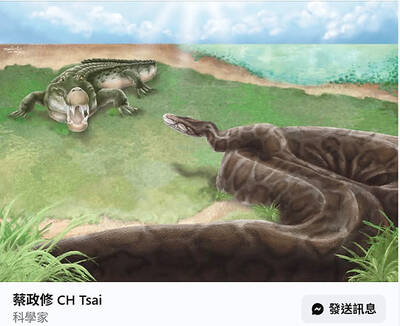
Taiwanese paleontologists have discovered fossil evidence that pythons up to 4m long inhabited Taiwan during the Pleistocene epoch, reporting their findings in the international scientific journal Historical Biology. National Taiwan University (NTU) Institute of Ecology and Evolutionary Biology associate professor Tsai Cheng-hsiu (蔡政修) led the team that discovered the largest snake fossil ever found in Taiwan. The single trunk vertebra was discovered in Tainan at the Chiting Formation, dated to between 400,000 and 800,000 years ago in the Middle Pleistocene, the paper said. The area also produced Taiwan’s first avian fossil, as well as crocodile, mammoth, saber-toothed cat and rhinoceros fossils, it said. Discoveries

Taiwanese paleontologists have discovered fossil evidence that pythons up to 4m long inhabited Taiwan during the Pleistocene epoch, reporting their findings in the international scientific journal Historical Biology. National Taiwan University (NTU) Institute of Ecology and Evolutionary Biology associate professor Tsai Cheng-hsiu (蔡政修) led the team that discovered the largest snake fossil ever found in Taiwan. A single trunk vertebra was discovered in Tainan at the Chiting Formation, dated to between 800,000 to 400,000 years ago in the Middle Pleistocene, the paper said. The area also produced Taiwan’s first avian fossil, as well as crocodile, mammoth, sabre-toothed cat and rhinoceros fossils, it said. Discoveries

Whether Japan would help defend Taiwan in case of a cross-strait conflict would depend on the US and the extent to which Japan would be allowed to act under the US-Japan Security Treaty, former Japanese minister of defense Satoshi Morimoto said. As China has not given up on the idea of invading Taiwan by force, to what extent Japan could support US military action would hinge on Washington’s intention and its negotiation with Tokyo, Morimoto said in an interview with the Liberty Times (sister paper of the Taipei Times) yesterday. There has to be sufficient mutual recognition of how Japan could provide


 RSS
RSS