


To sharpen the nation’s technological competitiveness by helping doctoral students focus on their research, the government will from September offer a four-year scholarship to 300 candidates, who are to receive at least NT$40,000 (US$1,265) per month, Minister of Science and Technology Chen Liang-gee (陳良基) told a news conference in Taipei yesterday.
Since taking office in February 2017, Chen has repeatedly said that the nation could lose its technological edge because of the decline in the number of students enrolling in technological programs.
To ease the financial burden of doctoral students and encourage them to produce more quality research, Chen said he first broached the subject of a scholarship program at a meeting with university principals in January and has garnered support from Minister of Education Pan Wen-chung (潘文忠).
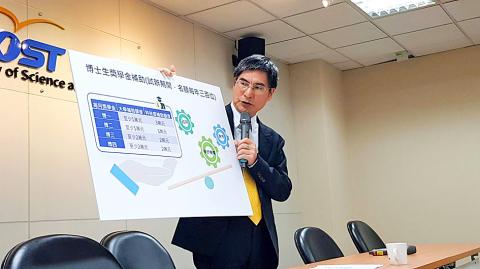
Photo: Chien Hui-ju, Taipei Times
Universities can file applications with the ministry to nominate outstanding doctoral students — including foreigners — for the scholarship, he said.
The scholarships would be funded by the ministry and universities, with the government providing about NT$30,000 per student, with the remainder subsidized by schools, he said.
Scholarship recipients would be subject to evaluations and those who failed to meet the school’s standards would lose their funding in the second year, he said.
While some students might take longer to finish their program, the four-year limit was set using international standards for similar scholarships as a reference, he added.
The program would start its trial run this year, as the science and education ministries still need to ask for an additional budget from the Executive Yuan in the following years, Chen said, adding that he hoped the program could be expanded to cover 600 candidates each year.
The science ministry is to accept applications for the scholarships from June 21 to July 31, it said.
The distribution of the 300-candidate quota among universities would depend on the proportion of the ministry’s research grant to each school, meaning those receiving more funds from the ministry would also get a larger quota for the scholarship, it added.
Apart from offering scholarships, the science ministry also encourages universities to propose plans for sharpening the abilities of doctoral students, Chen said, adding that it offers a maximum fund of NT$3 million annually to each school with such plans.

Taiwanese can file complaints with the Tourism Administration to report travel agencies if their activities caused termination of a person’s citizenship, Mainland Affairs Council Minister Chiu Chui-cheng (邱垂正) said yesterday, after a podcaster highlighted a case in which a person’s citizenship was canceled for receiving a single-use Chinese passport to enter Russia. The council is aware of incidents in which people who signed up through Chinese travel agencies for tours of Russia were told they could obtain Russian visas and fast-track border clearance, Chiu told reporters on the sidelines of an event in Taipei. However, the travel agencies actually applied

Japanese footwear brand Onitsuka Tiger today issued a public apology and said it has suspended an employee amid allegations that the staff member discriminated against a Vietnamese customer at its Taipei 101 store. Posting on the social media platform Threads yesterday, a user said that an employee at the store said that “those shoes are very expensive” when her friend, who is a migrant worker from Vietnam, asked for assistance. The employee then ignored her until she asked again, to which she replied: "We don't have a size 37." The post had amassed nearly 26,000 likes and 916 comments as of this

New measures aimed at making Taiwan more attractive to foreign professionals came into effect this month, the National Development Council said yesterday. Among the changes, international students at Taiwanese universities would be able to work in Taiwan without a work permit in the two years after they graduate, explainer materials provided by the council said. In addition, foreign nationals who graduated from one of the world’s top 200 universities within the past five years can also apply for a two-year open work permit. Previously, those graduates would have needed to apply for a work permit using point-based criteria or have a Taiwanese company
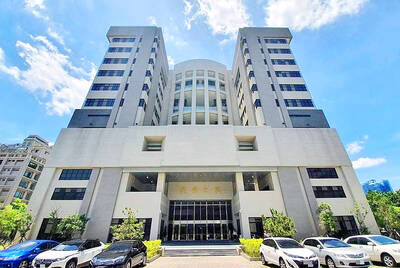
The Shilin District Prosecutors’ Office yesterday indicted two Taiwanese and issued a wanted notice for Pete Liu (劉作虎), founder of Shenzhen-based smartphone manufacturer OnePlus Technology Co (萬普拉斯科技), for allegedly contravening the Act Governing Relations Between the People of the Taiwan Area and the Mainland Area (臺灣地區與大陸地區人民關係條例) by poaching 70 engineers in Taiwan. Liu allegedly traveled to Taiwan at the end of 2014 and met with a Taiwanese man surnamed Lin (林) to discuss establishing a mobile software research and development (R&D) team in Taiwan, prosecutors said. Without approval from the government, Lin, following Liu’s instructions, recruited more than 70 software


 RSS
RSS