


Taiwanese oceanography is sailing into a new era with the establishment of more ocean-related agencies and research facilities, but the government’s inconsistent policies and ill-advised distribution of funds do not bode well for some veteran researchers.
The sinking of the 2,967-tonne Ocean Researcher V on Double Ten National Day in 2014, killing two researchers onboard, was a devastating blow to domestic oceanography.
“The loss is felt by the international community,” the journal Science reported two weeks after the shipwreck.
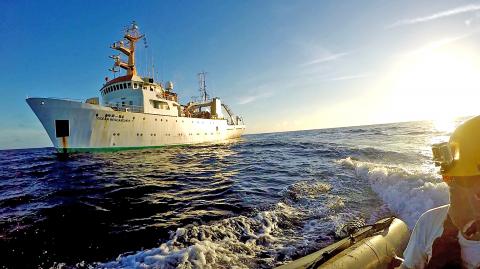
Photo courtesy of National Taiwan University Institute of Oceanography
It also drove a wedge between some academics and the Ministry of Science and Technology’s semi-official Taiwan Ocean Research Institute (TORI), whose decision to outsource vessel crew management proved unwise, said Wei Ching-ling (魏慶琳), a professor at National Taiwan University’s (NTU) Institute of Oceanography and former institute director.
More than four years later, a silver lining has appeared as the 2,629-tonne research vessel Legend (勵進), managed by the TORI, last month completed its first scientific expedition to collect geographical and atmospheric data in the South China Sea.
After the 2014 accident, the institute hired crewmembers itself to improve management, said TORI director Wang Chau-chang (王兆璋), who assumed the post in August 2017.
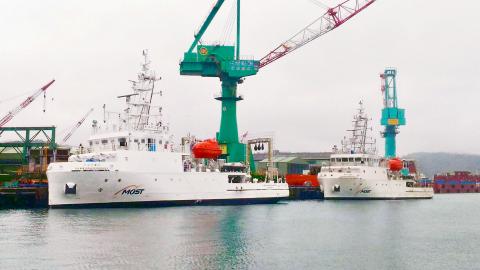
Photo courtesy of Oceanographic Society
Three new research vessels — the 2,200-tonne New Ocean Researcher I, 800-tonne New Ocean Researcher II and 800-tonne New Ocean Researcher III built by CSBC Corp — are to be delivered by the end of this year, Minister of Science and Technology Chen Liang-gee (陳良基) said.
Instead of having a government agency manage the vessels as some people have proposed, the ministry plans to have NTU, National Taiwan Ocean University and National Sun Yat-sen University (NSYSU) do so, Chen said.
The new vessels are designed to replace the 794-tonne Ocean Researcher I, 294-tonne Ocean Researcher II and 295-tonne Ocean Researcher III, which are managed by the three universities respectively.
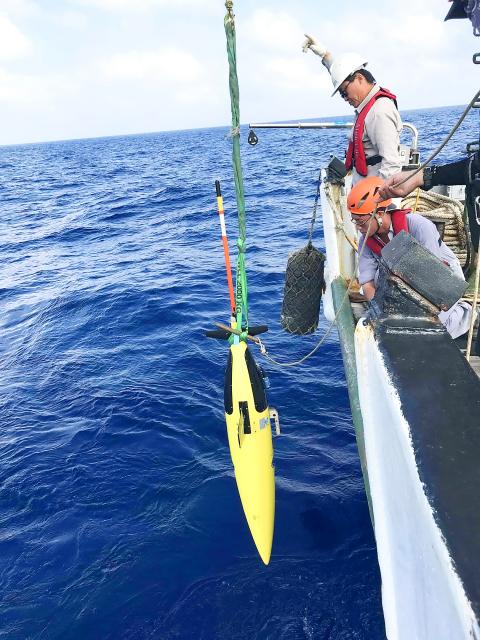
Photo courtesy of National Taiwan University Institute of Oceanography
Academics had reasoned with the ministry before it reached a decision, Wei said.
Having managed the Ocean Researcher I for more than three decades, the Institute of Oceanography laid the critical foundation for management of the vessel and its precision instruments.
It has also been commissioned by the ministry to operate its Ocean Data Bank.
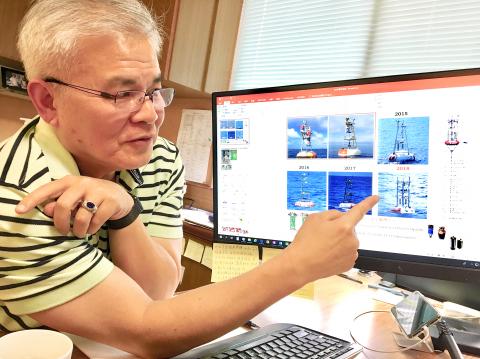
Photo: Lin Chia-nan, Taipei Times
However, the successive establishments of the TORI, the Ocean Affairs Council and the National Academy of Marine Research have made consistent planning of overall marine policy difficult, Wei said.
Inaugurated last month, the academy vowed to oversee national marine policy, manage a national ocean database, build a fleet of research vessels and foster the development of power generation from marine currents, among other goals.
In short, it is to take over certain responsibilities from the academia and the ministry.
The ocean-related agencies were often directed by engineers whose policies were seldom grounded in scientific evidence due to their lack of knowledge about oceans, Wei said.
His previous proposal that TORI use their ocean data buoys to monitor maritime and typhoon conditions in waters off Taiwan’s east coast did not meet a positive response, so he sought funds from various sources to support such a plan, which was first conceived by late institute professor Tang Tswen-yung (唐存勇), Wei said.
Their hard work paid off as their research paper on Super Typhoon Nepartak in 2016 using data collected from the buoys was published in the journal Nature Communications on April 9 and covered by numerous foreign media outlets.
Wei also questioned the council’s plan to promote marine current power development, saying it is “impossible” to control ocean currents.
Considered an expert in the field, NSYSU ocean engineer Chen Yang-yi (陳陽益) was appointed as the council’s first deputy minister in April last year.
His team in 2016 claimed to have installed the world’s first deep-sea pilot turbine with a capacity of 50 kilowatts (KW) in waters southeast of Pingtung County and generated 26.31KW of power when the Kuroshio current flowed at 1.27m per second.
Members of TORI, National Cheng Kung University (NCKU), Ching Fu Shipbuilding Co and Wanchi Steel Industrial Co were also part of the team, local media reported.
However, sources familiar with the matter said that their buoyant platform carrying the turbine was unmoored and washed out to the east coast.
Ching Fu in 2017 got embroiled in a fraud scandal involving naval minesweepers.
Nonetheless, the council last month approved another eight-month project for developing marine current power with a budget of nearly NT$65 million (US$2.06 million), just before Chen Yang-yi left his council post and returned to NSYSU this month.
The project was hosted by NSYSU marine engineer Shyue Shiahn-wern (薛憲文) and included other engineers from NTU and NCKU, the members of TORI, Wanchi Steel and Chung-hua Institution for Economic Research, but did not involve Ching Fu this time.
Chen Yang-yi said his name is not officially listed in the project, so he would not be handling the funds.
He confirmed that the turbine platform had floated away after consecutive typhoons, but said it was recovered and shipped back to NSYSU.
As the platform’s underwater mooring base is intact, they would develop stronger platforms and underwater foundations to resist typhoons, he said.
Team members are now testing a new turbine with a capacity of 400KW in waters off Tainan’s Anping Port (安平港) and plan to test it in deeper waters off the east coast where the Kuroshio passes, possibly in October, he said.
Next year, they would also work with Japanese firms to test turbines in deeper waters, and the council has budgeted up to NT$70 million for the plan, he said.
Unlike intermittent wind energy, the Kuroshio can be harnessed to generate power “any time,” he said, anticipating increasing exploitation of the current.
Chen Yang-yi’s role is not illegal, as he only serves as the team’s technical adviser, said Huang Shih-wei (黃世偉), director of the council’s Department of Technology and Cultural Affairs.
Institute of Oceanography director Jan Sen (詹森), who is also chairman of the Oceanographic Society, said that generating power from the Kuroshio is like “a pie in the sky” given current technological limitations.
A research paper led by Jan, titled “Large variability of the Kuroshio at 23.75°N east of Taiwan,” has quantified the “tremendous variability” of the current’s velocity, volume, flow structure, heat and salt transport using data collected from nine ship-based surveys from 2012 to 2014.
The paper, published in the Journal of Geophysical Research: Oceans in 2015, was identified by the American Geophysical Union as one of its “research spotlights.”
He and fellow researchers came to realize that the Kuroshio is not as stable as previously perceived, Jan said, lamenting that some people keep throwing government funds into the sea.
Apart from ongoing surveys east of Taiwan, they are also working on a collaborative project with the US Naval Research Laboratory and other institutions to study internal waves east of Dongsha Atoll in the South China Sea, Jan said.
He pursued the collaboration after the ministry shelved his integrated proposal for a project in the South China Sea involving physical oceanography, geological survey, disaster prevention, ocean acidification and biodiversity studies, although it was the government that encouraged him to make the proposal in early 2016, Jan said.
The suspension was allegedly due to national security concerns about their plan to install radars on Itu Aba (Taiping Island, 太平島), but the real cause has never been clear, he said.
“Despite limited funds, we are confident the [Taiwan-US] project would succeed and allow us to produce more excellent research papers to advance our knowledge of the complex marine system,” Jan said.
Asked about his expectations for the future of domestic oceanography, Jan said he hopes that young researchers would work harder to produce exceptional research and sustain the institute’s established connections with the global oceanographic community.
The government should also fully support oceanographic research to improve disaster mitigation, national defense and understanding about global warming, he added.
The science ministry said it is working on Earth sciences development with a more macroscopic perspective.
It has launched programs to improve natural disaster monitoring, exported related technologies to Southeast Asian countries last year and signed 10 memorandums of understanding with countries targeted by the New Southbound Policy, a ministry official said, adding that oceanographic surveys are no less important.

UPGRADE: The Kang Ding-class frigate is replacing its Chaparall missiles with Tien Chien II and Hua Yang VLS, which would provide it with long-range, 360° air defense Taiwan plans to produce 1,200 to 1,376 Hai Chien II missiles (海劍二, Sea Sword II) — also known as TC-2N — to serve as the standard air defense system of the navy’s surface combatant fleet, a source said yesterday. Last week, the Hai Chien II, the naval version of the Tien Kung II missile (天劍二, Sky Sword II), completed a live-fire test in waters off the National Chungshan Institute of Science and Technology’s Jiupeng facility (九鵬) in Pingtung County’s Manjhou Township (滿州). The MIM72 Chaparral and other dated air defense missiles that currently arm Taiwanese ships have inadequate range to combat Chinese

REASONS FOR TRAVEL: An assistant professor said that proposed amendments to penalize drivers if they used drugs overseas would not deter people from traveling People who operate a motor vehicle under the influence of marijuana would have their driver’s license revoked, even if they used the substance while overseas, the Ministry of Transportation and Communications said yesterday, citing proposed amendments to the Road Traffic Management and Penalty Act (道路交通管理處罰條例). The amendments would also authorize the government to revoke the licenses of people determined to have used Category 1 or Category 2 narcotics, even if they were not operating a vehicle while under the influence of drugs, as well as ban them from taking the license test for three years, the ministry said. People aged 18 or
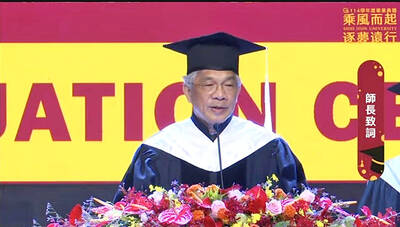
Shih Hsin University President Chen Ching-he (陳清河) yesterday issued a public apology for comments made in his commencement speech last week, stating that he has asked the school to suspend his duties and halt his wages for two months as a show of contrition. At the commencement ceremony on May 30, Chen said, “If you don’t manage your time well, or your own emotions, or your health, then I am telling every one of you — put a quick end to ‘you,’ because the world has no need for ‘you.’” The comments have sparked significant controversy online, and Chen through an open

Johanne Liou (劉喬安), a Taiwanese woman who shot to unwanted fame during the Sunflower movement protests in 2014, returned to Taiwan last night after being deported from the US. She is to stand trial in Taiwan for charges involving embezzlement, fraud and drug crimes. The Criminal Investigation Bureau (CIB) said it took her into custody at Taiwan Taoyuan International Airport and would first question her before transferring her to the New Taipei District Prosecutors’ Office. She was arrested upon disembarking a flight from San Francisco that landed shortly before 7pm. Liou absconded to the US in 2019 after jumping bail


 RSS
RSS