


While some Taiwanese might not be familiar with the name He Qinglian (何清漣), the information in her book Red Infiltration: The Truth About the Global Expansion of Chinese Media (紅色滲透:中國媒體全球擴張的真相) — published in March — should be well known.
He, a Chinese academic in exile, presents information from a variety of sources to show how China is permeating media globally and affecting Chinese, or those of Chinese descent, throughout the world through media controlled by the Chinese Communist Party (CCP), Chinese organizations and institutions.
While the book has made her persona non grata in China, He, in an interview with the Chinese-language Liberty Times (the Taipei Times’ sister newspaper) in Taipei on May 14, simply said: “I am doing what any moral academic would do.”

Photo: Lin Cheng-kung, Taipei Times
Asked about a National Security Bureau statement saying that some Taiwanese media outlets were under the control of the CCP and several representatives of media organizations attending a summit on May 10 in Beijing, where Chinese People’s Political Consultative Conference National Committee Chairman Wang Yang (汪洋) spoke on how Beijing’s “one country, two systems” framework should be covered more, He said that these were only small steps in Chinese attempts to infiltrate and permeate the media.
“China began influencing Taiwan as early as the 1990s and even went through Singapore to buy out Taiwanese media organizations,” she said.
In her 2005 book The Fog of Censorship: Media Control in China (霧鎖中國:中國大陸控制媒體策略大揭密), He wrote how China controlled the media within its borders — controlling the Internet, shutting down media companies that refused to follow commands, “disappearing” nosy reporters and honoring reporters who worked with the Chinese government.
However, “China knows that foreign media would never report China the way it wanted to be reported,” she wrote.
“To correct this, the Chinese government had allotted 45 billion yuan [US$6.5 billion] in a campaign to influence, buy out or hold shares across major media outlets so they would have a voice,” she wrote.
The methods that China uses to achieve this goal are: buy out a company, or own a significant share of its stock; give it benefits; or, in Hong Kong, appoint the owner to the National Committee of the Chinese People’s Political Consultative Conference, she said.
“The method is one of undetected infiltration of companies and if that were not successful, Beijing would certainly not continue it. Many people make choices based on information disseminated by these companies,” she said.
Using the Taiwanese independence issue as an example, she said: “Some Taiwanese media outlets have already become the mouthpiece of the CCP and are even worse than the People’s Daily. Judging from the support for unification in surveys, this brainwashing is extremely effective.”
Some Taiwanese mistakenly think that Taiwan would prosper economically after unification, she said, adding that while people yearn for wealth, serious money is made from collusion between the state and corporate entities.
Behind rich people in China such as tycoons Xiao Jianhua (肖建華) and Jack Ma (馬雲) stands the politburo or members of their family, He said, adding that as soon as their political support crumbles, their riches turn to rags.
“There is a saying in China: ‘How you make your fortune is exactly how you will fall,’” she said. “If you live in China, then you do not have a sense of security.”
At her previous job as a news editor for the Shenzhen Legal Daily in China, He said that at the time she noticed the increasingly severe issues of population, enclosure and corporate-government cooperation and wrote about them for the Hong Kong-based Twenty-First Century and another magazine based in Beijing.
Despite her misgivings that her writing — which touched on sensitive topics — would not be printed, He said she nonetheless acquiesced to friends’ urging that she publish a book of them.
As she foresaw, none of the 13 companies she visited would publish the book, He said, adding that even Joint Publishing Co’s Shanghai branch, which initially agreed to publish the book and was even set to go to print, backed out after workers protested that doing so could cost them their jobs.
The book, titled China’s Pitfall (中國現代化的陷阱) in Hong Kong, was printed by the Chinese-language Mirror Media magazine and — after tens of thousands of words were removed with the backing of Liu Ji (劉吉), adviser to then-Chinese president Jiang Zemin (江澤民) — was printed in mainland China in 1998, He said.
However, the book led to her seeking asylum in the US.
Members of the Chinese government were displeased with it and following her 35,000-word essay, titled China’s Listing Social Structure (當前中國社會結構演變的總體性分析), in 2000, she was removed from her job and banned from publishing.
During a business trip to Beijing in July 2000, He said that she and her son had been severely injured by a vehicle that intentionally drove into them.
She knew this was a warning from the Chinese state, she said.
She made plans to leave for the US, but was forced to bring them forward when her home was searched two weeks before she was to depart, she said.
“A bag of documents I was planning to take to the US, as well as a cellphone I kept to contact my friends in the US, was taken,” He said, adding that she had feigned illness to take a day off work and immediately set off for Beijing International Airport.
It was fortunate that China at the time had not instituted its interlinked CCTV surveillance system and that there was a disconnect between the airport and customs, “otherwise I would not have made it out of the country,” she said.
She left in such a rush that she did not even have time to contact her son, whom she had left with relatives, although she contacted her ex-husband to pick up their son, she said, adding that she was reunited with her son in the US three years later.
She wrote her books not only to allow other nations to understand China’s ambitions, but also because she loved her home nation, she said.
“Seeing my predictions come true makes me sad,” He said, adding that while it was a testimony to her competency as an academic, she had hoped that China, as a country, would heed her warnings and seek to improve matters.
Seeing China continue on its path of immorality and clinging to its authoritarian state, He said that as she cannot change China, she was writing so “the Chinese model would not spread to other countries, sparing the people such pain and suffering.”
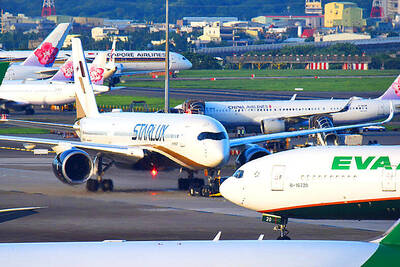
Trips for more than 100,000 international and domestic air travelers could be disrupted as China launches a military exercise around Taiwan today, Taiwan’s Civil Aviation Administration (CAA) said yesterday. The exercise could affect nearly 900 flights scheduled to enter the Taipei Flight Information Region (FIR) during the exercise window, it added. A notice issued by the Chinese Civil Aviation Administration showed there would be seven temporary zones around the Taiwan Strait which would be used for live-fire exercises, lasting from 8am to 6pm today. All aircraft are prohibited from entering during exercise, it says. Taipei FIR has 14 international air routes and
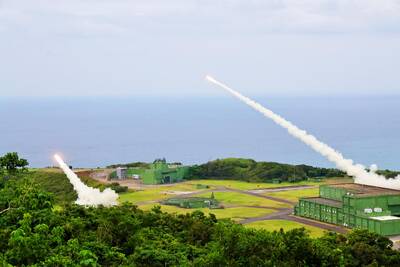
Taiwan lacks effective and cost-efficient armaments to intercept rockets, making the planned “T-Dome” interception system necessary, two experts said on Tuesday. The concerns were raised after China’s military fired two waves of rockets during live-fire drills around Taiwan on Tuesday, part of two-day exercises code-named “Justice Mission 2025.” The first wave involved 17 rockets launched at 9am from Pingtan in China’s Fujian Province, according to Lieutenant General Hsieh Jih-sheng (謝日升) of the Office of the Deputy Chief of the General Staff for Intelligence at the Ministry of National Defense. Those rockets landed 70 nautical miles (129.6km) northeast of Keelung without flying over Taiwan,
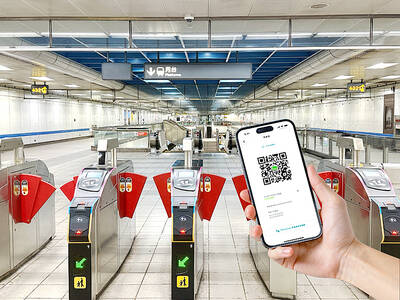
City buses in Taipei and New Taipei City, as well as the Taipei MRT, would on Saturday begin accepting QR code payments from five electronic payment providers, the Taipei Department of Transportation said yesterday. The new option would allow passengers to use the “transportation QR code” feature from EasyWallet, iPass Money, iCash Pay, Jkopay or PXPay Plus. Passengers should open their preferred electronic payment app, select the “transportation code” — not the regular payment code — unlock it, and scan the code at ticket readers or gates, General Planning Division Director-General Liu Kuo-chu (劉國著) said. People should move through the
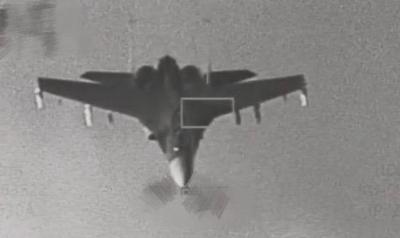
The Ministry of National Defense (MND) today released images of the military tracking China’s People's Liberation Army (PLA) movements during the latest round of Chinese drills around Taiwan. The PLA began "Justice Mission 2025" drills today, carrying out live-fire drills, simulated strikes on land and maritime targets, and exercises to blockade the nation's main ports. The exercises are to continue tomorrow, with the PLA announcing sea and air space restrictions for five zones around Taiwan for 10 hours starting from 8:30am. The ministry today released images showing a Chinese J-16 fighter jet tracked by a F-16V Block 20 jet and the


 RSS
RSS