


Kaohsiung Mayor Han Kuo-yu (韓國瑜) is favored to win in a three-way race for the presidency, while former premier William Lai (賴清德) would have the edge if it were a two-way battle, a survey by the Taiwan New Constitution Foundation-Trend Survey and Research released yesterday showed.
Although he has yet to declare his intention, Han is widely expected to become the Chinese Nationalist Party’s (KMT) candidate for next year’s presidential election, while Lai has announced his candidacy for the Democratic Progressive Party’s (DPP) presidential primary.
Independent Taipei Mayor Ko Wen-je (柯文哲) has not made an announcement.
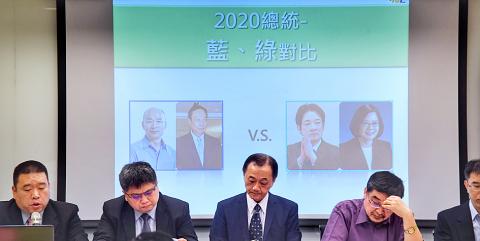
Photo: CNA
Using only landline samples for a three-way race, Han, Lai and Ko would claim 35.2 percent, 33.8 percent and 25.3 percent respectively of the vote, the poll showed.
However, using only cellphone samples for the race, Han and Ko are virtually tied at 31.6 percent and 31.5 percent respectively, while Lai trailed at 28.4 percent.
However, Lai would be ahead of Han in a two-way race, based on landline-only and cellphone-only versions of the poll.
A landline poll showed Lai’s 47.5 percent edging out Han’s 43.5 percent, while a cellphone poll showed Lai’s 45.7 percent leading Han’s 40.9 percent.
Should President Tsai Ing-wen (蔡英文) run as the DPP’s presidential candidate, she would trail Han in all race configurations and in both versions of the survey, although the difference was narrower than the margin of error in some cases, the poll showed.
In a three-way race using landline-only samples, Han polled 35.4 percent, Tsai 33.8 percent and Ko 24.6 percent, while using cellphone-only samples, Han polled 33.8 percent, Tsai 30.2 percent and Ko 29 percent.
In a two-way race, Han’s 46 percent would lead Tsai’s 43.6 percent in a landline survey, but the two candidates would be virtually tied in a cellphone survey, with Han at 43.1 percent and Tsai at 42.8 percent.
However, the poll also showed that Han is the most disliked presidential hopeful, with 33.6 percent of landline respondents saying he is their least favorite candidate, while it was 29 percent among cellphone respondents.
Former New Taipei City mayor Eric Chu (朱立倫) is the least disliked among the presidential hopefuls, with 2.3 percent of landline respondents and 3 percent of cellphone respondents citing him as their least favorite candidate.
Within the DPP, Lai had a significant edge over Tsai, leading 50 percent to 32.9 percent via landline and 45.7 percent to 38.2 percent via cellphone, the poll showed.
The survey, conducted on Tuesday and Wednesday, collected 1,068 samples, and had a margin of error of 3 percentage points.
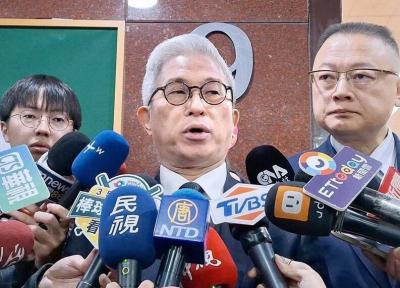
Foundation creator Koo Kwang-ming (辜寬敏) said that the poll showed that there is no significant difference between surveys conducted over landlines or cellphones.
Addressing some academics’ suggestion that Lai volunteer to be Tsai’s running mate, Koo said: “A joint Tsai-Lai ticket is not in the realm of possibility.”
In related developments, DPP spokesman Luo Wen-jia (羅文嘉) said that Tsai and Lai have agreed to include cellphone interviews in the party’s primary poll.
Both have also agreed to hold two televised policy presentations, Luo told a news conference after the party held a second negotiation between Tsai’s and Lai’s campaigns.
However, the weighting of cellphone interviews and methodology are to be decided at a later date, aided by input from professionals at the DPP survey center and other domestic and foreign experts with experience in cellphone polls, Luo added.
Additional reporting by Su Fun-her
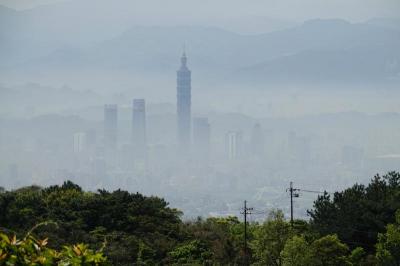
A strong continental cold air mass is to bring pollutants to Taiwan from tomorrow, the Ministry of Environment said today, as it issued an “orange” air quality alert for most of the country. All of Taiwan except for Hualien and Taitung counties is to be under an “orange” air quality alert tomorrow, indicating air quality that is unhealthy for sensitive groups. In China, areas from Shandong to Shanghai have been enveloped in haze since Saturday, the ministry said in a news release. Yesterday, hourly concentrations of PM2.5 in these areas ranged from 65 to 160 micrograms per cubic meter (mg/m³), and pollutants were
Taiwan’s armed forces have established response protocols for a wide range of sudden contingencies, including the “Wan Chun Plan” to protect the head of state, the Ministry of Defense (MND) said today. After US President Donald Trump on Saturday launched a series of airstrikes in Venezuela and kidnapped Venezuelan President Nicolas Maduro, concerns have been raised as to whether China would launch a similar “decapitation strike” on Taiwan. The armed forces regularly coordinate with relevant agencies and practice drills to ensure preparedness for a wide range of scenarios, Vice Minister of National Defense Hsu Szu-chien (徐斯儉) told reporters before a
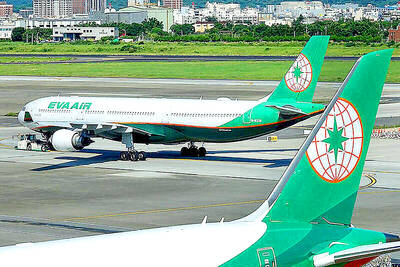
EVA Airways on Saturday said that it had suspended a pilot and opened an investigation after he allegedly lost his temper and punched the first officer several times as their plane was taxiing before takeoff at Los Angeles International Airport. According to a report published on Thursday by The Reporter, the incident occurred after the flight’s Malaysian first officer tried to warn the Taiwanese pilot, surnamed Wen (文), that he was taxiing faster than the speed limit of 30 knots (55.6kph). After alerting the pilot several times without response, the first officer manually applied the brakes in accordance with standard operating
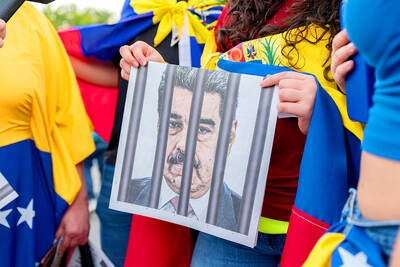
NOT AN OPENING: Trump’s violation of international law does not affect China’s consideration in attacking Taiwan; Beijing lacks capability, not precedent, an official said Taiwanese officials see the US’ capture of the president of Venezuela as a powerful deterrent to Beijing’s aggression and a timely reminder of the US’ ability to defeat militaries equipped with Chinese-made weapons. The strikes that toppled Venezuelan President Nicolas Maduro signaled to authoritarian leaders, including Chinese President Xi Jinping (習近平), US President Donald Trump’s willingness to use military might for international affairs core to US interests, one senior official in Taipei’s security circle said. That reassured Taiwan, the person said. Taipei has also dismissed the idea that Trump’s apparent violation of international law could embolden Beijing, said the official, who was not


 RSS
RSS