


Civic groups from Taiwan, Hong Kong and North America are to hold a series of events to commemorate the 30th anniversary of the Tiananmen Square Massacre starting from Saturday, the New School For Democracy (NSD) said yesterday.
The events include a three-day academic conference, a photography exhibition and candlelight vigil, concerts, art installations and talks to commemorate the massacre’s victims and celebrate freedom of expression, the NSD said at a news conference at the Legislative Yuan in Taipei.
Groups organizing the events with the NSD include the Taiwan Association of University Professors (TAUP); Hong Kong’s Democratic Party, Labour Party and Civic Party; and the Hong Kong Alliance in Support of Patriotic Democratic Movements of China.
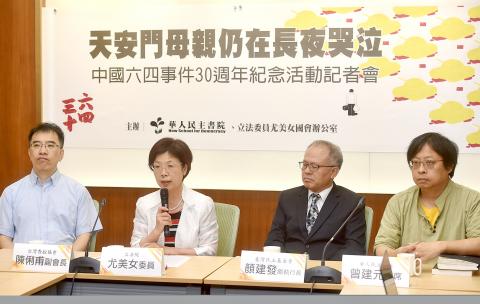
Photo: Chien Jung-fong, Taipei Times
The Tiananmen Square protests of 1989 were part of the third wave of global democracy movements that helped shape Taiwan’s democracy, NSD chairman Tseng Chien-yuan (曾建元) said.
“When we look back at the incident, we do not see it as a foreign event that took place on the other side of the Taiwan Strait, but rather an incident important to Taiwan’s democratization,” he said.
Due to increased pressure from Beijing, this year’s academic conference is to be held at National Taiwan University, instead of in Hong Kong, TAUP vice president Chen Li-fu (陳俐甫) said.
“This is the first time that TAUP is co-organizing the conference and we feel that if we do not do it this year, perhaps next year it could be held in Guam, because Taiwan might no longer be able to host it,” Chen said.
If Taiwanese do not learn from the massacre, they could suffer the same fate, he said.
“If China managed to annex Taiwan, the place where violent suppression is most likely to occur would be Taiwan, as it would be the most politically different area from Beijing,” he said.
The meaning of the Tiananmen Square Massacre has changed significantly for Taiwanese over the past three decades, he said.
“Before, we commemorated the massacre in an effort to defend human rights, but today we also commemorate it to defend Taiwan’s sovereignty,” he said. “We have always sympathized with massacre victims, but now we are also scared for ourselves.”
Over the past three decades, there has been “no truth, no apology and no repentance” from Chinese authorities, as the rule of law and protections of human rights continue to deteriorate in China, Democratic Progressive Party Legislator You Mei-nu (尤美女) said.
Hopefully, the commemorative events will help people better understand the history of the massacre and today’s China, and offer new perspectives regarding Taiwan’s future, she said.
Information about the events can be found on the New School For Democracy’s Web site: http://idemocracy.asia.

LOUD AND PROUD Taiwan might have taken a drubbing against Australia and Japan, but you might not know it from the enthusiasm and numbers of the fans Taiwan might not be expected to win the World Baseball Classic (WBC) but their fans are making their presence felt in Tokyo, with tens of thousands decked out in the team’s blue, blowing horns and singing songs. Taiwanese fans have packed out the Tokyo Dome for all three of their games so far and even threatened to drown out home team supporters when their team played Japan on Friday. They blew trumpets, chanted for their favorite players and had their own cheerleading squad who dance on a stage during the game. The team struggled to match that exuberance on the field, with
Taiwanese paleontologists have discovered fossil evidence that pythons up to 4m long inhabited Taiwan during the Pleistocene epoch, reporting their findings in the international scientific journal Historical Biology. National Taiwan University (NTU) Institute of Ecology and Evolutionary Biology associate professor Tsai Cheng-hsiu (蔡政修) led the team that discovered the largest snake fossil ever found in Taiwan. The single trunk vertebra was discovered in Tainan at the Chiting Formation, dated to between 400,000 and 800,000 years ago in the Middle Pleistocene, the paper said. The area also produced Taiwan’s first avian fossil, as well as crocodile, mammoth, saber-toothed cat and rhinoceros fossils, it said. Discoveries

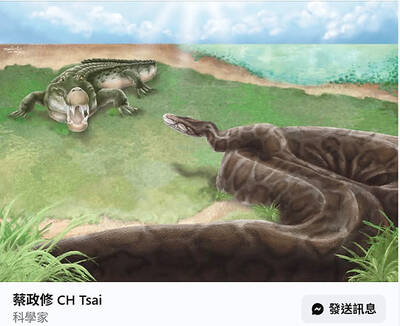
Taiwanese paleontologists have discovered fossil evidence that pythons up to 4m long inhabited Taiwan during the Pleistocene epoch, reporting their findings in the international scientific journal Historical Biology. National Taiwan University (NTU) Institute of Ecology and Evolutionary Biology associate professor Tsai Cheng-hsiu (蔡政修) led the team that discovered the largest snake fossil ever found in Taiwan. A single trunk vertebra was discovered in Tainan at the Chiting Formation, dated to between 800,000 to 400,000 years ago in the Middle Pleistocene, the paper said. The area also produced Taiwan’s first avian fossil, as well as crocodile, mammoth, sabre-toothed cat and rhinoceros fossils, it said. Discoveries

Whether Japan would help defend Taiwan in case of a cross-strait conflict would depend on the US and the extent to which Japan would be allowed to act under the US-Japan Security Treaty, former Japanese minister of defense Satoshi Morimoto said. As China has not given up on the idea of invading Taiwan by force, to what extent Japan could support US military action would hinge on Washington’s intention and its negotiation with Tokyo, Morimoto said in an interview with the Liberty Times (sister paper of the Taipei Times) yesterday. There has to be sufficient mutual recognition of how Japan could provide


 RSS
RSS