


On average 35 women are diagnosed with breast cancer every day in Taiwan, with Taipei and New Taipei City having the highest incidence rates in the nation, the Formosa Cancer Foundation said yesterday.
On the eve of Mother’s Day yesterday, the foundation held its annual walking event to raise breast cancer awareness in Taipei, the foundation said.
The number of cancer patients in Taiwan is continuously growing, with an average of one person diagnosed with cancer every 4 minutes, 58 seconds, it said.
“Breast cancer is the most common type of cancer affecting women in Taiwan, and the incidence rate continues to grow,” foundation chief executive officer Lai Gi-ming (賴基銘) said.
The number of breast cancer patients is about three times what it was two decades ago, and 12,672 new cases of breast cancer were detected in 2016 alone, meaning that on average 35 women were diagnosed with breast cancer every day, or three every two hours, he said.
While breast cancer is often detected in elderly women, cancer registration data from the past few years shows that about one-third of the cases were women aged 30 to 49, Lai said, adding that increases could be caused by late pregnancies or exposure to endocrine disruptors in the environment.
Breast cancer incidence rates were highest in Taipei and New Taipei City in 2015, but the worst death rates were in Pingtung County and Tainan in 2017, he said.
The difference in geographical distribution might be explained by southern Taiwan generally having fewer medical resources and a lack of awareness of breast cancer recurrence, Lai said.
The higher incidence rates in northern Taiwan might be because people there generally eat out more and consume larger quantities of meat and fats, he said.
“Breast cancer can be prevented and detected at an early stage, but according to [Health Promotion Administration] data, the screening rate is only about 40 percent [nationwide],” he said. “Women who are 45 years old or above are eligible for a free breast cancer screening, but why are they not motivated to go for a mammogram?”
Three common misconceptions are that performing a regular self-examination is enough, having a chest X-ray is enough and not having to worry because of not having a family history of breast cancer, Lai said.
However, a self-examination sometimes fails to detect early signs of breast cancer, chest X-rays are usually for detecting problems in the lungs, ribs or other organs, and only 10 to 20 percent of all breast cancer cases are thought to be linked to family history, so getting a regular mammogram is very important, he said.
Lai said the foundation wants to remind people that breast cancer can be prevented, and that the five-year survival rate if breast cancer is detected early is more than 90 percent.
Eating more fruit and vegetables, doing exercise and avoiding stress can also reduce a person’s chances of having breast cancer, he added.

LOUD AND PROUD Taiwan might have taken a drubbing against Australia and Japan, but you might not know it from the enthusiasm and numbers of the fans Taiwan might not be expected to win the World Baseball Classic (WBC) but their fans are making their presence felt in Tokyo, with tens of thousands decked out in the team’s blue, blowing horns and singing songs. Taiwanese fans have packed out the Tokyo Dome for all three of their games so far and even threatened to drown out home team supporters when their team played Japan on Friday. They blew trumpets, chanted for their favorite players and had their own cheerleading squad who dance on a stage during the game. The team struggled to match that exuberance on the field, with
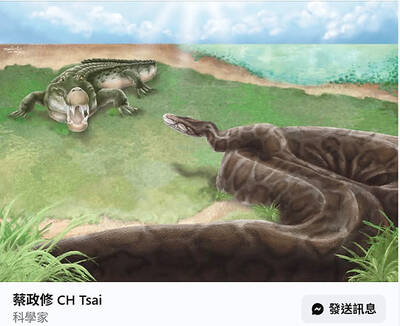
Taiwanese paleontologists have discovered fossil evidence that pythons up to 4m long inhabited Taiwan during the Pleistocene epoch, reporting their findings in the international scientific journal Historical Biology. National Taiwan University (NTU) Institute of Ecology and Evolutionary Biology associate professor Tsai Cheng-hsiu (蔡政修) led the team that discovered the largest snake fossil ever found in Taiwan. The single trunk vertebra was discovered in Tainan at the Chiting Formation, dated to between 400,000 and 800,000 years ago in the Middle Pleistocene, the paper said. The area also produced Taiwan’s first avian fossil, as well as crocodile, mammoth, saber-toothed cat and rhinoceros fossils, it said. Discoveries

Taiwanese paleontologists have discovered fossil evidence that pythons up to 4m long inhabited Taiwan during the Pleistocene epoch, reporting their findings in the international scientific journal Historical Biology. National Taiwan University (NTU) Institute of Ecology and Evolutionary Biology associate professor Tsai Cheng-hsiu (蔡政修) led the team that discovered the largest snake fossil ever found in Taiwan. A single trunk vertebra was discovered in Tainan at the Chiting Formation, dated to between 800,000 to 400,000 years ago in the Middle Pleistocene, the paper said. The area also produced Taiwan’s first avian fossil, as well as crocodile, mammoth, sabre-toothed cat and rhinoceros fossils, it said. Discoveries
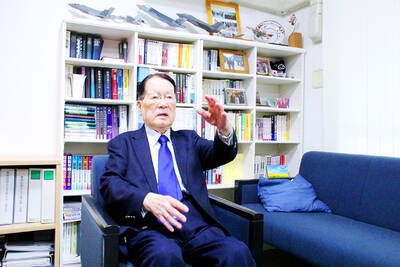
Whether Japan would help defend Taiwan in case of a cross-strait conflict would depend on the US and the extent to which Japan would be allowed to act under the US-Japan Security Treaty, former Japanese minister of defense Satoshi Morimoto said. As China has not given up on the idea of invading Taiwan by force, to what extent Japan could support US military action would hinge on Washington’s intention and its negotiation with Tokyo, Morimoto said in an interview with the Liberty Times (sister paper of the Taipei Times) yesterday. There has to be sufficient mutual recognition of how Japan could provide


 RSS
RSS