


The Control Yuan yesterday said that the Environmental Protection Administration (EPA) has failed to reduce plastic pollution, despite reduction policies since 2002, and asked it to improve its waste disposal scheme.
Marine garbage affects nearly 80 percent of water around the nation, with plastic making up 66.3 percent of the waste, Control Yuan member Chang Wu-shou (張武修) told a news conference in Taipei.
While the EPA in 2002 began implementing policies to limit the use of plastic, in 2006 it loosened regulations for catering businesses, delaying a ban on plastic bags, Chang said.
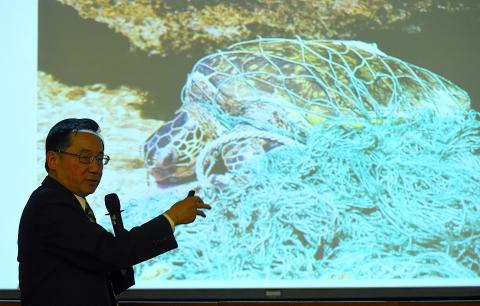
Photo: Liao Chen-huei, Taipei Times
Recycling of plastic bags has been inadequate due to a lack of firms able to dispose of them and a shortage of incentives to promote a circular economy, he said.
Production and consumption of plastic bags over the past 10 years has risen steadily, showing that the EPA is derelict in its duties, he said.
The Cabinet must improve cross-agency collaboration by boosting the involvement of the Ocean Conservation Administration (OCA) and the Fisheries Agency, which are tasked with tackling marine pollution and waste fishing gear, he said.
EPA Department of Waste Management Director-General Lai Ying-ying (賴瑩瑩) said that the agency would improve its plastics reduction policy.
It would promote recycling of used and dirty plastics bags, as they can be used in alternative fuels, Lai said.
As for cleaner plastic bags, they can be used to make more bags or flower pots, with about nine firms able to contribute, she said.
From next month, the EPA would select hypermarkets to demonstrate a plastic bag recycling project, while in July or August it would also release draft guidelines for e-commerce platforms to cut unnecessary packaging, she said.
Separately yesterday, OCA Director-General Huang Hsiang-wen (黃向文) said that the agency has filed with the Executive Yuan a four-year proposal from next year to survey, monitor and clean ocean pollution.
In addition to collaboration with other government agencies and non-governmental groups, it is also increasing interaction with US, European and Southeast Asian experts to improve its response to marine pollution, Huang said.

LOUD AND PROUD Taiwan might have taken a drubbing against Australia and Japan, but you might not know it from the enthusiasm and numbers of the fans Taiwan might not be expected to win the World Baseball Classic (WBC) but their fans are making their presence felt in Tokyo, with tens of thousands decked out in the team’s blue, blowing horns and singing songs. Taiwanese fans have packed out the Tokyo Dome for all three of their games so far and even threatened to drown out home team supporters when their team played Japan on Friday. They blew trumpets, chanted for their favorite players and had their own cheerleading squad who dance on a stage during the game. The team struggled to match that exuberance on the field, with
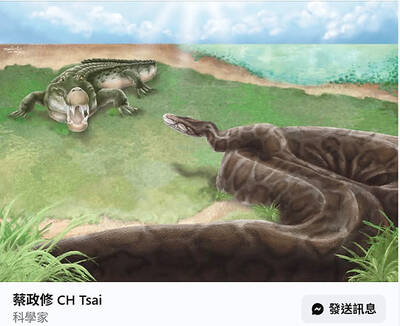
Taiwanese paleontologists have discovered fossil evidence that pythons up to 4m long inhabited Taiwan during the Pleistocene epoch, reporting their findings in the international scientific journal Historical Biology. National Taiwan University (NTU) Institute of Ecology and Evolutionary Biology associate professor Tsai Cheng-hsiu (蔡政修) led the team that discovered the largest snake fossil ever found in Taiwan. The single trunk vertebra was discovered in Tainan at the Chiting Formation, dated to between 400,000 and 800,000 years ago in the Middle Pleistocene, the paper said. The area also produced Taiwan’s first avian fossil, as well as crocodile, mammoth, saber-toothed cat and rhinoceros fossils, it said. Discoveries

Taiwanese paleontologists have discovered fossil evidence that pythons up to 4m long inhabited Taiwan during the Pleistocene epoch, reporting their findings in the international scientific journal Historical Biology. National Taiwan University (NTU) Institute of Ecology and Evolutionary Biology associate professor Tsai Cheng-hsiu (蔡政修) led the team that discovered the largest snake fossil ever found in Taiwan. A single trunk vertebra was discovered in Tainan at the Chiting Formation, dated to between 800,000 to 400,000 years ago in the Middle Pleistocene, the paper said. The area also produced Taiwan’s first avian fossil, as well as crocodile, mammoth, sabre-toothed cat and rhinoceros fossils, it said. Discoveries

Whether Japan would help defend Taiwan in case of a cross-strait conflict would depend on the US and the extent to which Japan would be allowed to act under the US-Japan Security Treaty, former Japanese minister of defense Satoshi Morimoto said. As China has not given up on the idea of invading Taiwan by force, to what extent Japan could support US military action would hinge on Washington’s intention and its negotiation with Tokyo, Morimoto said in an interview with the Liberty Times (sister paper of the Taipei Times) yesterday. There has to be sufficient mutual recognition of how Japan could provide


 RSS
RSS