


A ban on giving single-use plastic straws in about 8,000 venues is to take effect from July, and is expected to reduce the number of plastic straws used by 100 million per year, the Environmental Protection Administration (EPA) said yesterday.
After announcing a draft for the ban on June 8 last year, the agency held several public hearings to gather opinions and revised some of its content.
Starting from July, about 8,000 venues ranging from government agencies, public and private schools, department stores, shopping malls and fast-food chains would be prohibited from offering customers eating at the venues single-use plastic straws, EPA Deputy Minister Shen Chih-hsiu (沈志修) said.
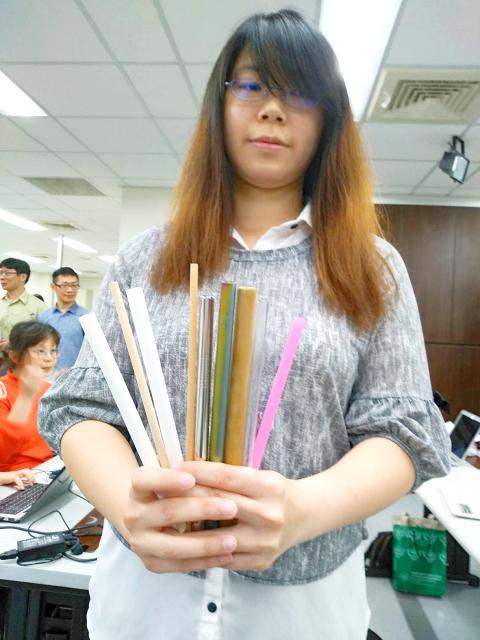
Photo: Liu Li-jen, Taipei Times
Those purchasing takeaways would not be affected for the moment, he said, adding that the agency would evaluate how to limit the use of plastic straws in take-out orders in a year’s time.
Biodegradable straws with an EPA-certified logo and plastic straws attached to beverages during the manufacturing process would not be banned, Shen said.
Also banned are straws made of paper, sugarcane fiber or other eco-friendly materials that contain plastic, even if it accounts for less than 10 percent of their weight, he said.
The agency had not included such straws in the draft, as most paper-made lunchboxes contain a plastic layer for insulation that accounts for less than 10 percent of their weight, Department of Waste Management Director-General Lai Ying-ying (賴瑩瑩) said.
Over the past year, some developers have introduced paper straws without the plastic layer, so the agency considers it possible to ban those that contain plastic, she said.
Biodegradable straws refer to those made from polylactic acid, which decompose more easily than entirely plastic straws, Lai said.
Taiwanese use nearly 3 billion plastic straws per year, department senior technical specialist Lee Yi-hua (李宜樺) said.
From July, venues contravening the regulation would be warned, while repeat offenders would face a fine of NT$1,200 to NT$6,000 under the Waste Disposal Act (廢棄物清理法), he said.
From July next year, offenders would be fined without receiving a warning, he said.
Despite some disagreement about the proposed ban last year, it has triggered new commercial opportunities, as eco-friendlier straws continue to be launched and reusable straws are selling better online, Lee said.
The agency would put up notices on the doors of affected venues to remind consumers of the ban, department technical specialist Teng Pi-shin (鄧丕信) said.
McDonald’s Taiwan has said that it plans to implement its no-straw policy nationwide by the end of next month, and would be introducing a new lid to enable people to sip cold drinks without a straw.

Considering that most countries issue more than five denominations of banknotes, the central bank has decided to redesign all five denominations, the bank said as it prepares for the first major overhaul of the banknotes in more than 24 years. Central bank Governor Yang Chin-lung (楊金龍) is expected to report to the Legislative Yuan today on the bank’s operations and the redesign’s progress. The bank in a report sent to the legislature ahead of today’s meeting said it had commissioned a survey on the public’s preferences. Survey results showed that NT$100 and NT$1,000 banknotes are the most commonly used, while NT$200 and NT$2,000

The Centers for Disease Control (CDC) yesterday reported the first case of a new COVID-19 subvariant — BA.3.2 — in a 10-year-old Singaporean girl who had a fever upon arrival in Taiwan and tested positive for the disease. The girl left Taiwan on March 20 and the case did not have a direct impact on the local community, it said. The WHO added the BA.3.2 strain to its list of Variants Under Monitoring in December last year, but this was the first imported case of the COVID-19 variant in Taiwan, CDC Deputy Director-General Lin Ming-cheng (林明誠) said. The girl arrived in Taiwan on

South Korea is planning to revise its controversial electronic arrival card, a step Taiwanese officials said prompted them to hold off on planned retaliatory measures, a South Korean media report said yesterday. A Yonhap News Agency report said that the South Korean Ministry of Foreign Affairs is planning to remove the “previous departure place” and “next destination” fields from its e-arrival card system. The plan, reached after interagency consultations, is under review and aims to simplify entry procedures and align the electronic form with the paper version, a South Korean ministry official said. The fields — which appeared only on the electronic form

The Ministry of Foreign Affairs (MOFA) is suspending retaliation measures against South Korea that were set to take effect tomorrow, after Seoul said it is updating its e-arrival system, MOFA said today. The measures were to be a new round of retaliation after Taiwan on March 1 changed South Korea's designation on government-issued alien resident certificates held by South Korean nationals to "South Korea” from the "Republic of Korea," the country’s official name. The move came after months of protests to Seoul over its listing of Taiwan as "China (Taiwan)" in dropdown menus on its new online immigration entry system. MOFA last week


 RSS
RSS