


Chinese Nationalist Party (KMT) Chairman Wu Den-yih (吳敦義) yesterday made it official: He has no intention of running for president.
As someone with more than four decades of experience in politics, if he wanted to make a run, he would have announced it on Nov. 24 last year after the party won mayoral and commissioner elections in 15 of the nation’s 22 cities and counties, he told the KMT Central Standing Committee at its weekly meeting.
“The reason I did not do that was because I have no such intention,” he said.
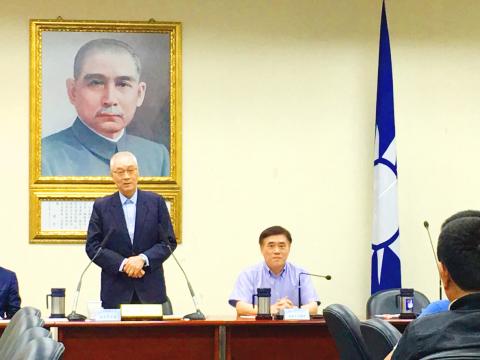
Photo: Lin Liang-sheng, Taipei Times
As chairman “his only goal” is to find a presidential candidate with “impeccable integrity, skills and experience and the greatest chance to win the election,” so that the KMT would regain power and bring the Republic of China (ROC) back to a bright path, he said.
He called for party solidarity and said that the KMT would aim to win at least 60 of the 113 seats in the Legislative Yuan.
KMT spokesman Ouyang Long (歐陽龍) said after the committee meeting that party officials would soon arrange for Wu to meet with potential candidates for next year’s presidential election: Kaohsiung Mayor Han Kuo-yu (韓國瑜), former New Taipei City mayor Eric Chu (朱立倫) and KMT Legislator Wang Jin-pyng (王金平).
Before the meeting, committee member Vincent Hsu (徐正文) and a dozen KMT members gathered outside the meeting room to urge the Central Standing Committee to bring forward the date of the party’s annual national congress to next month to discuss enlisting Han to run and nominate him without a primary.
A petition for such a move that he launched has won support from KMT members in 18 cities and counties, Hsu said.
The proposal represents “the voice of lower-ranked party members, KMT Central Committee members and Han’s supporters,” he said.
Central Standing Committee member Lee Chao-ping (李昭平) agreed to put forward the proposal during the meeting.
However, Ouyang told reporters after the meeting that the proposal had not been put forward for discussion because it contravened KMT regulations.
Party regulations state that members must be informed of the date and agenda of a national convention at least two months in advance, KMT deputy spokesman Hsiao Ching-yan (蕭敬嚴) said.
The next national congress is scheduled for July and cannot be moved forward any earlier than June, he said.
While regulations allow extraordinary national congresses to be held, the Central Committee must approve such a decision or it must be proposed by more than half of the party’s local chapters, he said.
“Whether that is necessary must be carefully considered,” Hsiao said, adding that the primary schedule has not been changed.
Applications for the primary would be accepted next month, with the primary scheduled for June and the nomination of the primary winner would be confirmed by the national congress the following month, he said.
The schedule could be adjusted if necessary, Ouyang said, adding that the Democratic Progressive Party has yet to decide on its candidate and there could be candidates from other parties.
Additional reporting by CNA

FUKUOKA SITUATION: Japanese media reported that the pathogen is expected to be identified by the summer, while the CDC downplayed the idea that it was hMPV A “mysterious cold-like illness” reported in Japan’s Fukuoka Prefecture does not seem to be a new disease, but Japanese authorities have been asked about the situation, the Centers for Disease Control (CDC) said yesterday. The Fukuoka Prefectural Medical Association on Wednesday told a news conference that a “mystery cold” that has become a hot topic on social media is “highly likely to be caused by some kind of viral infection,” Japan’s KBC News reported. “Many people are experiencing symptoms starting with a sore throat, followed by a runny nose, phlegm and a severe cough,” KBC News reported, citing association officials. Health authorities are

Nvidia Corp CEO Jensen Huang (黃仁勳) arrived in Taiwan yesterday ahead of upcoming AI and technology events, saying he plans to meet with clients and Taiwan Semiconductor Manufacturing Co Chairman C.C. Wei (魏哲家) during his visit. After landing at Taipei Songshan Airport, Huang posed for photos with fans and handed out Yakult drinks to reporters and supporters waiting at the scene, saying he has “a lot to do” during the trip. Asked about reports that Nvidia’s planned headquarters site in Taipei’s Beitou Shilin Technology Park could break ground on May 27, Huang said that if the company holds an event, he would

The Ministry of Finance this afternoon announced the winning numbers for the March-April uniform invoice lottery. The winning number for the NT$10 million (US$318,060) special prize is 19531471, and the winning number for the NT$2 million grand prize is 85941329. Three numbers were drawn for the NT$200,000 first prize: 07225810, 20231230 and 83518781. Those with receipts matching the last seven digits of any of the first-prize numbers will win the NT$40,000 second prize, while those matching the last six digits will win the NT$10,000 third prize. Those whose receipts match the last five digits of the first-prize numbers can claim the NT$4,000 fourth prize,
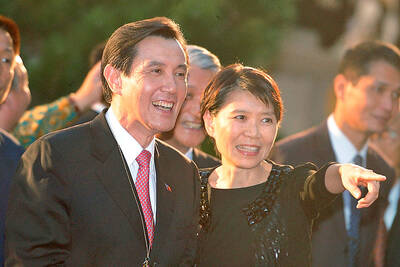
Former president Ma Ying-jeou (馬英九) yesterday expressed “shock and regret” over a statement issued by his wife without his consent, and rejected her assertion that his eldest sister, Ma Yi-nan (馬以南), would manage his medical care or act as his spokesperson amid an ongoing embezzlement probe into his foundation. Ma Ying-jeou in a statement said he was shocked by a statement by his wife, Chou Mei-ching (周美青), regarding his affairs. Ma Yi-nan “must not” be in charge of his healthcare and other personal affairs, nor can she be allowed to represent the Ma family, the former president said. He said he was also


 RSS
RSS