


Government-funded influenza vaccinations would be changed from trivalent to quadrivalent vaccines starting next flu season, the Ministry of Health and Welfare said yesterday.
Specialists from the ministry and its affiliated Centers for Disease Control (CDC) held meetings and suggested purchasing quadrivalent flu vaccines for the government-funded vaccination program this year, which was approved by the Cabinet, Minister of Health and Welfare Chen Shih-chung (陳時中) said.
“We have decided to administer quadrivalent vaccines,” he said, adding that the Food and Drug Administration is working on their procurement.
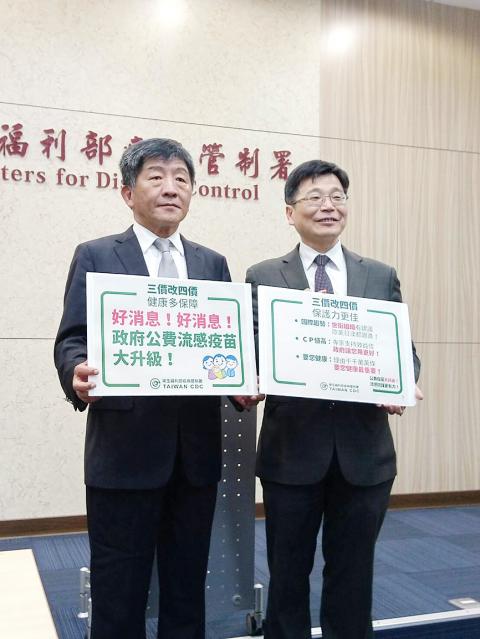
Photo: Wu Liang-yi, Taipei Times
The government has been funding a trivalent vaccine that protects against the influenza A (H1N1) strain, the influenza A (H3N2) strain and a Victoria lineage influenza B strain, Chen said.
However, CDC disease monitoring data from the past 10 years showed that two strains of the influenza type B were often circulating at the same time, he said.
Quadrivalent vaccines protect against two strains of the influenza type A strains and two strains of the influenza type B.
The WHO also recommends quadrivalent vaccines as the first choice, and they have been adopted by many European countries as well as the US, Japan, Australia and others, Chen said.
A cost-benefit analysis of flu vaccines also suggests that purchasing quadrivalent vaccines would be a better choice, he added.
The new vaccines are expected to cost about NT$1.5 billion (US$48.63 million), which is about NT$790 million higher than last year and would be paid from the CDC’s vaccination fund, CDC Director-General Chou Jih-haw (周志浩) said.
The goal this year is to administer about 6 million doses of government-funded vaccines, including 300,000 doses for children under three, Chou said.
However, as a WHO advisory body has been late in recommending an H3N2 strain for influenza vaccines this year, vaccine manufacturers have just begun producing the vaccines, so there is a chance that government-funded flu vaccinations might begin sometime after Oct. 1, Chen said.

Actor Darren Wang (王大陸) was sentenced to six months in prison, commutable to a fine, by the New Taipei District Court today for contravening the Personal Data Protection Act (個人資料保護法) in a case linked to an alleged draft-dodging scheme. Wang allegedly paid NT$3.6 million (US$114,380) to an illegal group to help him evade mandatory military service through falsified medical documents, prosecutors said. He transferred the funds to Chen Chih-ming (陳志明), the alleged mastermind of a draft-evasion ring, although he lost contact with him as he was already in detention on fraud charges, they said. Chen is accused of helping a

SECURITY: Starlink owner Elon Musk has taken pro-Beijing positions, and allowing pro-China companies to control Taiwan’s critical infrastructure is risky, a legislator said Starlink was reluctant to offer services in Taiwan because of the nation’s extremely high penetration rates in 4G and 5G services, the Ministry of Digital Affairs said yesterday. The ministry made the comments at a meeting of the legislature’s Transportation Committee, which reviewed amendments to Article 36 of the Telecommunications Management Act (電信管理法). Article 36 bans foreigners from holding more than 49 percent of shares in public telecommunications networks, while shares foreigners directly and indirectly hold are also capped at 60 percent of the total, unless specified otherwise by law. The amendments, sponsored by Chinese Nationalist Party (KMT) Legislator Ko

The eastern extension of the Taipei MRT Red Line could begin operations as early as late June, the Taipei Department of Rapid Transit Systems said yesterday. Taipei Rapid Transit Corp said it is considering offering one month of free rides on the new section to mark its opening. Construction progress on the 1.4km extension, which is to run from the current terminal Xiangshan Station to a new eastern terminal, Guangci/Fengtian Temple Station, was 90.6 percent complete by the end of last month, the department said in a report to the Taipei City Council's Transportation Committee. While construction began in October 2016 with an
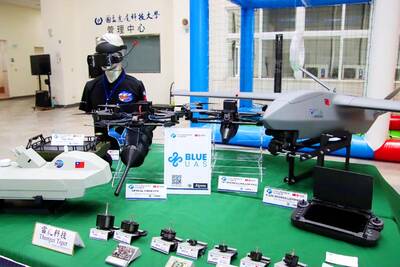
NON-RED SUPPLY: Boosting the nation’s drone industry is becoming increasingly urgent as China’s UAV dominance could become an issue in a crisis, an analyst said Taiwan’s drone exports to Europe grew 41.7-fold from 2024 to last year, with demand from Ukraine’s fight against Russian aggression the most likely driver of growth, a study showed. The Institute for Democracy, Society and Emerging Technology (DSET) in a statement on Wednesday said it found that many of Taiwan’s uncrewed aerial vehicle (UAV) sales were from Poland and the Czech Republic. These countries likely transferred the drones to Ukraine to aid it in its fight against the Russian invasion that started in 2022, it said. Despite the gains, Taiwan is not the dominant drone exporter to these markets, ranking second and fourth


 RSS
RSS