


Former national taekwondo team member Chuang Chia-chia (莊佳佳), who has been suspended from competition for two years following a controversy over missed doping tests, on Friday blamed her ban on “administrative negligence.”
The names of Universiade gold medalist Chuang, 29, and Asian Games gold medalist Huang Yun-wen (黃韻文), 24, also a taekwondo athlete, made local headlines a day after the Chinese Taipei Olympic Committee (CTOC) published at the request of the World Anti-Doping Agency (WADA) a list of athletes prohibited from competition due to failed doping tests.
On Oct. 3, 2017, Chuang was handed a two-year ban from the sport, which she said was not related to having taken banned substances, but rather her failure to show up for doping tests on three occasions.
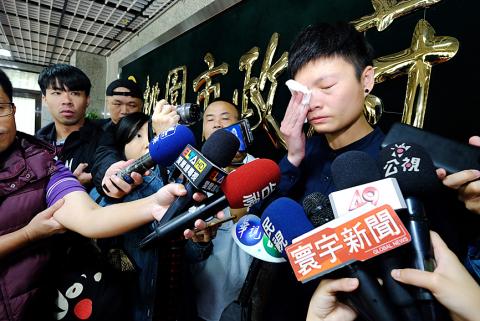
Photo: CNA
Chuang, who now serves as head of the Taoyuan Department of Sports, told a news conference that she had not been informed she was being sought by WADA, or that she was supposed to personally record her whereabouts online, until after she failed to show up for two separate tests in the first seven months of 2017.
She knew she was supposed to be tested on Sept. 15, 2017, but said that she could not take the test because she was “away.”
It was not until December last year that she became aware that she had been prohibited from competition and service as a coach, Chuang said, adding that she had not taken any banned substances.
Chuang has filed a petition to protest her innocence.
She expressed bafflement and said that she should not have to shoulder the result of “administrative negligence.”
“I’m a victim and do not want to see other athletes troubled by the same problem,” she said, asking authorities to take athletes’ doping tests seriously.
In 2017, Chuang failed to show up for doping tests on May 17, July 27 and Sept. 15, World Taekwondo Federation data showed.
In December last year, Chuang filed a petition with the federation after the Chinese Taipei Taekwondo Association (CTTA) informing her of the ban.
CTTA secretary-general Yu Kuo-chen (余國振) told a separate news conference that he has little knowledge of Chuang’s missed doping tests, because he did not take over the post until June last year, by which time it was too late to fix the problem.
Pointing out that it is the responsibility of the athletes to take the matter of doping tests seriously, even though the association is obligated to assist them, Yu said that it was Chuang’s own failure to take the tests seriously that put her on the banned list.
However, Yu did not explain why the CTTA did not notify Chuang of the ban until the end of November last year, even though WADA had published it on Oct. 3, 2017.
The list of names published by the CTOC on Thursday does not include the two taekwondo athletes because the federation had already published their names on its official Web site, the organization said.
On Wednesday, CTOC deputy secretary-general Cheng Shih-chung (鄭世忠) said that it is not the committee’s practice to publish the names of athletes banned for doping offenses, and that the information was not previously disclosed “out of respect for the privacy of the athletes” and “to spare them further harm.”
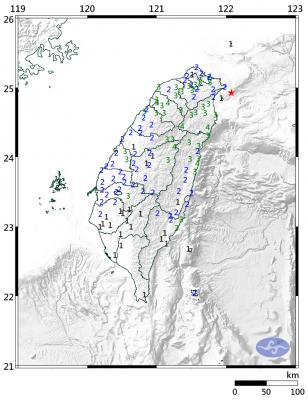
A magnitude 6.1 earthquake struck off the coast of Yilan County at 8:39pm tonight, the Central Weather Administration (CWA) said, with no immediate reports of damage or injuries. The epicenter was 38.7km east-northeast of Yilan County Hall at a focal depth of 98.3km, the CWA’s Seismological Center said. The quake’s maximum intensity, which gauges the actual physical effect of a seismic event, was a level 4 on Taiwan’s 7-tier intensity scale, the center said. That intensity level was recorded in Yilan County’s Nanao Township (南澳), Hsinchu County’s Guansi Township (關西), Nantou County’s Hehuanshan (合歡山) and Hualien County’s Yanliao (鹽寮). An intensity of 3 was
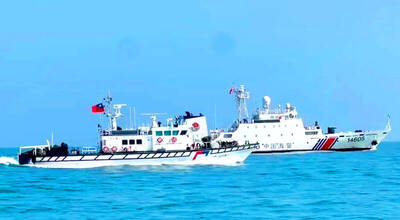
Instead of focusing solely on the threat of a full-scale military invasion, the US and its allies must prepare for a potential Chinese “quarantine” of Taiwan enforced through customs inspections, Stanford University Hoover fellow Eyck Freymann said in a Foreign Affairs article published on Wednesday. China could use various “gray zone” tactics in “reconfiguring the regional and ultimately the global economic order without a war,” said Freymann, who is also a nonresident research fellow at the US Naval War College. China might seize control of Taiwan’s links to the outside world by requiring all flights and ships entering or leaving Taiwan
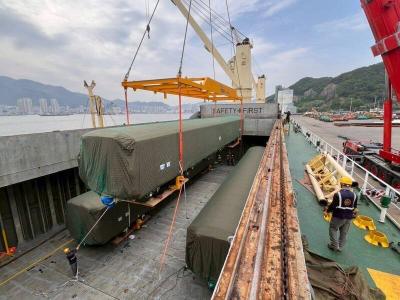
The first of 10 new high-capacity trains purchased from South Korea’s Hyundai Rotem arrived at the Port of Taipei yesterday to meet the demands of an expanding metro network, Taipei Rapid Transit Corp (TRTC) said yesterday. The train completed a three-day, 1,200km voyage from the Port of Masan in South Korea, the company said. Costing NT$590 million (US$18.79 million) each, the new six-carriage trains feature a redesigned interior based on "human-centric" transportation concepts, TRTC said. The design utilizes continuous longitudinal seating to widen the aisles and optimize passenger flow, while also upgrading passenger information displays and driving control systems for a more comfortable
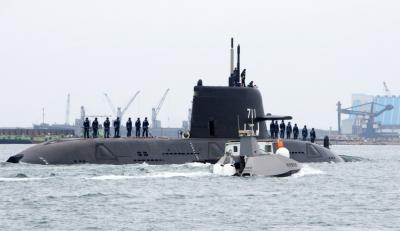
Taiwan's first indigenous defense submarine, the SS-711 Hai Kun (海鯤, or Narwhal), departed for its 13th sea trial at 7am today, marking its seventh submerged test, with delivery to the navy scheduled for July. The outing also marked its first sea deployment since President William Lai (賴清德) boarded the submarine for an inspection on March 19, drawing a crowd of military enthusiasts who gathered to show support. The submarine this morning departed port accompanied by CSBC Corp’s Endeavor Manta (奮進魔鬼魚號) uncrewed surface vessel and a navy M109 assault boat. Amid public interest in key milestones such as torpedo-launching operations and overnight submerged trials,


 RSS
RSS