


Sitting on the floor at an international airport while charging his phone using a wall outlet was “practical,” Taipei Mayor Ko Wen-je (柯文哲) said yesterday, amid criticism that he was presenting a poor image of Taiwan’s capital.
Ko was photographed sitting on a carpeted floor at Israel’s Ben Gurion Airport. The photo was posted on Ko’s Facebook page on Wednesday last week, the final day of his five-day trip to Israel, along with a few other photos from his visit.
While the post garnered more than 29,000 likes, the photo of him wearing a suit and sitting cross-legged on the floor was also criticized.
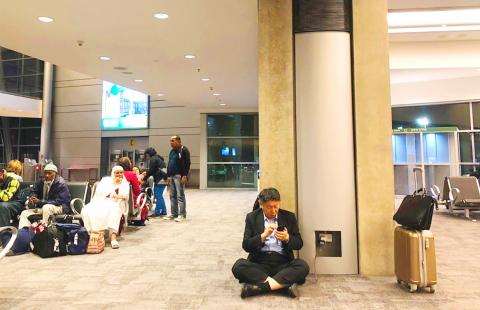
Photo taken from Facebook
The Taipei branch of Taiwan Radical Wings said Ko was “a humiliating government head” for sitting on the floor, blocking a walking area with his bag and using an outlet rather than a charging station.
Chinese Nationalist Party (KMT) Taipei City Councilor Wang Chih-ping’s (汪志冰) on Friday said that Ko’s behavior could create a negative impression of Taipei.
Wang said Ko was pretentious, pretending to be casual and close with regular Taiwanese.
His staff should have assisted him to charge the phone, she said.
Democratic Progressive Party Taipei City Councilor Wang Shih-cheng (王世堅) also called Ko pretentious, adding that there must be charging stations at the airport, so Ko was pretending to be easygoing, but as a mayor, he should practice proper international etiquette.
Ko yesterday said he is a practical person and although his staff might have had portable power banks, he would have felt bad if he had drained their devices and he did not want to bother them.
He charged it at an outlet at Taiwan Taoyuan International Airport standing up, but sat down in Israel because he thought no one would recognize him there, Ko said.
“The Taiwanese public is good at being fake and phony,” he said, adding that he hates how people expect a mayor to wear a suit and necktie, talk in a certain way and have staff members do everything.
Ko said he has seen many people sit on the floor while charging devices at Taoyuan airport, so those who say he should not have used a wall outlet are just nitpicking.


Kenting National Park service technician Yang Jien-fon (楊政峰) won a silver award in World Grand Prix Photography Awards Spring Season for his photograph of two male rat snakes intertwined in combat. Yang’s colleagues at Kenting National Park said he is a master of nature photography who has been held back by his job in civil service. The awards accept entries in all four seasons across six categories: architectural and urban photography, black-and-white and fine art photography, commercial and fashion photography, documentary and people photography, nature and experimental photography, and mobile photography. Awards are ranked according to scores and divided into platinum, gold and

More than half of the bamboo vipers captured in Tainan in the past few years were found in the city’s Sinhua District (新化), while other districts had smaller catches or none at all. Every year, Tainan captures about 6,000 snakes which have made their way into people’s homes. Of the six major venomous snakes in Taiwan, the cobra, the many-banded krait, the brown-spotted pit viper and the bamboo viper are the most frequently captured. The high concentration of bamboo vipers captured in Sinhua District is puzzling. Tainan Agriculture Bureau Forestry and Nature Conservation Division head Chu Chien-ming (朱健明) earlier this week said that the

The first bluefin tuna of the season, brought to shore in Pingtung County and weighing 190kg, was yesterday auctioned for NT$10,600 (US$333.5) per kilogram, setting a record high for the local market. The auction was held at the fish market in Donggang Fishing Harbor, where the Siaoliouciou Island-registered fishing vessel Fu Yu Ching No. 2 delivered the “Pingtung First Tuna” it had caught for bidding. Bidding was intense, and the tuna was ultimately jointly purchased by a local restaurant and a local company for NT$10,600 per kilogram — NT$300 ,more than last year — for a total of NT$2.014 million. The 67-year-old skipper
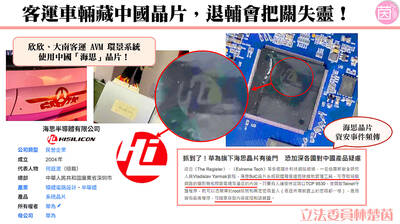
BREACH OF CONTRACT: The bus operators would seek compensation and have demanded that the manufacturer replace the chips with ones that meet regulations Two bus operators found to be using buses with China-made chips are to demand that the original manufacturers replace the systems and provide compensation for breach of contract, the Veterans Affairs Council said yesterday. Democratic Progressive Party Legislator Michelle Lin (林楚茵) yesterday said that Da Nan Bus Co and Shin-Shin Bus Co Ltd have fielded a total of 82 buses that are using Chinese chips. The bus models were made by Tron-E, while the systems provider was CYE Electronics, Lin said. Lin alleged that the buses were using chips manufactured by Huawei subsidiary HiSilicon Co, which presents a national security risk if the


 RSS
RSS