


While legislators are known for their politics, many pursue hobbies that have led to interesting collections.
Several Democratic Progressive Party (DPP) and Chinese Nationalist Party (KMT) lawmakers shared the stories behind their collections with the Liberty Times (sister newspaper of the Taipei Times) recently.
DPP Legislator Lu Sun-ling (呂孫綾), who at 30 is currently the nation’s youngest lawmaker, often spends her free time assembling miniature models of famous landmarks, comic-book characters and military items.

Photo: Huang Hsin-po, Taipei Times
Her hobby not only helps her relax and improves her organizational skills, but serves to remind her that not to omit a single component when tackling any endeavor, she said.
The current favorite from her collection is a model of the CM-32 armored vehicle — commonly known as the “Clouded Leopard.”
“When I first started [in politics], people doubted my ability to succeed in a harsh male-dominated political environment, but I have always felt that as a younger woman I can offer a unique perspective,” she said.

Photo courtesy of Hsu Shu-hua’s office
Her first move as lawmaker was to suggest that the Ministry of National Defense’s Youth Daily News promote sales of the Clouded Leopard model as a way of helping it engage with the public, she said.
The model has proven popular, which she took as confirmation of her ability to succeed in politics, and why she likes it so much, she said.
Her DPP colleague, Cheng Yun-peng (鄭運鵬), has been called “the legislature’s biggest nerd” due to his fascination with US comic book characters and Japanese anime.

Photo: Huang Hsin-po, Taipei Times
One of Cheng’s hobbies is drawing anime-inspired sketches, and his office at the legislature is filled with collectibles from anime films and series, including toys from the popular Gundam series and a robot form of Sanrio’s Hello Kitty character.
Cheng also has models based on Spiderman and Harley Quinn — characters from DC Comics.
“Actually, I am afraid I would be in trouble with my wife if she knew I bought so much, so I keep them at the office,” Cheng said.
As a child, he loved Japanese manga, but could not afford to buy them and so could only read them on occasion by renting issues from comic book shops, he said.
After he began working, he used his salary to start his own collection of manga and collectibles, he said.
His favorite items are from Mazinger Z anime series, as well as its spin-offs, Cheng said.
KMT Legislator Hsu Shu-hua (許淑華) likes to collecting Smurf figurines and other collectibles from Belgian comic franchise.
Hsu, who has more than 600 figurines in her collection, began collecting 10 years ago when she saw Smurfs collectibles at a shop in Taichung’s Fengjia Commercial District (逢甲商圈).
The figurines brought back childhood memories of watching The Smurfs, she said.
She has since traveled to Belgium, where she bought more figurines, Hsu said.
KMT Legislator John Wu’s (吳志揚) collection reflects his passion for sports, which is really no surprise as he also serves as Chinese Professional Baseball League (CPBL) commissioner.
He said the item that was hardest to acquire is a baseball signed by pitcher Wang Chien-ming (王建民), who played for teams in Taiwan as well as in Major League Baseball.
He flew to the east coast of the US in 2015 to visit Wang, who had been keeping a low profile after sustaining an injury, only to discover that the player had left for Seattle after being signed by the Mariners, Wu said.
He immediately boarded another plane for Seattle and was eventually able to meet Wang and get a signed ball, the lawmaker said.
Among his other favorite items are a basketball that looks like a baseball, which was used by Taiwanese-American Jeremy Lin (林書豪) during an NBA Central Division game in 2016, as well as dirt from the Hsinchu CKS Baseball Stadium, collected before it was demolished last year, he said.
However, a signed glove and ball from legendary baseball player Sadaharu Oh (王貞治) are his most prized possessions, Wu said.
“I had to go through a number of channels to get these items,” he said.
DPP Legislator Wang Ting-yu (王定宇) prides himself on his collection of patrol caps from military bases around the nation and abroad.
However, the caps are less of a collection and more of a reminder of his base visits, he said.
The most memorable cap is one that he got when he visited Republic of China Air Force pilots training at Luke Air Force Base in Arizona, he said.
“I was drinking and chatting with [members of] the US’ 21st Fighter Squadron in 40 degree Celsius temperatures in the middle of the desert,” Wang said, adding that he helped get a karaoke machine for the base at the squadron’s request.
He once flew to Itu Abu Island (Taiping Island, 太平島) to visit military personnel stationed there, he said.
He was able to help negotiate permission last year for family members of the personnel stationed on the island to visit them during the Mid-Autumn Festival, when the relatives were able to stay overnight in the barracks there, Wang said.
Looking at the hats makes him think of the brave young officers guarding their posts, Wang said.
“Every hat represents emotions and responsibility,” he said.
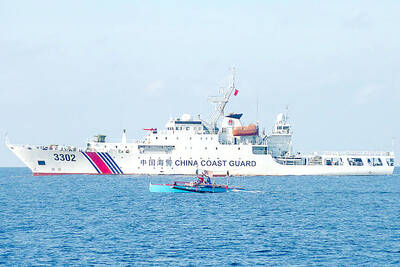
EXPANSIONIST: China deploys an average of 40 to 50 warships and coast guard vessels daily in the South China Sea, despite pledges not to militarize the region, an official said China is attempting to expand its influence across the First Island Chain and increase pressure on Japan by sending coast guard vessels into waters off of Taiwan under the pretext of maritime negotiations with Japan and the Philippines, a national security official said yesterday. China’s recent actions in the waters east of Taiwan and Japan and the Philippines’ exclusive economic zones (EEZ) are attempts to establish dominance in First Island Chain waters, said the official who declined to be named, adding that this is “expansion disguised as law enforcement.” Framing China’s actions solely as a cross-strait issue is a serious misjudgment that
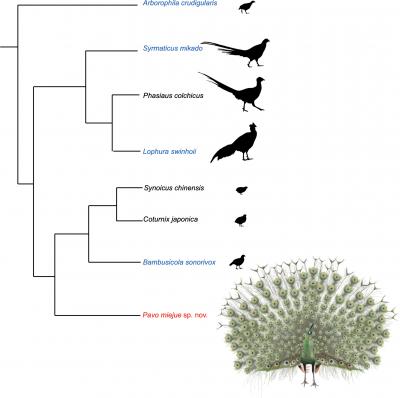
Through analyzing fossil evidence, a research team at National Taiwan University (NTU) discovered the largest endemic bird to have lived in Taiwan, naming it Pavo miejue, or extinct peafowl (滅絕孔雀). The Mikado pheasant, which is printed on the back of the NT$1,000 bank note, was previously believed to be the biggest endemic bird to Taiwan. The research team’s findings suggest that Pavo miejue lived during the Pleistocene epoch tens of thousands of years ago. It is the first endemic extinct bird species discovered and formally named in Taiwan. The study was coauthored by NTU Institute of Ecology and Evolutionary Biology professor Tsai Cheng-hsiu (蔡政修),
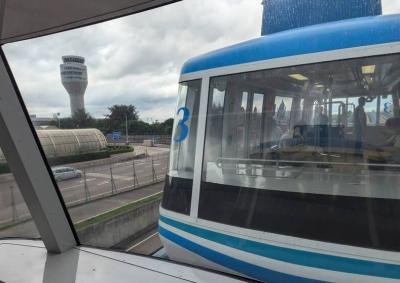
Taiwan Taoyuan International Airport is to suspend its automated Skytrain service connecting Terminal 1 and Terminal 2 starting on July 1 to facilitate connection works for the upcoming Terminal 3, the airport operator said today. Passengers and staff who need to travel between the two terminals after the suspension can instead use the Taoyuan MRT or the airport's 24-hour shuttle bus service, Taoyuan International Airport Corp said. The Taoyuan MRT Airport Line directly links the two terminals, while the shuttle buses are to operate around the clock, the company added. The Skytrain provides free transportation between the airport’s two terminals for travelers and
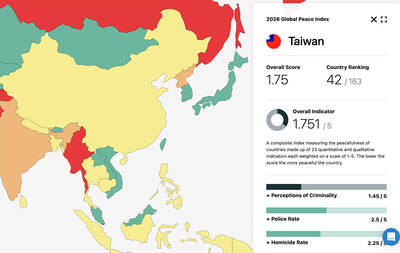
Taiwan ranked 42nd in terms of peacefulness among 163 countries, down five places from last year, according to this year’s Global Peace Index. With an overall score of 1.751, Taiwan dropped from 37th last year, the report published by the global Institute for Economics and Peace showed. The overall score measures a country’s level of peacefulness using 23 quantitative and qualitative indicators across three domains — ongoing domestic and international conflict, societal safety and security, and militarization. While Taiwan ranked 42nd worldwide, it was listed in ninth place among the 19 Asian-Pacific countries in the report, after New Zealand, Singapore, Japan, Malaysia,


 RSS
RSS