


For many people, taking part in the International Cooperation and Development Fund’s volunteer programs has turned out to be a life-changing experience. While some found new carrier opportunities, others gained new perspectives on life.
Cheng Kun-mu (鄭坤木), who manages the fund’s project in Nicaragua, said that he initially joined the agricultural volunteer program in Panama when he completed his graduate degree focusing on plant pests and diseases more than a decade ago.
While he was working in a mountain town near the border, coffee bean prices slumped and he decided to help local farmers change their principal agricultural export from coffee beans to bananas.
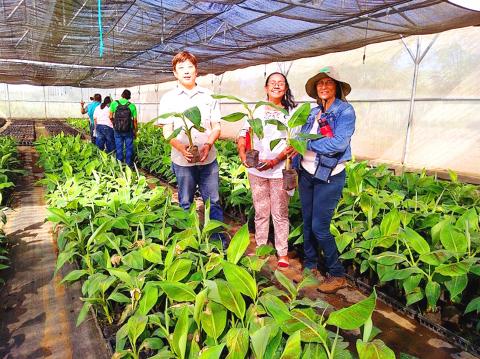
Photo courtesy of Cheng Kun-mu
Using his expertise in pest and disease control, he helped more than 60 farmers manage their new banana plantations.
About a year later, with the help of the local agriculture department, the town refined the quality of its bananas and exported them.
The project was later emulated in Nicaragua, one of Taiwan’s diplomatic allies, where it was received with equal enthusiasm.
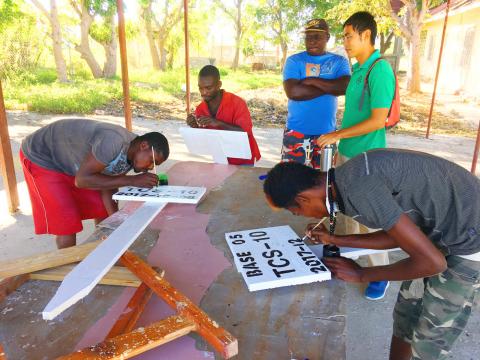
Photo courtesy of Yeh Juei-en
After the initial excitement fades, volunteers committed to long-term programs might experience a period of confusion, during which they might doubt their self-worth, Cheng said.
However, that was when he learned to look at things from other people’s perspectives, he said.
“Instead of considering myself an expert only there to help them, I learned to see myself as their friend, understand how they feel as well as identify their problems,” Cheng said.
He encouraged fellow Taiwanese to participate in volunteer work abroad to promote Taiwan.
“If you are willing to do that, there would be more people who know about Taiwan and support it,” he said.
Taipei Medical University Hospital International Healthcare Center vice executive officer Yu Ying-ju (尤櫻儒) also had a unique experience when she took part in the fund’s international volunteer program.
“The volunteer experience was life-changing for me,” she said.
She did not grow up dreaming of living abroad and planned to live a stable life, Yu said.
However, in 2011, she joined a volunteer program in Palau after having worked as a nurse for six years, hoping to help more people with the skills and experience she had gained.
She had come across an advertisement by the fund and remembered what a former schoolmate had told her about being a volunteer, Yu said.
In Palau, she was assigned to an elementary school with scarce resources and found that the students only had canned meat for lunch.
Concerned that a lack of vegetables and variety in their diets could lead to malnutrition, obesity and other health problems, she initiated a program with the fund’s agriculture experts to grow vegetables on campus.
They improved the soil on campus and grew vegetables to ensure that the students kept a more balanced diet.
The program, which was well-received, was later introduced to other schools.
Thank to the program, some of the students developed an interest in agriculture and said that they wanted to learn to grow vegetables in Taiwan, she said.
After leaving Palau, Yu studied nursing in the UK, before visiting Burkina Faso for an international healthcare project.
Now she is pursuing a doctoral degree in public health.
Many years after leaving Palau, she revisited it once and saw that the program that she initiated was still ongoing, Yu said.
Providing medical assistance to other nations is a great way of promoting Taiwan, she said.
“If you ask the children what their favorite nation is, they would definitely tell you it is Taiwan,” she said.

Taiwan must first strengthen its own national defense to deter a potential invasion by China as cross-strait tensions continue to rise, multiple European lawmakers said on Friday. In a media interview in Taipei marking the conclusion of an eight-member European parliamentary delegation’s six-day visit to Taiwan, the lawmakers urged Taipei to remain vigilant and increase defense spending. “All those who claim they want to protect you actually want to conquer you,” Ukrainian lawmaker Serhii Soboliev said when asked what lessons Taiwan could draw from Russia’s invasion of Ukraine. Soboliev described the Kremlin as a “new fascist Nazi regime” that justified

The US House of Representatives yesterday passed the PROTECT Taiwan Act, which stipulates that Washington would exclude China from participating in major global financial organizations if its actions directly threaten Taiwan’s security. The bill, proposed by Republican US Representative Frank Lucas, passed with 395 votes in favor and two against. It stipulates that if China’s actions pose any threat to Taiwan’s security, economic or social systems, the US would, “to the maximum extent practicable,” exclude China from international financial institutions, including the G20, the Bank for International Settlements and the Financial Stability Board. The bill makes it clear that China

‘T-DOME’: IBCS would increase Taiwan’s defense capabilities, enabling air defense units to use data from any sensor system and cut reaction time, a defense official said A defense official yesterday said that a purported new arms sale the US is assembling for Taiwan likely includes Integrated Battle Command Systems (IBCS). The anonymous official’s comments came hours after the Financial Times (FT) reported that Washington is preparing a US$20 billion arms sale encompassing “Patriot missiles and other weapons,” citing eight sources. The Taiwanese official said the IBCS is an advanced command and control system that would play a key role in President William Lai’s (賴清德) flagship defense program, the “T-Dome,” an integrated air defense network to counter ballistic missiles and other threats. The IBCS would increase Taiwan’s

NOMINAL NEWLYWEDS: A man’s family and his wife — his long-term caregiver — are engaged in a legal dogfight over the propriety and validity of the recent union A centenarian’s marriage to his caregiver unbeknownst to his children has prompted legal action, as the caregiver accuses the man’s children of violating her personal liberty and damaging her reputation, while the children have sought a legal option to have the marriage annulled. According to sources, the 102-year-old man surnamed Wang (王) lives in Taipei’s Zhongshan District (中山) and previously worked as a land registration agent. Wang reportedly owns multiple properties and parcels of land worth several hundred million New Taiwan dollars and has ten children. His caregiver, a 69-year-old surnamed Lai (賴), has been caring for him since about 1999,


 RSS
RSS