


The National Communications Commission (NCC) yesterday said it fined CtiTV News NT$200,000 (US$6,487) for failing to check the facts when reporting about then-Kaohsiung mayoral candidate Chen Chi-mai’s (陳其邁) rally in Cishan District (旗山) in November last year.
It was the first time since the Satellite Broadcasting Act (衛星廣播電視法) was amended in 2016 that the commission invoked Article 27, Paragraph 3, Subparagraph 4, which requires broadcasting companies to adhere to the principle of fact-checking, to penalize broadcast media.
The controversy over CtiTV’s report began when Democratic Progressive Party (DPP) Legislator Chiu Yi-ying (邱議瑩) hosted a campaign rally for Chen on Nov.11.
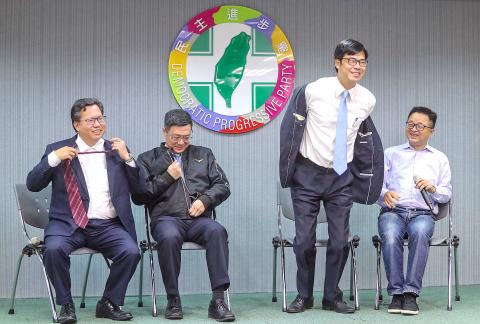
Photo: CNA
Toward the end of the rally, Chiu, speaking in Hoklo (commonly known as Taiwanese) thanked her supporters for staying for so long into the rally, but the news station reported that Chiu asked people not to leave.
Chiu later filed a complaint with the NCC, saying that CtiTV’s misinterpretation of her announcement affected the tone of Chen’s campaign.
The content was reviewed by an independent committee formed by third-party experts, NCC spokesman Wong Po-tsung (翁柏宗) said.
The committee found that the broadcast deliberately twisted Chiu’s statement and misled the audience, he said, adding that CtiTV did not run a correction.
Eastern Broadcasting Co (EBC) was also fined NT$200,000 for disseminating false information about African swine fever, which the commission said could undermine efforts to keep the disease out of the nation.
The committee ruled that EBC News breached Article 27, Paragraph 3, Subparagraph 3 of the act, which bans satellite broadcasting companies from producing content that could disrupt public order and adversely affect good social customs, Wong said.
EBC Evening News on Dec.13 reported that people who purchased products on the Chinese e-commerce site Taobao (淘寶) were given pork sausages as gifts and said that the sausages could be contaminated with the disease, the committee said.
The program’s headline suggested that people thoroughly cook the sausages before eating them or throw them away, but that is not the correct way to handle pork from disease-affected areas as suggested by the Bureau of Animal and Plant Health Inspection and Quarantine, the commission said.
Under the act, broadcasting companies can be fined NT$200,000 to NT$2 million for breaching the subparagraphs, Wong said.
However, EBC News changed the headline of the report after its news department identified the problems with it, Wong said, adding that the commission therefore handed it a more lenient fine.
Regarding the controversies caused by last year’s broadcast of commercials produced by the Happiness of Our Next Generation Alliance, a group opposed to same-sex marriage, Wong said that the independent committee told the commission that it should remind all broadcast media business associations to pay attention to diversity when broadcasting commercials.
The commission would also hold a seminar this year to discuss how advertisements could be more balanced in reflecting public opinion on different issues.
In related news, the commission yesterday passed a draft for a proposed media diversity preservation and monopolization prevention act, which is soon to be submitted to the Executive Yuan for review.
The draft act would ban mergers among terrestrial television services, the commission said, adding that mergers among satellite broadcasters and cable broadcasters would be banned if any party holds more than 30 percent of the market share.
The bill also includes clauses that prohibit cable television systems from engaging in cross-media integration if they own more than 20 percent of the nation’s cable service subscribers.
A broadcasting company can own no more than three media outlets, it said.
For cases that do not fall into any of the stated categories, the commission would review media mergers with a list of criteria and ensure that they do not compromise the public interest, the commission said.
Management at financial holding companies would also be barred from holding more than 10 percent of a media company’s shares or directly or indirectly controlling its personnel, finance and operations, it said.
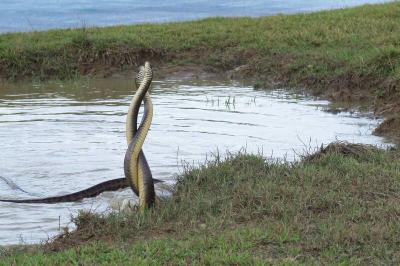
Kenting National Park service technician Yang Jien-fon (楊政峰) won a silver award in World Grand Prix Photography Awards Spring Season for his photograph of two male rat snakes intertwined in combat. Yang’s colleagues at Kenting National Park said he is a master of nature photography who has been held back by his job in civil service. The awards accept entries in all four seasons across six categories: architectural and urban photography, black-and-white and fine art photography, commercial and fashion photography, documentary and people photography, nature and experimental photography, and mobile photography. Awards are ranked according to scores and divided into platinum, gold and

The Chinese Nationalist Party (KMT) caucus yesterday said it opposes the introduction of migrant workers from India until a mechanism is in place to prevent workers from absconding. Minister of Labor Hung Sun-han (洪申翰) on Thursday told the Legislative Yuan that the first group of migrant workers from India could be introduced as early as this year, as part of a government program. The caucus’ opposition to the policy is based on the assessment that “the risk is too high,” KMT caucus secretary-general Lin Pei-hsiang (林沛祥) said. Taiwan has a serious and long-standing problem of migrant workers absconding from their contracts, indicating that

SPACE VETERAN: Kjell N. Lindgren, who helps lead NASA’s human spaceflight missions, has been on two expeditions on the ISS and has spent 311 days in space Taiwan-born US astronaut Kjell N. Lindgren is to visit Taiwan to promote technological partnerships through one of the programs organized by the US for its 250th national anniversary. Lindgren would be in Taiwan from Tuesday to Saturday next week as part of the US Bureau of Educational and Cultural Affairs’ US Speaker Program, organized to celebrate the 250th anniversary of the signing of the Declaration of Independence, the American Institute in Taiwan (AIT) said in a statement yesterday. Lindgren plans to engage with key leaders across the nation “to advance cutting-edge technological partnerships and inspire the next generation of scientists and engineers,”

TRADE-OFF: Beijing seeks to trade a bowl of tempura for a Chinese delicacy, an official said, while another said its promises were attempts to interfere in the polls The government must carefully consider the national security implications of building a bridge connecting Kinmen County and Xiamen, China, the Public Construction Commission (PCC) said yesterday. PCC Commissioner Derek Chen (陳金德), who is also a minister without portfolio, made the remarks in a meeting of the legislature’s Transportation Committee, after Democratic Progressive Party Legislator Hsu Fu-kuei (徐富癸) asked about China’s proposal of new infrastructure projects to further connect Kinmen and Lienchiang (Matsu) counties with Xiamen. China unveiled the bridge plan, along with nine other policies for Taiwan, on Sunday, the last day of Chinese Nationalist Party (KMT) Chairwoman Cheng Li-wun’s (鄭麗文) visit


 RSS
RSS