


Historians on Saturday called on the Hsinchu County Government to designate an etched rock at Emei Elementary School in Hsinchu County as a historical artifact, saying that the 91-year-old anniversary marker has important historical value.
The monument was set up in 1928 for the school’s 30th anniversary, but had been left untended until it was rediscovered 20 years ago, covered in moss and weeds.
The Hsinchu County Bureau of Cultural Affairs said the stone monument was inspected about 10 years ago, while its Cultural Heritage Division makes non-scheduled visits to check its condition from time to time and the school does a good job of preserving it.
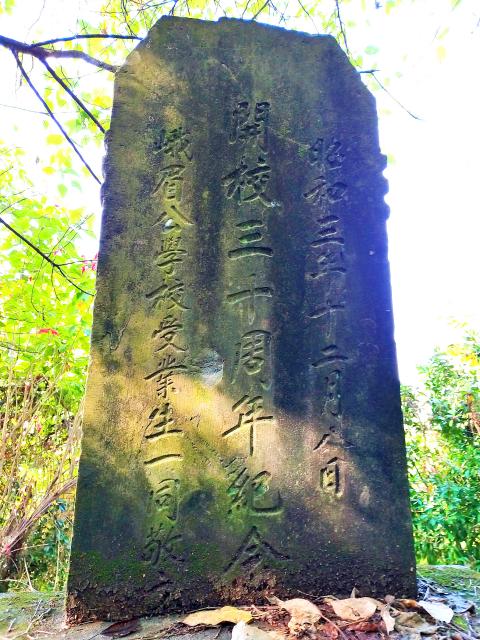
Photo: Liao Hsieh-ju, Taipei Times
The division said that requests to designate it as a historical monument would be reviewed in accordance with the Cultural Heritage Preservation Act (文化資產保存法).
At the school’s 120th anniversary in October last year, Chiang Hsin-chi (姜信淇), a retired former principal of the school, said he found a photograph of the monument while preparing for the school’s 100th anniversary in 1998.
None of the teachers knew about the monument at the time, he said.
He found the monument among bushes and weeds on a hill within the school grounds, and elderly residents told him that it was erected in 1928 during the Japanese colonial period to celebrate the 30th anniversary of the school’s establishment, as well as commemorate its founding principal, Ujiie Teiji, and a teacher, Chiang said.
The teacher, Sung Ching (宋進), was memorialized because he brought more than 30 students from a private school he previously ran to Emei, boosting its low student numbers, Chiang said.
Records showed that when Taiwan lost its UN seat in 1971, Taipei developed animosity over Japan’s recognition of Beijing as the sole seat of the Chinese government, so it ordered that all monuments or public facilities that portrayed “the superiority of Japanese imperialism” should be eliminated, he said.
The Emei monument might have survived because the weeds covered it and it had been forgotten for many years, he said.
The stone monument was toppled in the 1960s due to vibrations from work by Taiwan Water Corp on a nearby plant, Chiang said.
Restoring the monument was coordinated by alumnus Yang Mu-huo (楊木火), who worked for the utility at the time, but a portion of the monument was destroyed in the process, Chiang said.
A platform for a flag pole and stone steps are near the monument, suggesting that the site could have been used for morning devotionals to the Japanese emperor of the time, Chiang said, adding that its location in the eastern section of the grounds supported this idea.

Taiwanese can file complaints with the Tourism Administration to report travel agencies if their activities caused termination of a person’s citizenship, Mainland Affairs Council Minister Chiu Chui-cheng (邱垂正) said yesterday, after a podcaster highlighted a case in which a person’s citizenship was canceled for receiving a single-use Chinese passport to enter Russia. The council is aware of incidents in which people who signed up through Chinese travel agencies for tours of Russia were told they could obtain Russian visas and fast-track border clearance, Chiu told reporters on the sidelines of an event in Taipei. However, the travel agencies actually applied
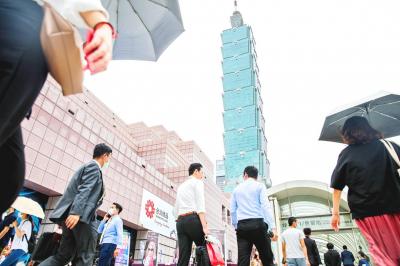
Japanese footwear brand Onitsuka Tiger today issued a public apology and said it has suspended an employee amid allegations that the staff member discriminated against a Vietnamese customer at its Taipei 101 store. Posting on the social media platform Threads yesterday, a user said that an employee at the store said that “those shoes are very expensive” when her friend, who is a migrant worker from Vietnam, asked for assistance. The employee then ignored her until she asked again, to which she replied: "We don't have a size 37." The post had amassed nearly 26,000 likes and 916 comments as of this

New measures aimed at making Taiwan more attractive to foreign professionals came into effect this month, the National Development Council said yesterday. Among the changes, international students at Taiwanese universities would be able to work in Taiwan without a work permit in the two years after they graduate, explainer materials provided by the council said. In addition, foreign nationals who graduated from one of the world’s top 200 universities within the past five years can also apply for a two-year open work permit. Previously, those graduates would have needed to apply for a work permit using point-based criteria or have a Taiwanese company
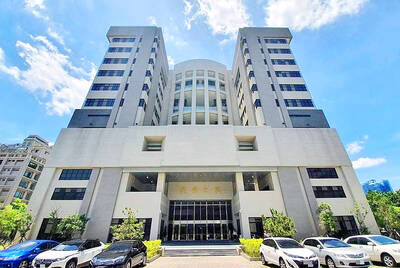
The Shilin District Prosecutors’ Office yesterday indicted two Taiwanese and issued a wanted notice for Pete Liu (劉作虎), founder of Shenzhen-based smartphone manufacturer OnePlus Technology Co (萬普拉斯科技), for allegedly contravening the Act Governing Relations Between the People of the Taiwan Area and the Mainland Area (臺灣地區與大陸地區人民關係條例) by poaching 70 engineers in Taiwan. Liu allegedly traveled to Taiwan at the end of 2014 and met with a Taiwanese man surnamed Lin (林) to discuss establishing a mobile software research and development (R&D) team in Taiwan, prosecutors said. Without approval from the government, Lin, following Liu’s instructions, recruited more than 70 software


 RSS
RSS