


The Taiwan Catholic Foundation of Alzheimer’s Disease and Related Dementia has released three videos showing how people with dementia and their families have gone from feeling lost to accepting treatment and living full lives.
Benign interaction with friends and family could help patients change their perspective on their condition and help ameliorate the symptoms of dementia, foundation CEO Teng Shih-hsiung (鄧世雄) said.
One of the videos features 91-year-old Lin Tien-fa (林添發), whose family noticed that his condition began with forgetting his hat or documents, until he even forgot his friend’s phone number while dialing, said Lin’s daughter-in-law, Yang Chun-cha (楊春茶).
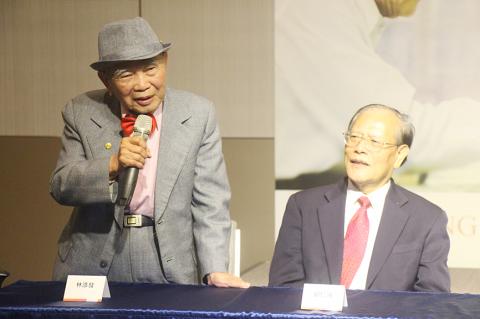
Photo: CNA
The family took Lin to see a doctor, who about 17 years ago diagnosed him with dementia, Yang said, adding that at the time of his diagnosis, Lin’s mental facilities regressed to the equivalent of a seven-year-old.
Lin said he was panicked after receiving the diagnosis, but decided to rehabilitate his mental faculties by teaching other elderly people in his community how to speak Japanese, which he still remembered, as he had learned it as a child.
Using his memory to prepare lessons every day helped his condition, as did regular exercise through taichi and half-hour strolls around his house, Lin said, adding that participating in social gatherings as often as possible also helped.
Lin said his desire to help others might also have helped him combat the condition, as he is helping to establish an elderly care center, with assistance from the Hondao Senior Citizens Welfare Foundation of Sanhe Community in Chiayi County’s Dalin Township (大林).
He has also sought further education and this year received a master’s degree, Lin added.
Another video featured 70-year-old Liu Jen-hai (劉仁海), who was diagnosed with dementia in 2013 after he was unable to find a nearby parking lot for nearly five hours when taking his wife, Yang Chu-feng (楊菊鳳), to a hospital.
Yang Chu-feng said that their lives were turned upside down by the news and relations between them became tense.
Liu at first was unable to accept the news, and constantly asked the same question multiple times and was unable to find his way home, she said.
The couple attended many events, which helped lessen the tension between them, she said, adding that Liu now arranges many activities that require the use of his brain.
“I know that I have dementia, but this would hold no sway over how I live my life and I fully intend to help others,” Liu said.
“Those of us with dementia should not be afraid,” he added.
The last video features the story of former teacher Pai Wan-chih (白婉芝).
Pai said that she was thunderstruck when she received her diagnosis and closed herself off from others for six months.
However, she realized that she must change her perception of the condition if she wanted to take care of herself, Pai said, adding that she opened herself to the world again, while carefully planning her diet and exercise.
“Dementia is not contagious and people should not be afraid,” Pai said, adding that it is a natural part of life.
“So what if you forget something? People must learn to live with such conditions — only then will it become better,” Pai said, adding that she is thankful to many of her friends for giving her hope.

A strong continental cold air mass is to bring pollutants to Taiwan from tomorrow, the Ministry of Environment said today, as it issued an “orange” air quality alert for most of the country. All of Taiwan except for Hualien and Taitung counties is to be under an “orange” air quality alert tomorrow, indicating air quality that is unhealthy for sensitive groups. In China, areas from Shandong to Shanghai have been enveloped in haze since Saturday, the ministry said in a news release. Yesterday, hourly concentrations of PM2.5 in these areas ranged from 65 to 160 micrograms per cubic meter (mg/m³), and pollutants were
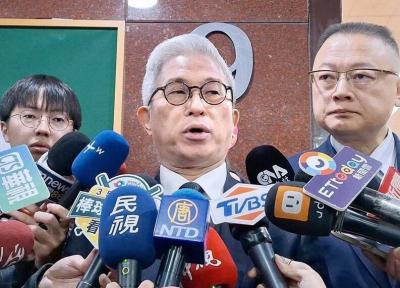
Taiwan’s armed forces have established response protocols for a wide range of sudden contingencies, including the “Wan Chun Plan” to protect the head of state, the Ministry of Defense (MND) said today. After US President Donald Trump on Saturday launched a series of airstrikes in Venezuela and kidnapped Venezuelan President Nicolas Maduro, concerns have been raised as to whether China would launch a similar “decapitation strike” on Taiwan. The armed forces regularly coordinate with relevant agencies and practice drills to ensure preparedness for a wide range of scenarios, Vice Minister of National Defense Hsu Szu-chien (徐斯儉) told reporters before a

EVA Airways on Saturday said that it had suspended a pilot and opened an investigation after he allegedly lost his temper and punched the first officer several times as their plane was taxiing before takeoff at Los Angeles International Airport. According to a report published on Thursday by The Reporter, the incident occurred after the flight’s Malaysian first officer tried to warn the Taiwanese pilot, surnamed Wen (文), that he was taxiing faster than the speed limit of 30 knots (55.6kph). After alerting the pilot several times without response, the first officer manually applied the brakes in accordance with standard operating
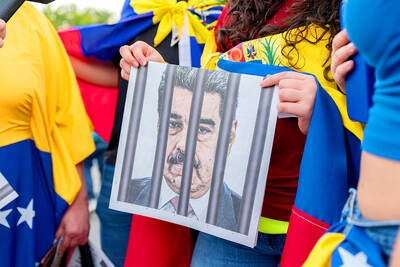
NOT AN OPENING: Trump’s violation of international law does not affect China’s consideration in attacking Taiwan; Beijing lacks capability, not precedent, an official said Taiwanese officials see the US’ capture of the president of Venezuela as a powerful deterrent to Beijing’s aggression and a timely reminder of the US’ ability to defeat militaries equipped with Chinese-made weapons. The strikes that toppled Venezuelan President Nicolas Maduro signaled to authoritarian leaders, including Chinese President Xi Jinping (習近平), US President Donald Trump’s willingness to use military might for international affairs core to US interests, one senior official in Taipei’s security circle said. That reassured Taiwan, the person said. Taipei has also dismissed the idea that Trump’s apparent violation of international law could embolden Beijing, said the official, who was not


 RSS
RSS