


Lawyers representing Yu Chen-chung (尤振仲), conductor of Puyuma Express train No. 6432 that derailed on Oct. 21 in Yilan County, yesterday said that Yu rejected the government’s claim that his negligence caused the train to speed, which in turn caused the deadly incident.
Yu said that there are differences between his account and two reports released by an Executive Yuan investigative task force last month and earlier this month, which said that a series of mechanical malfunctions on the train and poor troubleshooting by the conductor and the Taiwan Railways Administration (TRA) dispatch control room were to blame for the derailment near Sinma Station (新馬) that killed 18 people and injured 273.
“I do not accept the charge that human negligence caused the train to speed,” a statement issued by Yu through his lawyers read, after the driver was advised by a doctor to avoid further public exposure.
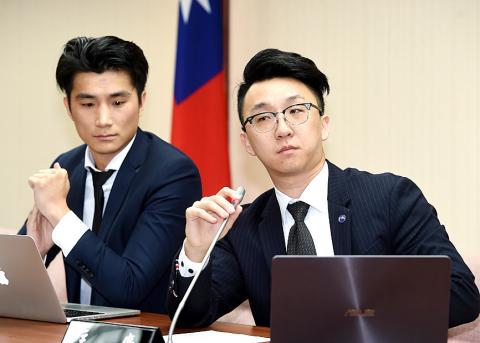
Photo: Fang Pin-chao, Taipei Times
This month’s report said that Yu because of power problems turned off the automatic train protection (ATP) system that prevents the train from speeding after it left Dasi Train Station (大溪), 44km north of Sinma.
Yu did not deny deactivating the ATP, but said that the report is incorrect in stating that he had been speeding and “left the speed command gear at 140kph” after the train left Luodong Station (羅東), 9km north of Sinma.
The train continued to travel at that speed, nearly double the limit, as it entered a curve near Sinma, the report said.
However, Yu said that he remembers keeping the speed at about 82kph after the train passed Wulaokeng Bridge (武荖坑橋), about 1km north of Sinma.
“Yu said he did not speed at any moment during the journey,” said his lawyer, Chen Hsiang-chuan (陳湘傳), adding that it did not occur to Yu that the train might be speeding because he had not increased the speed himself.
Some time after the train passed Luodong Station, Yu made a final attempt to reset the air compressors, which he and train dispatchers considered to be the cause of the power problems.
He then found that the train was speeding and attempted to stop it, said another of Yu’s lawyers, Alex Yen (閻道至).
The report made no mention of Yu applying the brakes, Yen said, while declining to give the exact sequence of Yu’s efforts to slow down the train or his awareness of it speeding, because they are “part of the communication records not released by the authorities.”
The only thing that is certain is that “Yu had very little time to respond properly after realizing that the train was speeding,” Yen said.
Yen urged the task force to release audio communication records and investigators’ interviews with Yu.
The report includes text communication records, but no post-accident accounts from Yu.

The military has spotted two Chinese warships operating in waters near Penghu County in the Taiwan Strait and sent its own naval and air forces to monitor the vessels, the Ministry of National Defense (MND) said. Beijing sends warships and warplanes into the waters and skies around Taiwan on an almost daily basis, drawing condemnation from Taipei. While the ministry offers daily updates on the locations of Chinese military aircraft, it only rarely gives details of where Chinese warships are operating, generally only when it detects aircraft carriers, as happened last week. A Chinese destroyer and a frigate entered waters to the southwest

A magnitude 6.1 earthquake struck off the coast of Yilan County at 8:39pm tonight, the Central Weather Administration (CWA) said, with no immediate reports of damage or injuries. The epicenter was 38.7km east-northeast of Yilan County Hall at a focal depth of 98.3km, the CWA’s Seismological Center said. The quake’s maximum intensity, which gauges the actual physical effect of a seismic event, was a level 4 on Taiwan’s 7-tier intensity scale, the center said. That intensity level was recorded in Yilan County’s Nanao Township (南澳), Hsinchu County’s Guansi Township (關西), Nantou County’s Hehuanshan (合歡山) and Hualien County’s Yanliao (鹽寮). An intensity of 3 was
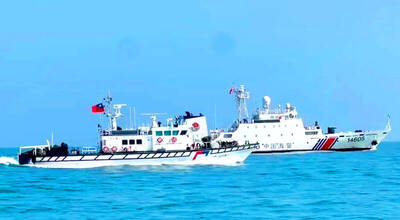
Instead of focusing solely on the threat of a full-scale military invasion, the US and its allies must prepare for a potential Chinese “quarantine” of Taiwan enforced through customs inspections, Stanford University Hoover fellow Eyck Freymann said in a Foreign Affairs article published on Wednesday. China could use various “gray zone” tactics in “reconfiguring the regional and ultimately the global economic order without a war,” said Freymann, who is also a nonresident research fellow at the US Naval War College. China might seize control of Taiwan’s links to the outside world by requiring all flights and ships entering or leaving Taiwan
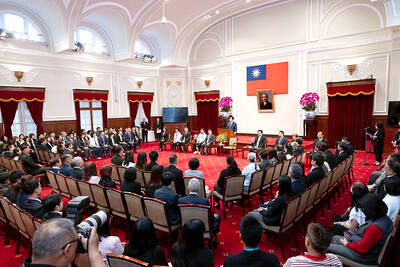
The next minimum wage hike is expected to exceed NT$30,000, President William Lai (賴清德) said yesterday during an award ceremony honoring “model workers,” including migrant workers, at the Presidential Office ahead of Workers’ Day today. Lai said he wished to thank the awardees on behalf of the nation and extend his most sincere respect for their hard work, on which Taiwan’s prosperity has been built. Lai specifically thanked 10 migrant workers selected for the award, saying that although they left their home countries to further their own goals, their efforts have benefited Taiwan as well. The nation’s industrial sector and small businesses lay


 RSS
RSS