


Premier William Lai (賴清德) yesterday inspected the disposal of leftover pig food at a hog farm in Taichung and called on farmers and all Taiwanese to join hands to guard against African swine fever.
The government has been stepping up measures against the disease since China reported its first infection in August and illegal Chinese pork imports continue to be intercepted by customs officials.
Following President Tsai Ing-wen’s (蔡英文) visit to Yunlin County hog farms on Saturday, Lai yesterday visited Rueising livestock farm in Cingshuei District (清水) to inspect processes meant to reduce the chances of infection.
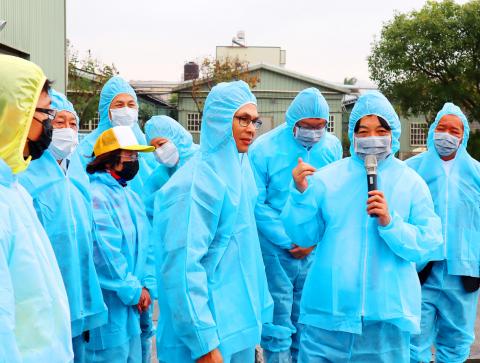
Photo: Ou Su-mei, Taipei Times
When foot-and-mouth disease reached Taiwan in 1997, the nation suffered economic losses exceeding NT$170 billion (US$5.5 billion at today’s exchange rate) and culled more than 4 million pigs, leaving a scar on the domestic hog industry, Lai said.
If African swine fever enters the nation, its impact might be more severe than foot-and-mouth disease, given that it can be transmitted in numerous ways and survive in frozen pork for up to 1,000 days and in refrigerated pork for 100 days, he said.
Without a vaccine or cure available, the disease might ruin the domestic hog industry, which has an annual revenue of more than NT$200 billion, Council of Agriculture (COA) Deputy Minister Lee Tui-chih (李退之) said, calling on people to protect the famous Taiwanese dish rice with braised pork and other pork dishes.
“Disease prevention should be considered a battle,” and every single livestock farm is like a castle defending the front line, Lai said.
Many Taiwanese work on pig farms in China, so they might carry the virus into the nation, he said, urging farmers to maintain required quarantine measures and control the movement of personnel, vehicles and equipment on farms.
Food is one of the virus’ main transmission channels, but it can be eradicated if leftovers are heated to 90°C for one hour before being fed to pigs, he said.
Farmers without heating devices can use fodder instead of leftovers and the government would provide subsidies for such a switch, Lai said.
The nation has 2,045 hog farms that use leftovers to feed pigs, while the council is helping 67 farms without heating devices to switch to fodder, COA Acting Minister Chen Chi-chung (陳吉仲) said on Saturday while accompanying Tsai in Yunlin.
Lai asked local governments to set up standard procedures for burying pigs in preparation for the possible arrival of the disease.
The number of dead pigs might exceed the total capacity of incinerators and disposal firms, he said.
Additional reporting by CNA
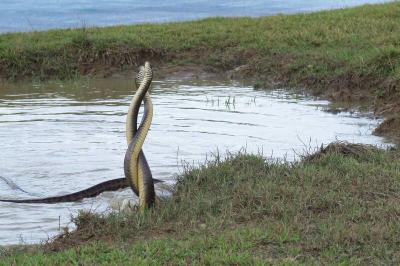
Kenting National Park service technician Yang Jien-fon (楊政峰) won a silver award in World Grand Prix Photography Awards Spring Season for his photograph of two male rat snakes intertwined in combat. Yang’s colleagues at Kenting National Park said he is a master of nature photography who has been held back by his job in civil service. The awards accept entries in all four seasons across six categories: architectural and urban photography, black-and-white and fine art photography, commercial and fashion photography, documentary and people photography, nature and experimental photography, and mobile photography. Awards are ranked according to scores and divided into platinum, gold and

The Chinese Nationalist Party (KMT) caucus yesterday said it opposes the introduction of migrant workers from India until a mechanism is in place to prevent workers from absconding. Minister of Labor Hung Sun-han (洪申翰) on Thursday told the Legislative Yuan that the first group of migrant workers from India could be introduced as early as this year, as part of a government program. The caucus’ opposition to the policy is based on the assessment that “the risk is too high,” KMT caucus secretary-general Lin Pei-hsiang (林沛祥) said. Taiwan has a serious and long-standing problem of migrant workers absconding from their contracts, indicating that

SPACE VETERAN: Kjell N. Lindgren, who helps lead NASA’s human spaceflight missions, has been on two expeditions on the ISS and has spent 311 days in space Taiwan-born US astronaut Kjell N. Lindgren is to visit Taiwan to promote technological partnerships through one of the programs organized by the US for its 250th national anniversary. Lindgren would be in Taiwan from Tuesday to Saturday next week as part of the US Bureau of Educational and Cultural Affairs’ US Speaker Program, organized to celebrate the 250th anniversary of the signing of the Declaration of Independence, the American Institute in Taiwan (AIT) said in a statement yesterday. Lindgren plans to engage with key leaders across the nation “to advance cutting-edge technological partnerships and inspire the next generation of scientists and engineers,”

TRADE-OFF: Beijing seeks to trade a bowl of tempura for a Chinese delicacy, an official said, while another said its promises were attempts to interfere in the polls The government must carefully consider the national security implications of building a bridge connecting Kinmen County and Xiamen, China, the Public Construction Commission (PCC) said yesterday. PCC Commissioner Derek Chen (陳金德), who is also a minister without portfolio, made the remarks in a meeting of the legislature’s Transportation Committee, after Democratic Progressive Party Legislator Hsu Fu-kuei (徐富癸) asked about China’s proposal of new infrastructure projects to further connect Kinmen and Lienchiang (Matsu) counties with Xiamen. China unveiled the bridge plan, along with nine other policies for Taiwan, on Sunday, the last day of Chinese Nationalist Party (KMT) Chairwoman Cheng Li-wun’s (鄭麗文) visit


 RSS
RSS