


The Taiwan High Court has found a matchmaking agency responsible for ruining the marriage of its clients and ordered that it must pay the former groom, surnamed Chen (陳), NT$500,000 in handling and reneging fees.
Chen in April 2016 signed a contract with the agency and paid NT$380,000 for it to arrange a marriage with a foreign spouse and her immigration to Taiwan.
The agency contacted an Indonesian agent, known only as A-chin (阿進), who arranged for Chen and the former bride, a woman surnamed Huang (黃), to meet, marry and register their marriage in Indonesia.
Chen returned to Taiwan to prepare for Huang’s arrival, but was later informed that A-chin had not started preparing Huang’s departure due to financial disagreements between A-chin and the agency, the court said.
Chen did his best to facilitate a deal, as A-chin refused to hand over the marriage certificate before the disagreements were resolved, it said.
A-chin relented and mailed the certificate to Chen, but Huang had already said that she “was not going through with the marriage” due to the long time the negotiations had taken, the court said.
According to Article 982 of the Civil Code, as Chen and Huang had not registered their marriage at a Taiwanese household registration office, the court could not recognize the marriage as legal, it said.
Chen took the agency to court as he considered it wholly at fault, demanding that it not only return his advance payment of NT$380,000, but should pay double the amount for not honoring the contract.
However, the agency said that it had fulfilled the contract, as it oversaw the introduction and marriage of Chen and Huang, and had helped them obtain an Indonesian marriage certificate.
“We are not at fault, as we could not guarantee that Huang would be willing to come to Taiwan,” the agency was quoted by the court as saying.
The court ruled that Chen’s marriage went sour primarily due to financial disputes between the agency and A-chin.
However, it ruled that Chen’s demand for the firm to pay double the advance payment in compensation for breach of contract was too excessive.
The agency should return the advance payment and pay an additional NT$115,000 in compensation for a total of NT$500,000, the court said in the ruling, which was final.

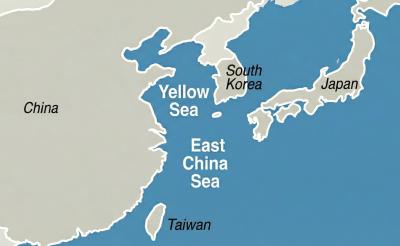
China has reserved offshore airspace in the Yellow Sea and East China Sea from March 27 to May 6, issuing alerts usually used to warn of military exercises, although no such exercises have been announced, the Wall Street Journal (WSJ) reported yesterday. Reserving such a large area for 40 days without explanation is an “unusual step,” as military exercises normally only last a few days, the paper said. These alerts, known as Notice to Air Missions (Notams), “are intended to inform pilots and aviation authorities of temporary airspace hazards or restrictions,” the article said. The airspace reserved in the alert is
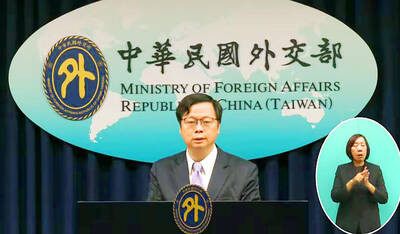
NAMING SPAT: The foreign ministry called on Denmark to propose an acceptable solution to the erroneous nationality used for Taiwanese on residence permits Taiwan has revoked some privileges for Danish diplomatic staff over a Danish permit that lists “Taiwan” as “China,” Eric Huang (黃鈞耀), head of the Ministry of Foreign Affairs’ Department of European Affairs, told a news conference in Taipei yesterday. Reporters asked Huang whether the Danish government had responded to the ministry’s request that it correct the nationality on Danish residence permits of Taiwanese, which has been listed as “China” since 2024. Taiwan’s representative office in Denmark continues to communicate with the Danish government, and the ministry has revoked some privileges previously granted to Danish representatives in Taiwan and would continue to review

More than 6,000 Taiwanese students have participated in exchange programs in China over the past two years, despite the Mainland Affairs Council’s (MAC) “orange light” travel advisory, government records showed. The MAC’s publicly available registry showed that Taiwanese college and university students who went on exchange programs across the Strait numbered 3,592 and 2,966 people respectively. The National Immigration Agency data revealed that 2,296 and 2,551 Chinese students visited Taiwan for study in the same two years. A review of the Web sites of publicly-run universities and colleges showed that Taiwanese higher education institutions continued to recruit students for Chinese educational programs without

A bipartisan group of US senators has introduced a bill to enhance cooperation with Taiwan on drone development and to reduce reliance on supply chains linked to China. The proposed Blue Skies for Taiwan Act of 2026 was introduced by Republican US senators Ted Cruz and John Curtis, and Democratic US senators Jeff Merkley and Andy Kim. The legislation seeks to ease constraints on Taiwan-US cooperation in uncrewed aerial systems (UAS), including dependence on China-sourced components, limited access to capital and regulatory barriers under US export controls, a news release issued by Cruz on Wednesday said. The bill would establish a "Blue UAS


 RSS
RSS