

The Executive Yuan’s proposal to legalize same-sex unions by drafting a separate law would go against the result of a referendum passed last Saturday that asked: “Do you agree that the right to persons of the same sex to create a permanent union should be guaranteed by an institution other than marriage as defined by the Civil Code?” the Happiness of the Next Generation Alliance said yesterday.
Referendum No. 12 is one of three initiated by the alliance that passed the voting threshold.
The alliance’s goal was to push for legislation that allows same-sex couples to register as “family members” or parties in a civil union, not a special law to legalize same-sex marriage, alliance president Tseng Hsien-ying (曾獻瑩) said at a news conference in Taipei.

Photo: Fang Pin-chao, Taipei Times
The alliance would launch a working group to support legislative efforts and draft a bill that would regulate same-sex couples’ property rights and rights to make medical decisions for each other, he said.
The Cabinet’s proposal to legalize same-sex marriage through a special law contradicts the will of the public, Tseng said, before calling on the Ministry of Education to respond to the passage of Referendum No. 11, which calls for a halt to the inclusion of homosexuality in gender equality education.
Chinese Nationalist Party (KMT) Legislator Lai Shyh-bao (賴士葆), who attended the news conference, said that Judicial Yuan President Hsu Tzong-li’s (許宗力) comments that referendums do not supersede the Constitution held 7 million people in contempt.

Photo: CNA
Hsu is not qualified to be the president of the Judicial Yuan and the government should respect the will of the people, Lai said, adding: “Referendums are not opinion polls.”
In related news, the perception that the Democratic Progressive Party’s (DPP) stance on same-sex marriage was partly to blame for its rout in last week’s elections has reportedly put pressure on the party’s most prominent proponents of legalization, lawmakers Tuan Yi-kang (段宜康) and Yu Mei-nu (尤美女).
When asked to respond, Tuan said that even if the referendums oblige the Cabinet to propose legalizing marriage equality via a special law, the Council of Grand Justice’s Interpretation No. 748 remains the law.
“If we renege on our support for marriage equality when the rainbow flags flew, our opposition to nuclear power during marches and our ideal of rectifying our national name… then what is the point of the DPP?” Tuan asked.
“If we conceded, there would be no difference between the KMT and us,” he said. “We will become simply another political party with a different color scheme.”
The interpretation delivered on May 24 last year ruled that the Civil Code’s definition of marriage as a union between a man and a woman is unconstitutional and contradicts the principle of equal protection under the law.
Asked to comment, Yu said the referendums have been “immensely harmful” to young LGBT people.
“Since the vote, nine gay people have died from suicide, two have attempted to commit suicide and 23 people have reported being bullied,” she said. “Taiwanese society should stop this crazy rampage.”
DPP caucus whip Ker Chien-ming (柯建銘) said that party members should put aside their personal views and follow the party’s consensus.
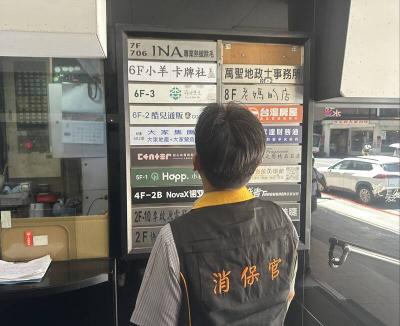
Taipei police today said they have launched an investigation into a well-known Pokemon Trading Card Game store in Taipei's Ximending (西門町) area after its sudden closure, with customers suspecting the owner absconded with up to NT$300 million (US$9.24 million). Little Sheep Card Shop (小羊卡牌社) in Wanhua District (萬華) — which specializes in card purchases and pre-orders, card grading services in Japan, submissions to the US and consignment sales — opened a physical storefront in January. Its three official Line groups, hosting up to 5,000 members each, and social media accounts on Facebook and Instagram all disappeared overnight, with the Ximending
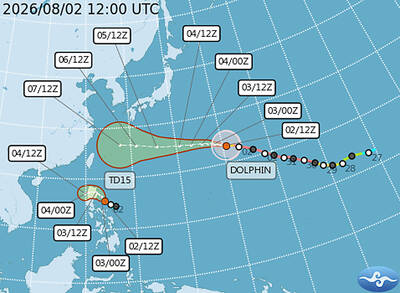
Typhoon Dolphin could bring heavy rain to northern Taiwan later this week if it tracks closer to the nation after passing the Ryukyu Islands, the Central Weather Administration (CWA) said yesterday. The CWA said forecast models agree the storm is to move toward the Ryukyu Islands through Thursday, but diverge over its path after that. One scenario has Typhoon Dolphin passing north of Taiwan, while another has it curving toward the Korean Peninsula if the Pacific high pressure system currently over the East China Sea and Taiwan weakens. Because of the uncertainty, it is still too
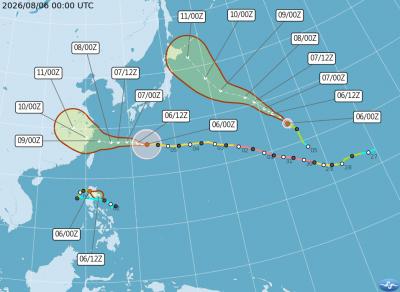
Typhoon Dolphin is expected to enter the East China Sea on Saturday and intensify rainfall in western regions over the weekend as the typhoon’s outer circulation sweeps across the sea north of Taiwan, independent meteorologist Daniel Wu (吳德榮) said today. The eastern coast should prepare for extreme heat caused by downslope winds over the weekend, while southwesterly winds from Monday would bring localized heavy rain to the southwest, he said. As Typhoon Dolphin’s outer bands move past northern Taiwan over the next couple of days, northern, central and southern areas would experience showers tomorrow, he said. Rainfall over the weekend would lead to
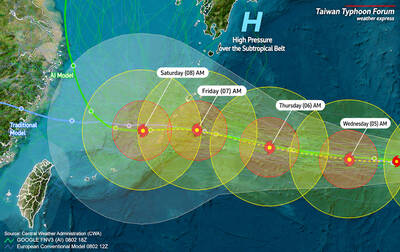
Taiwan could issue a sea warning for Typhoon Dolphin as early as Friday afternoon if the storm maintains its current westward track, the Central Weather Administration (CWA) said yesterday. As of 2pm yesterday, the center of the typhoon was about 2,590km east of Taipei and moving west at 21kph, potentially bringing hazardous conditions to waters surrounding Taiwan by Saturday. Dolphin is expected to reach waters south of the Ryukyu Islands around Saturday, but its track beyond that remains highly uncertain, CWA forecaster Lin Ping-yu (林秉煜) said. The typhoon could either continue moving westward or veer northward, Lin said. A westward track would bring


 RSS
RSS