


A coalition of civil groups yesterday accused the Central Election Commission (CEC) of interfering with referendum proposals and called on all members of the executive committee to step down.
“I had hoped that the amendments would break the birdcage, but then I found there were still many ways the commission could interfere with a proposal,” Aletheia University Department of Law associate professor Wu Ching-chin (吳景欽) told a news conference in Taipei, referring to amendments to the Referendum Act (公民投票法) passed last year that significantly lowered the threshold for initiating referendums and abolished an Executive Yuan referendum review committee.
The law had been known as a “birdcage act” due to many previous restrictions that had made it nearly impossible to initiate or pass a referendum.
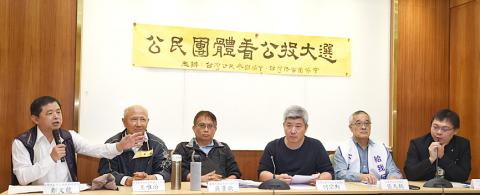
Photo: Liu Hsin-de, Taipei Times
A referendum question he submitted to the commission in April asking the government to return surplus tax revenue to members of the public was rejected on the grounds that the word “surplus” is suggestive and that questions related to taxes are banned by law, Wu said.
He told the commission that “surplus tax revenue” was the same term used by the Ministry of Finance and that the government has been using it for 40 years, but his opinion was ignored, he said.
The commission also did not offer any explanation as to why it would contravene the law to ask questions related to taxes, he said.
“My referendum question did not concern increasing or cutting taxes, or even government budgets. It would only require the government to pass legislation that clarifies where the surplus comes from and where it should go,” Wu said.
Meanwhile, Nuclear Myth Busters founder Huang Shih-hsiu (黃士修), who initiated a referendum to scrap the government’s plan to phase out nuclear power that passed on Saturday, accused to the commission of trying to “oppress certain proposals.”
While Huang’s proposal asked: “Do you agree that Subparagraph 1, Article 95 of the Electricity Act, which reads: ‘Nuclear-energy-based power-generating facilities shall wholly stop running by 2025,’ should be abolished?” the commission had initially required him to remove the phrase describing the content of the cited law, saying it would prevent it from being objective or neutral, he said.
“They simply did not want voters to immediately understand that the question was about the ‘nuclear-free homeland by 2025’ policy,” Huang said.
The commission was unfair in its handling of referendum proposals and its members are unqualified to remain in their posts, Taiwan Citizen Participation Association director-general Ho Tsung-hsun (何宗勳) said.
“All members of its executive committee should step down. Simply having the commission chairman step down is not enough to appease the public’s anger,” Ho said.

More than half of the bamboo vipers captured in Tainan in the past few years were found in the city’s Sinhua District (新化), while other districts had smaller catches or none at all. Every year, Tainan captures about 6,000 snakes which have made their way into people’s homes. Of the six major venomous snakes in Taiwan, the cobra, the many-banded krait, the brown-spotted pit viper and the bamboo viper are the most frequently captured. The high concentration of bamboo vipers captured in Sinhua District is puzzling. Tainan Agriculture Bureau Forestry and Nature Conservation Division head Chu Chien-ming (朱健明) earlier this week said that the
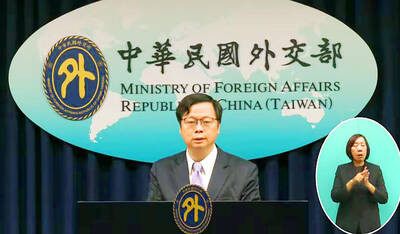
NAMING SPAT: The foreign ministry called on Denmark to propose an acceptable solution to the erroneous nationality used for Taiwanese on residence permits Taiwan has revoked some privileges for Danish diplomatic staff over a Danish permit that lists “Taiwan” as “China,” Eric Huang (黃鈞耀), head of the Ministry of Foreign Affairs’ Department of European Affairs, told a news conference in Taipei yesterday. Reporters asked Huang whether the Danish government had responded to the ministry’s request that it correct the nationality on Danish residence permits of Taiwanese, which has been listed as “China” since 2024. Taiwan’s representative office in Denmark continues to communicate with the Danish government, and the ministry has revoked some privileges previously granted to Danish representatives in Taiwan and would continue to review
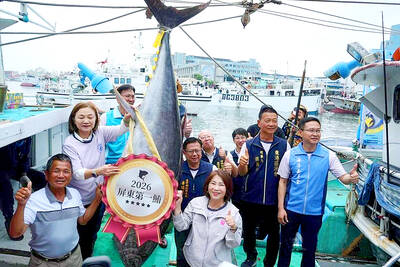
The first bluefin tuna of the season, brought to shore in Pingtung County and weighing 190kg, was yesterday auctioned for NT$10,600 (US$333.5) per kilogram, setting a record high for the local market. The auction was held at the fish market in Donggang Fishing Harbor, where the Siaoliouciou Island-registered fishing vessel Fu Yu Ching No. 2 delivered the “Pingtung First Tuna” it had caught for bidding. Bidding was intense, and the tuna was ultimately jointly purchased by a local restaurant and a local company for NT$10,600 per kilogram — NT$300 ,more than last year — for a total of NT$2.014 million. The 67-year-old skipper

China has reserved offshore airspace over the Yellow Sea and East China Sea from March 27 to May 6, issuing alerts that are usually used to warn of military exercises, although no such exercises have been announced, the Wall Street Journal (WSJ) reported on Sunday. Reserving such a large area for 40 days without explanation is an “unusual step,” as military exercises normally only last a few days, the paper said. The alerts, known as notice to air missions (NOTAMs), “are intended to inform pilots and aviation authorities of temporary airspace hazards or restrictions,” the article said. The airspace reserved in the alert


 RSS
RSS