


As people yesterday lined up at polling stations nationwide to vote, there were some incidents of ballots being destroyed and numerous reports of voting delays because of the massive turnout, resulting in people still waiting in line after the polls were scheduled to close at 4pm.
The Central Election Commission (CEC) announced that voting would continue until those who were in line at 4pm had cast their ballots.
Commission officials attributed the high voter turnout to the warm, sunny weather and heated mayoral and city council races in several of the special municipalities.
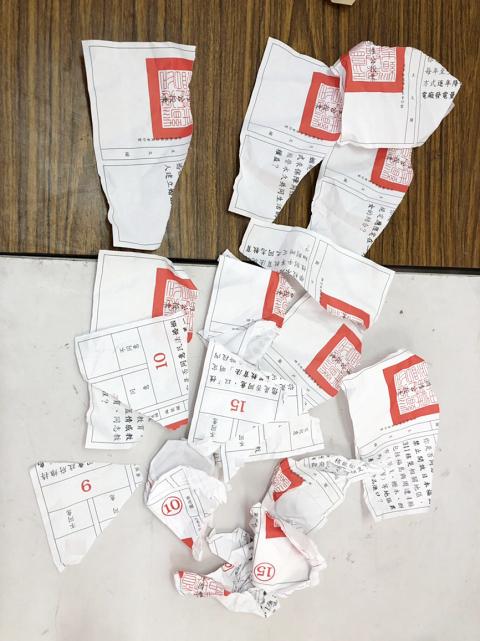
Photo: CNA
The combination of the nine-in-one elections and 10 referendums also contributed to lengthy voting waits, officials said.
President Tsai Ing-wen (蔡英文) arrived at her polling station at Sioulang Elementary School in New Taipei City about 8:30am, where she waited in line with other residents for about 30 minutes.
Although her security team was around her, Tsai chatted with those near her in line while they waited.
“This is the mark of a democracy, of people voting to express their will. This is the first time we have so many referendum questions, so voters need to spend a little more time. When more referendum votes are held in the future, then people will be more familiar with the process,” Tsai said later.
Hon Hai Precision Industry Co chairman Terry Gou (郭台銘) complained about the long lines, saying he had to wait for about an hour arriving about 11am at his polling station at Dongmen Elementary School in Taipei.
Taipei City Mayor Ko Wen-je (柯文哲) arrived at 10am at his polling station in Songshan District (松山) and waited one-and-a-half hours to vote.
There were still lines of people waiting to cast their ballots as of 6pm in several locations, including Taipei, New Taipei City, Taoyuan and Kaohsiung.
In a dramatic episode, a 62-year-old Kaohsiung resident surnamed Su (蘇) died just after casting her ballots at a polling station in Hunei District (湖內).
She collapsed inside the polling station, and was rushed by ambulance to a local hospital, but could not be revived, and Kaohsiung officials said it appeared she had experienced a stroke.
As of 4pm, 41 incidents of ballots being destroyed had been reported, officials said.
A woman surnamed Yeh (葉) in New Taipei’s Sindian District (新店) was questioned after she tore up her 10 referendum ballots.
She would be fined NT$50,000, or NT$5,000 per ballot, for contravening Article 44 of the Referendum Act (公民投票法), officials said.
Three incidents were reported in New Taipei City of people taking cellphones into voting booths, officials said, adding that the two men and one woman were taken in for questioning for contravening the Civil Servants Election And Recall Act (公職人員選舉罷免法), and could face fines of up to NT$300,000.
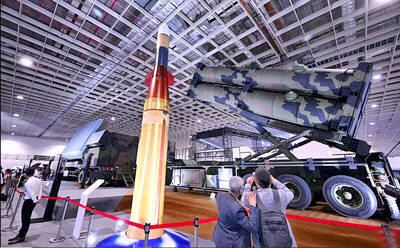
Taiwan is to commence mass production of the Tien Kung (天弓, “Sky Bow”) III, IV and V missiles by the second quarter of this year if the legislature approves the government’s NT$1.25 trillion (US$39.78 billion) special defense budget, an official said yesterday. Commenting on condition of anonymity, a defense official with knowledge of the matter said that the advanced systems are expected to provide crucial capabilities against ballistic and cruise missiles for the proposed “T-Dome,” an advanced, multi-layered air defense network. The Tien Kung III is an air defense missile with a maximum interception altitude of 35km. The Tien Kung IV and V
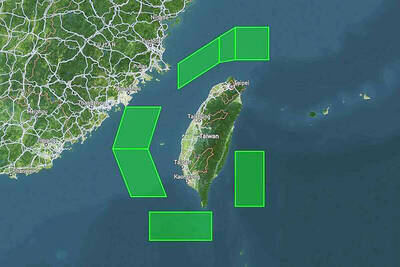
The disruption of 941 flights in and out of Taiwan due to China’s large-scale military exercises was no accident, but rather the result of a “quasi-blockade” used to simulate creating the air and sea routes needed for an amphibious landing, a military expert said. The disruptions occurred on Tuesday and lasted about 10 hours as China conducted live-fire drills in the Taiwan Strait. The Civil Aviation Administration (CAA) said the exercises affected 857 international flights and 84 domestic flights, affecting more than 100,000 travelers. Su Tzu-yun (蘇紫雲), a research fellow at the government-sponsored Institute for National Defense and Security Research, said the air
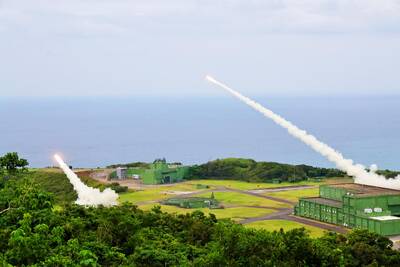
Taiwan lacks effective and cost-efficient armaments to intercept rockets, making the planned “T-Dome” interception system necessary, two experts said on Tuesday. The concerns were raised after China’s military fired two waves of rockets during live-fire drills around Taiwan on Tuesday, part of two-day exercises code-named “Justice Mission 2025.” The first wave involved 17 rockets launched at 9am from Pingtan in China’s Fujian Province, according to Lieutenant General Hsieh Jih-sheng (謝日升) of the Office of the Deputy Chief of the General Staff for Intelligence at the Ministry of National Defense. Those rockets landed 70 nautical miles (129.6km) northeast of Keelung without flying over Taiwan,
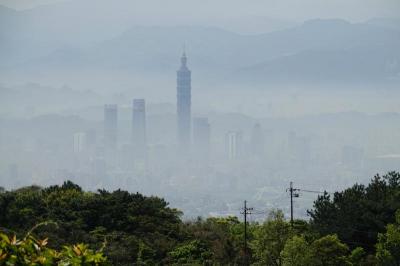
A strong continental cold air mass is to bring pollutants to Taiwan from tomorrow, the Ministry of Environment said today, as it issued an “orange” air quality alert for most of the country. All of Taiwan except for Hualien and Taitung counties is to be under an “orange” air quality alert tomorrow, indicating air quality that is unhealthy for sensitive groups. In China, areas from Shandong to Shanghai have been enveloped in haze since Saturday, the ministry said in a news release. Yesterday, hourly concentrations of PM2.5 in these areas ranged from 65 to 160 micrograms per cubic meter (mg/m³), and pollutants were


 RSS
RSS