

President Tsai Ing-wen (蔡英文) on Saturday called on Taiwanese living abroad to return home and cast their ballots in the nine-in-one elections on Nov. 24, saying it would be in the interest of safeguarding democracy.
“As the Nov. 24 local government elections approach, the whole world is watching whether Taiwanese will vote for a China- leaning party or choose one that is committed to democracy and human rights,” Tsai said in a recorded video that was played at an event in Washington to mark the 50th anniversary of the Taiwanese Association of America.
Expressing gratitude to expatriates for their long-time support, Tsai urged them to return to vote in the elections and show the rest of the world their commitment to safeguarding the nation’s democracy.
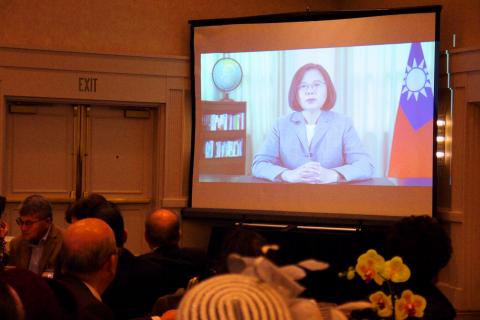
Photo: CNA
“Once our country is strong enough, we will never fear this changing world,” she said.
John Norris, managing director of the American Institute in Taiwan’s (AIT) Washington office, said at the event that next year marks the 40th anniversary of the Taiwan Relations Act and the US is looking forward to strengthening ties with Taiwan.
Over the past year, Taiwan and the US made achievements in the areas of security, economy, business and civilian interactions, Norris said, adding that Washington would take steps to show why it views Taipei as a reliable partner in the Indo-Pacific region and a force for good in the world.
Overseas Community Affairs Council Minister Wu Hsin-hsing (吳新興) said that the Tsai administration has not endorsed the so-called “1992 consensus,” as it would prohibit Taiwan from declaring itself a de jure and de facto independent country.
“Despite the 1992 consensus, China has already decided, without any negotiations with Taiwan, that it would like to bring Taiwan under the same ‘one country, two systems’ framework as Hong Kong,” Wu said.
However, Taiwan has strong backing from many countries, including the US, and is not isolated in the international community, he said, adding that the nation would continue to defend its free and democratic system in the face of China’s threats and challenges.
The “1992 consensus” — a term former Mainland Affairs Council chairman Su Chi (蘇起) admitted making up in 2000 — refers to a tacit understanding between the Chinese Nationalist Party (KMT) and the Chinese government that both sides acknowledge there is “one China,” with each side having its own interpretation of what “China” means.
Deputy Representative to the US Louis Huang (黃敏境) thanked the US for its support, citing US Secretary of State Mike Pompeo, who on Friday said Taiwan and the US share the common values of democracy, freedom and human rights.
The event was also attended by James Heller, director of the US Department of State’s Office of Taiwan Coordination.
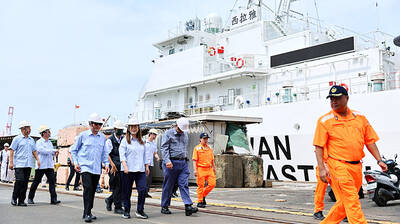
Ocean Affairs Council (OAC) Minister Kuan Bi-ling (管碧玲) on Wednesday said decommissioned coast guard vessels were given to the Philippines to enhance regional rescue capacity and would not affect Taiwanese fishers’ rights and benefits. Kuan made the remarks after confirmation on Tuesday that a 500-tonne Coast Guard Administration (CGA) patrol and rescue vessel would be given to the Philippine Coast Guard. The donation ceremony was reportedly done in Manila, but whether the vessel — previously numbered “CG123” and named Kinmen (金門) — has been handed over has yet to be confirmed. China’s Taiwan Affairs Office (TAO) on Wednesday criticized the donation for “taking

The Ministry of Finance today announced the winning numbers for the July-August uniform invoice lottery. The winning number for the NT$10 million (US$314,663) special prize is 89996565, while the winning number for the NT$2 million grand prize is 91098182. Three numbers were drawn for the NT$200,000 first prize: 54348835, 44991397 and 06595111. Those with receipts matching the last seven digits of any of the first-prize numbers can claim the NT$40,000 second prize, while those matching the last six digits qualify for the NT$10,000 third prize. Those whose receipts match the last five digits of the first-prize numbers are eligible for the NT$4,000 fourth prize,
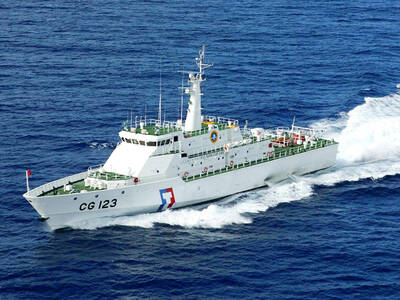
A decommissioned 500-tonne Kinmen-class patrol vessel recently donated by Taiwan’s Coast Guard Administration (CGA) has been delivered to the Philippine Coast Guard (PCG), a source said yesterday. The source said the vessel transferred to the PCG at a ceremony organized by the Philippine Non-government WPS Foundation on Monday was donated by the CGA. The CGA confirmed the donation on Wednesday last week following a United Daily News (UDN) report of a Philippine law enforcement vessel registered as "BLINGNO.1" setting sail for sea trials from Kaohsiung Port that day, citing tracking data from
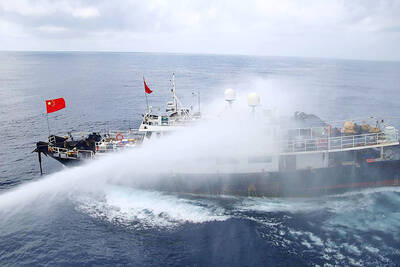
Taiwan has upgraded its maritime patrol capacity around the Pratas Islands (Dongsha Islands, 東沙群島) in the disputed South China Sea, including regularly sending larger ships there, the government said on Wednesday, responding to an increase in Chinese activities. Lying roughly between southern Taiwan and Hong Kong, the Taiwan-controlled Pratas Islands are seen by security experts as vulnerable to a Chinese attack due to their distance — more than 400km — from Taiwan. In a statement late on Wednesday, the Coast Guard Administration (CGA) said its overall patrol and enforcement capacity in Pratas waters has been “comprehensively upgraded.” With the completion of a wharf


 RSS
RSS