


Taipei Times (TT): Why did you decide to bring the Oslo Freedom Forum to Asia and why did you choose Taiwan as the first Asian host?
Gladstein: Asia is home to more than half of the world’s population, with about 4.4 billion people. If we are ignoring Asia, we are ignoring half of the world, so it is important to build an Oslo Freedom Forum community here.
Taiwan has an inspiring journey to tell. People like Egyptian actor and LGBT rights activist Omar Sharif Jr get really inspired when they hear about Taiwan’s story as a nation, which, without a civil war, went from dictatorship to democracy over time. That is really impressive and inspiring for all the people coming here from Russia, Bahrain and Egypt. They have their own stories to share, but they are also going to learn a lot from Taiwan.

Photo: Stacy Hsu, Taipei Times
The second reason is that it is a Chinese democracy. It is really important because Beijing says it all the time that the Chinese people are not ready for democracy, but Taiwan is living proof that they are liars.
Another reason is technology, which is going to be critical for the future of human rights. A recent Bloomberg article reported that the Chinese government put a backdoor on all Apple equipment whey they were making the chips. All of the devices we use can be used to spy on us, whether it is software like [China’s messaging app] WeChat, or hardware like a Chinese-made phone.
Technology is going to play a key role in whether or not we are going to live under surveillance. Taiwan is going to be really important, because you can make a lot of such equipment here, at companies like Taiwan Semiconductor Manufacturing Co, Asustek Computer Inc and others.
I would much rather trust a smartphone made here than in China. A lot of people do not realize how absolutely critical the semiconductor industry is to human rights.
TT: By choosing Taiwan as the first Asian host of the forum, are you trying to send a message to autocrats and dictators in the region?
Gladstein: We are not trying to [send a] message or talk to dictators, because we are not trying to scare them through an adversarial message. Our message is one of a positive nature for activists.
We want to tell activists in the region that they have a home and a place to come to — to learn how they can be more effective in getting resources, how technology can help them, how to avoid surveillance and how to bring democracy to their own country. They can come to Taiwan and Taiwan can be the center for that.
I want to make sure that we are on a positive message, not an adversarial and aggressive one. This is a positive conference. Too often, human rights activists are too negative and aggressive. We are trying to bring a narrative where we are building a community of people who care about civil liberty and freedom here.
We also hope [next year’s forum] will be here, but it depends on how well this [year’s forum] goes. Our goal is to build [a community for Asia] here and so far it has been an amazing reception.
TT: Taiwan has a vibrant civic society with scores of non-governmental organizations dedicated to the cause of advancing human rights, freedom and democracy. Do you have plans to cooperate with them?
Gladstein: Last time we were here, we visited many different activist groups, such as the Taiwan Association for Human Rights and the Open Culture Foundation. Of course we want to include all of them. Our goal is to give them a resource and a place where they can come and learn from other organizations regionally, in the hope that they will receive more support moving forward.
However, our mission is to help people in closed societies. We are not focusing on Taiwan. Taiwan is like the home base for this event and of course we want Taiwanese organizations to be involved, but our focus is on dictatorships.
We believe that Taiwanese can play a key role in that by sharing their own story of how they got here and what they are doing now, such as how Taiwanese people are trying to change the public history of the country, so that young people are not learning about propaganda, but are learning about real history.
TT: You have spoken quite positively about Taiwan’s democracy. Are there areas where you think the country could make a better effort?
Gladstein: No country is perfect. Taiwanese society has a lot of problems, like the economy and jobs. There are promises of gay rights, but it has not happened yet. There is also the death penalty issue.
If Taiwan actually makes same-sex marriage operational, it will be the first of hopefully many [in the region]. It is the same way in the US, where one state legalized same-sex marriage and then it started to spread.
You are going to see the same thing in Asia, hopefully, but Taiwan has to be the first. You can lead the way. If Taiwan is successful, it will be an indicator for the region and others will try to copy it.

EXCUSES: Beijing is using government and research vessels as a pretext to harass the nation and enter its EEZ, and engage in ‘hegemonic expansion,’ the coast guard said The Coast Guard Administration yesterday said it drove away Chinese oceanographic research vessel Xiang Yang Hong 22 (向陽紅33) from restricted waters after warning it that it was in Taiwan’s exclusive economic zone (EEZ). The Chinese vessel entered restricted waters off the coast of Yilan County’s Suao (蘇澳) at 11:35pm on Thursday, the coast guard said, adding that it dispatched the Lanyu patrol vessel and the boat PP-10077 to shadow the Chinese ship and issue radio warnings ordering it to leave. China has no sovereignty over waters off Taiwan’s east coast, Lanyu’s crew told Xiang Yang Hong 22 over the radio, and demanded
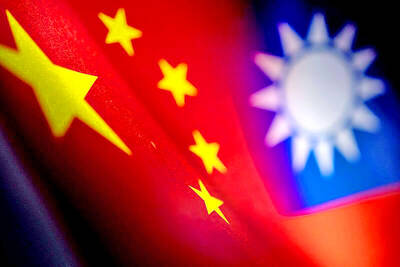
BAIT AND SWITCH: Allowing KMT-run counties to sell to China while the threat of abrupt cancelations hangs overhead is another form of coercion, officials said Beijing is using agricultural purchase offers announced during the Straits Forum to deepen Taiwan’s dependence on the Chinese market, a Taiwanese official said yesterday as they criticized the Taitung County commissioner’s participation in the initiative. During the Straits Forum held in Xiamen on Saturday, Chinese officials announced a sales and purchase agreement for agricultural products from some counties led by the Chinese Nationalist Party (KMT). Taitung County Commissioner Yao Ching-ling (饒慶鈴), who was barred from attending the event in person by the Mainland Affairs Council, participated via video. Under the agreement, China would purchase atemoyas, pomeloes, tea and grouper harvested in Taitung,
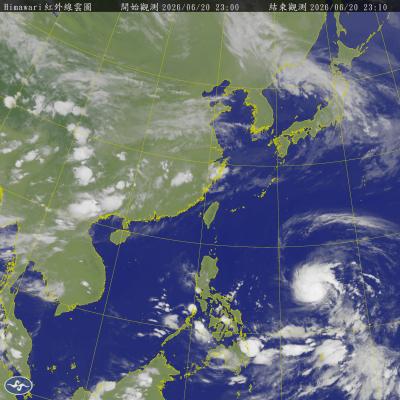
Tropical Storm Mekkhala is forecast to strengthen into a typhoon tomorrow and could come close enough to Taiwan later in the week to prompt a sea warning, the Central Weather Administration (CWA) said yesterday. As of 2 pm, the storm was located 1,870 kilometers southeast of Taiwan's southern tip and moving west- northwest at 23 km per hour. CWA forecaster Cheng Chieh-jen (鄭傑仁) said Mekkhala is expected to continue moving west-northwest through Tuesday under the influence of the Pacific high- pressure system before gradually turning north toward waters east of Taiwan or south of the Ryukyu Islands. The timing and angle of the

Four Taiwanese universities have been ranked among the world's top 200 institutions in the Quacquarelli Symonds (QS) World University Rankings for next year, the highest Taiwan has ever placed in the category, with National Taiwan University (NTU) achieving its best performance at 54th globally and 17th in Asia. The four Taiwanese institutions in the global top 200 are NTU (54th), National Tsing Hua University (142nd), National Yang Ming Chiao Tung University (177th) and National Cheng Kung University (191st), the rankings showed. All four universities achieved their highest-ever global rankings this year, QS data showed. National Cheng Kung University entered the top 200 for


 RSS
RSS