


Premier William Lai (賴清德) yesterday said that agencies concerned with economic development are confident they would solve problems facing businesses planning to move back to Taiwan.
Lai made the remarks after Democratic Progressive Party Legislator Chen Su-yueh (陳素月), who represents Changhua County, asked whether the government is ready to respond to the trend of Taiwanese businesses moving production lines back home in the wake of the trade war.
Investment is an indispensable factor to drive economic growth, which is the government’s top priority, Lai said.
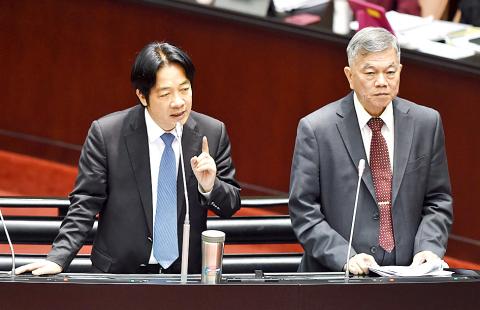
Photo: Chien Jung-fong, Taipei Times
Since he becane premier, the Ministry of Economic Affairs has been under orders to identify problems regarding the “five shortages” of land, water, electricity, talent and labor, and to engage in extensive talks with local industries, Lai said.
The ministry has established the InvesTaiwan Service Center in Taipei to address challenges facing industries, including challenges relating to businesses returning home from China, he said.
“Put simply, agencies of the Executive Yuan are confident they will be able to solve problems concerning returning Taiwanese businesses investing in the nation,” he said.
Chen asked whether there would be rivalry between returning businesses and their locally based counterparts stemming from the five shortages.
Lai said that returning might not be a suitable option for all firms that have operations in China.
For example, the government would not be able to handle labor-intensive companies with 10,000 or more employees if they were to return, so it would be best if the business models of those planning to return conformed with its development goals, he said.
The government would also provide support for businesses that might not be well suited to return and might seek to relocate to other nations, in particular those that plan to move to nations covered by the New Southbound Policy, Lai said.
The government would help them form clusters in those nations and attain sustainable growth, he said.
The ministry on Thursday at a weekly news conference at the Executive Yuan said firms that have expressed interest in returning are mostly manufacturers of communication devices or bicycles.
Also on Thursday, Lai, at a meeting to discuss facilitating investment by returning companies, assigned National Development Council Minister Chen Mei-ling (陳美伶) to put together a task force to address the issue.
The task force is in charge of helping returning businesses meet difficulties concerning capital and the five shortages.
Simply seeking to attract investment from local businesses does not work well in today’s business environment, which encourages industry chains, Lai said at the meeting on Thursday.
The ministry said it would make about 415 hectares of public land available for business use and it expects to expand that space to 1,470 hectares by 2022 by revitalizing unused plots.

LOUD AND PROUD Taiwan might have taken a drubbing against Australia and Japan, but you might not know it from the enthusiasm and numbers of the fans Taiwan might not be expected to win the World Baseball Classic (WBC) but their fans are making their presence felt in Tokyo, with tens of thousands decked out in the team’s blue, blowing horns and singing songs. Taiwanese fans have packed out the Tokyo Dome for all three of their games so far and even threatened to drown out home team supporters when their team played Japan on Friday. They blew trumpets, chanted for their favorite players and had their own cheerleading squad who dance on a stage during the game. The team struggled to match that exuberance on the field, with
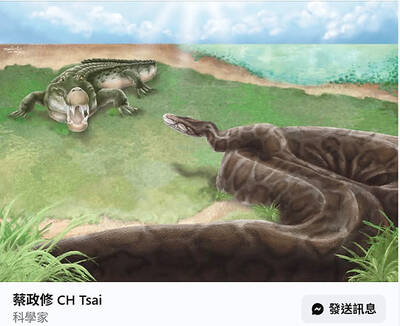
Taiwanese paleontologists have discovered fossil evidence that pythons up to 4m long inhabited Taiwan during the Pleistocene epoch, reporting their findings in the international scientific journal Historical Biology. National Taiwan University (NTU) Institute of Ecology and Evolutionary Biology associate professor Tsai Cheng-hsiu (蔡政修) led the team that discovered the largest snake fossil ever found in Taiwan. The single trunk vertebra was discovered in Tainan at the Chiting Formation, dated to between 400,000 and 800,000 years ago in the Middle Pleistocene, the paper said. The area also produced Taiwan’s first avian fossil, as well as crocodile, mammoth, saber-toothed cat and rhinoceros fossils, it said. Discoveries

Taiwanese paleontologists have discovered fossil evidence that pythons up to 4m long inhabited Taiwan during the Pleistocene epoch, reporting their findings in the international scientific journal Historical Biology. National Taiwan University (NTU) Institute of Ecology and Evolutionary Biology associate professor Tsai Cheng-hsiu (蔡政修) led the team that discovered the largest snake fossil ever found in Taiwan. A single trunk vertebra was discovered in Tainan at the Chiting Formation, dated to between 800,000 to 400,000 years ago in the Middle Pleistocene, the paper said. The area also produced Taiwan’s first avian fossil, as well as crocodile, mammoth, sabre-toothed cat and rhinoceros fossils, it said. Discoveries
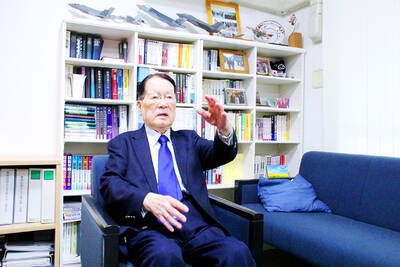
Whether Japan would help defend Taiwan in case of a cross-strait conflict would depend on the US and the extent to which Japan would be allowed to act under the US-Japan Security Treaty, former Japanese minister of defense Satoshi Morimoto said. As China has not given up on the idea of invading Taiwan by force, to what extent Japan could support US military action would hinge on Washington’s intention and its negotiation with Tokyo, Morimoto said in an interview with the Liberty Times (sister paper of the Taipei Times) yesterday. There has to be sufficient mutual recognition of how Japan could provide


 RSS
RSS