


Seven search-and-rescue dogs in Taiwan are UN-certified, the National Fire Agency’s Special Search and Rescue Team said yesterday as it took part in an annual drill held to mark National Disaster Prevention Day.
Taiwan has about 30 search-and-rescue dogs, spread across eight units, dog handler Chou Tsung-chi (周聰吉) said.
Of nine UN-certified search-and-rescue dogs in Asia, seven are in Taiwan and two are in Japan, he said, adding that it means they can be sent on humanitarian missions by the UN.
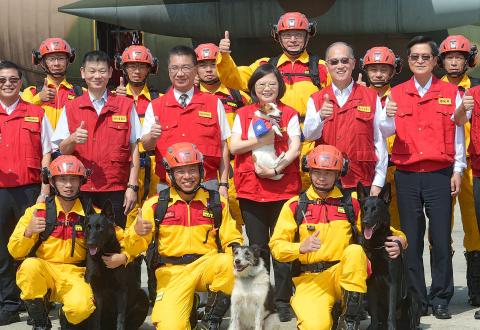
Photo: Chang Chia-ming, Taipei Times
As the seven dogs have only recently been certified, they have not yet taken part in international rescue missions, Chou said.
Taiwan began training search-and-rescue dogs after the 921 Earthquake on Sept. 21, 1999, when dogs from abroad joined the rescue efforts and helped locate many people, Chou said.
President Tsai Ing-wen (蔡英文) observed the drill and held one of the certified dogs on the team — a six-year-old Jack Russell terrier nicknamed Le Le (樂樂) — in her arms for a group photograph.
Le Le is responsible for performing search-and-rescue work in tight spaces, Chou said.
When buildings collapse during earthquakes, rescues rely on small dogs like Le Le that can enter through tiny gaps in buildings to search for survivors and victims, he said.
Le Le is the first Jack Russell to be trained into a search-and-rescue dog in Taiwan, the agency said, adding that it has also trained labrador retrievers, among other breeds.
Tsai told attendants that she would task the Executive Yuan with mapping the areas of disaster prevention that could be more precise and faster.
When faced with earthquakes, storms or floods, national agencies and local governments must apply the same standard operating procedures, update one another, divide tasks appropriately and cooperate, she said, adding that she would assess the improvements to the system on next year’s National Disaster Prevention Day.
Yesterday was the 19th anniversary of the 921 Earthquake, which took the lives of 2,456 people.
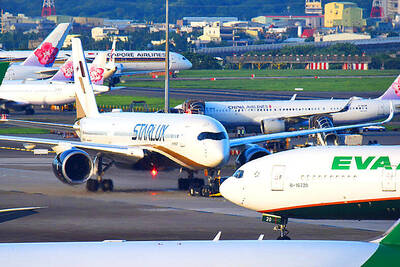
Trips for more than 100,000 international and domestic air travelers could be disrupted as China launches a military exercise around Taiwan today, Taiwan’s Civil Aviation Administration (CAA) said yesterday. The exercise could affect nearly 900 flights scheduled to enter the Taipei Flight Information Region (FIR) during the exercise window, it added. A notice issued by the Chinese Civil Aviation Administration showed there would be seven temporary zones around the Taiwan Strait which would be used for live-fire exercises, lasting from 8am to 6pm today. All aircraft are prohibited from entering during exercise, it says. Taipei FIR has 14 international air routes and
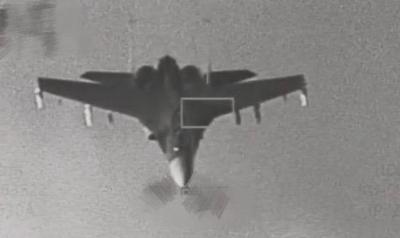
The Ministry of National Defense (MND) today released images of the military tracking China’s People's Liberation Army (PLA) movements during the latest round of Chinese drills around Taiwan. The PLA began "Justice Mission 2025" drills today, carrying out live-fire drills, simulated strikes on land and maritime targets, and exercises to blockade the nation's main ports. The exercises are to continue tomorrow, with the PLA announcing sea and air space restrictions for five zones around Taiwan for 10 hours starting from 8:30am. The ministry today released images showing a Chinese J-16 fighter jet tracked by a F-16V Block 20 jet and the

Snow fell on Yushan (Jade Mountain, 玉山) yesterday morning as a continental cold air mass sent temperatures below freezing on Taiwan’s tallest peak, the Central Weather Administration (CWA) said. Snowflakes were seen on Yushan’s north peak from 6:28am to 6:38am, but they did not fully cover the ground and no accumulation was recorded, the CWA said. As of 7:42am, the lowest temperature recorded across Taiwan was minus-5.5°C at Yushan’s Fengkou observatory and minus-4.7°C at the Yushan observatory, CWA data showed. On Hehuanshan (合歡山) in Nantou County, a low of 1.3°C was recorded at 6:39pm, when ice pellets fell at Songsyue Lodge (松雪樓), a
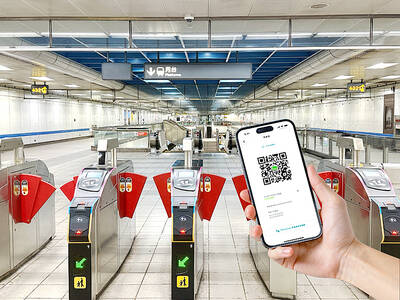
City buses in Taipei and New Taipei City, as well as the Taipei MRT, would on Saturday begin accepting QR code payments from five electronic payment providers, the Taipei Department of Transportation said yesterday. The new option would allow passengers to use the “transportation QR code” feature from EasyWallet, iPass Money, iCash Pay, Jkopay or PXPay Plus. Passengers should open their preferred electronic payment app, select the “transportation code” — not the regular payment code — unlock it, and scan the code at ticket readers or gates, General Planning Division Director-General Liu Kuo-chu (劉國著) said. People should move through the


 RSS
RSS