


The Ministry of Foreign Affairs yesterday dismissed allegations that it planned to give a “C” performance rating to all the staff at the Taipei Economic and Cultural Office’s Osaka branch over their failure to properly handle the aftermath of Typhoon Jebi earlier this month.
The allegations were made by political pundit and media personality Hector Kang (康仁俊) in political talk show Facenews (新聞面對面) on Monday, three days after the branch’s director-general, Su Chii-cherng (蘇啟誠), committed suicide amid criticism of the office.
The criticism arose following a staff member’s alleged refusal to help a Taiwanese tourist stranded in Osaka find accommodation in the wake of Jebi.
Su, 61, had assumed leadership of the office in July.
Su had previously served as director-general of the Taipei Economic and Cultural Office in Naha, Okinawa, and as deputy secretary-general of what is now the Taiwan-Japan Relations Association.
Su’s suicide has triggered a wave of speculations on what drove him to take his own life, with some engaging in finger-pointing.
Citing an anonymous source, Kang alleged that after the office came under fire for its perceived failure to promptly respond to the needs of Taiwanese stranded in the area due to Jebi and the ensuing closure of Kansai International Airport, “a ministry official threatened to give all of the office staff a ‘C’ performance rating this year.”
A “C” grade on a diplomat’s annual performance evaluation could have a negative impact on their prospects of gaining overseas assignments, Kang said, adding that the Osaka office has six diplomats — including an economic official, an educational official, an immigration official, a compatriot affairs secretary and a legal affairs secretary — as well as 17 local hires.
“The ministry’s annual performance evaluation of its officials is in complete accordance with the Civil Servants Evaluation Act (公務人員考績法) and is given by each division superior based on their subordinates’ job performance, moral conduct, knowledge, talent and other criteria,” ministry spokesman Andrew Lee (李憲章) told a news conference in Taipei.
The preliminary evaluation results would then need to be sent to an evaluation committee for further discussion, Lee said.
“It is impossible for the ministry to decide on a person’s performance rating before the evaluation even begins,” he said.
The ministry’s focus is to ensure that the nation’s overseas representative offices establish and properly implement emergency response mechanisms, so they can provide prompt and effective assistance to Taiwanese needing help, Lee said.

FUKUOKA SITUATION: Japanese media reported that the pathogen is expected to be identified by the summer, while the CDC downplayed the idea that it was hMPV A “mysterious cold-like illness” reported in Japan’s Fukuoka Prefecture does not seem to be a new disease, but Japanese authorities have been asked about the situation, the Centers for Disease Control (CDC) said yesterday. The Fukuoka Prefectural Medical Association on Wednesday told a news conference that a “mystery cold” that has become a hot topic on social media is “highly likely to be caused by some kind of viral infection,” Japan’s KBC News reported. “Many people are experiencing symptoms starting with a sore throat, followed by a runny nose, phlegm and a severe cough,” KBC News reported, citing association officials. Health authorities are

Nvidia Corp CEO Jensen Huang (黃仁勳) arrived in Taiwan yesterday ahead of upcoming AI and technology events, saying he plans to meet with clients and Taiwan Semiconductor Manufacturing Co Chairman C.C. Wei (魏哲家) during his visit. After landing at Taipei Songshan Airport, Huang posed for photos with fans and handed out Yakult drinks to reporters and supporters waiting at the scene, saying he has “a lot to do” during the trip. Asked about reports that Nvidia’s planned headquarters site in Taipei’s Beitou Shilin Technology Park could break ground on May 27, Huang said that if the company holds an event, he would

Carrefour Taiwan is to begin using a new name from the start of July, but it cannot divulge the name until then, the chairman of the supermarket chain's parent company said today. President Chain Store Co chairman Lo Chih-hsien (羅智先) was asked by reporters after a shareholders' meeting to confirm whether the company has settled on a new name for the supermarket brand. In March, the government-registered name of two Carrefour Taiwan branches was quietly changed to "Le Chia Kang" (樂家康) in Chinese, raising speculation that has been selected as the name. Lo said that because of local regulations and contractual obligations, the
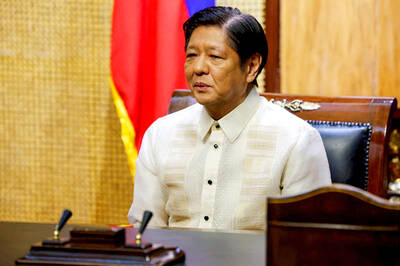
The Philippines would likely be involved in any conflict over Taiwan due to its proximity to the democracy claimed by China, President Ferdinand Marcos Jr said, reiterating a stance that risks angering Beijing. “In the Philippines, we do not have a choice because Taiwan is so close to the Philippines and we have almost 200,000 Filipino nationals living and working in Taiwan,” Marcos said in an interview with Japanese media in Manila on Monday. The Philippine leader’s comments come ahead of a state visit to Japan next week, where he is to meet with Japanese Prime Minister Sanae Takaichi to discuss security


 RSS
RSS