


President Tsai Ing-wen’s (蔡英文) approval rating dropped from 33.3 percent last month to 31.2 percent this month, her second-lowest score since taking office in May 2016, a Taiwanese Public Opinion Foundation poll showed yesterday.
Tsai’s visit to flood victims in Chiayi last month — during which she stood in an armored vehicle, smiled and waved before she was asked to step out of the vehicle — and Taiwan’s severance of diplomatic ties with El Salvador affected her approval rating, the foundation said.
Fifty-five percent of respondents said they disapproved of Tsai’s performance, while 31.2 percent approved — the largest discrepancy in the past two years, the poll showed.
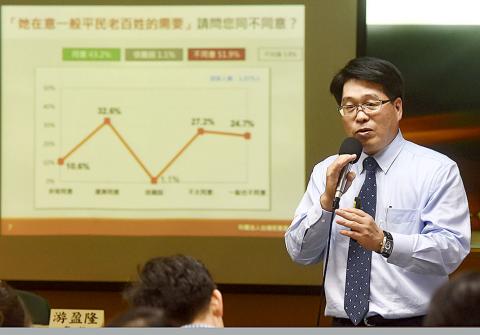
Photo: Chien Jung-fong, Taipei Times
The poll results show that the Democratic Progressive Party (DPP) administration is facing a worsening predicament, foundation chairman Michael You (游盈隆) said.
To analyze the change in Tsai’s approval rating, the foundation selected 10 of 13 questions that Gallup asked to evaluate US President Donald Trump’s character in June, You said.
Of the respondents, 56.4 percent said that Tsai is an intelligent leader, while 39.6 percent disagreed, he said, adding that it was Tsai’s only positive quality that voters see in her.
When asked whether Tsai is honest and trustworthy, 47.5 percent said no, while 46.4 percent said yes, the poll showed.
Asked whether Tsai put the nation’s interests ahead of her own political interests, 46.2 percent said she did not, while 46 percent said she did, it found.
About 54 percent of respondents said Tsai could not effect the changes the nation needs, while 43 percent said she could.
Tsai fared poorly in questions that gauged her leadership qualities, the survey found.
Nearly 52 percent of respondents said they disagreed with the statement that Tsai cares about the needs of ordinary people, while about 43 percent agreed.
Asked whether Tsai is a strong and decisive leader, 56.5 percent said she is not, while 38.1 percent said she is.
The poll found that 56.2 percent of respondents said Tsai has not kept her campaign promises, while 38 percent said she has.
According to the poll, 57.5 percent of respondents said she does not lead the government effectively, while 36.9 percent said she does.
As for the appointment of Cabinet members, 56.8 percent said Tsai did not pick good officials, while 36.5 percent said that she did.
Respondents gave Tsai the worst grade when asked whether she has worked well with the two other major political parties to get things done, with 61.7 percent saying she has not.
By contrast, the approval rating of Premier William Lai (賴清德) rose from 41.7 percent last month to 44.7 percent this month, You said, adding that Lai’s approval rating has remained steady from January through this month.
The poll also gauged people’s stance on cross-strait issues.
While 36.2 percent of respondents said they supported independence, 26.1 percent said that they supported unification with China and 23.2 percent said that they favored “maintaining the ‘status quo.’”
It was the first time that more respondents supported “unification with China” than “maintaining the ‘status quo.’”
The number of respondents favoring unification have risen from about 15 percent in May 2016 to 26.1 percent now, representing a great advance for unification supporters, You said, citing past surveys.
The poll found that 34.5 percent of respondents did not lean toward any political party, while 24.7 percent supported the DPP, 23.1 percent supported the Chinese Nationalist Party (KMT), 8 percent backed the New Power Party and 3.9 percent said they would vote for minor political parties.
The poll collected 1,075 valid samples and has a margin of error of 2.99 percentage points.
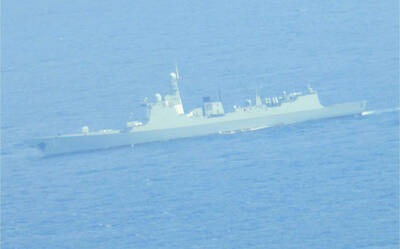
The military has spotted two Chinese warships operating in waters near Penghu County in the Taiwan Strait and sent its own naval and air forces to monitor the vessels, the Ministry of National Defense (MND) said. Beijing sends warships and warplanes into the waters and skies around Taiwan on an almost daily basis, drawing condemnation from Taipei. While the ministry offers daily updates on the locations of Chinese military aircraft, it only rarely gives details of where Chinese warships are operating, generally only when it detects aircraft carriers, as happened last week. A Chinese destroyer and a frigate entered waters to the southwest
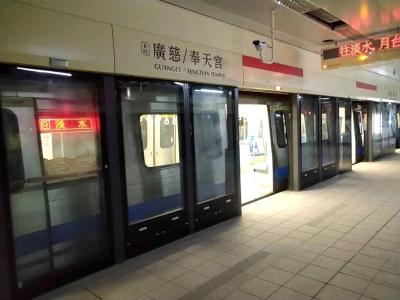
The eastern extension of the Taipei MRT Red Line could begin operations as early as late June, the Taipei Department of Rapid Transit Systems said yesterday. Taipei Rapid Transit Corp said it is considering offering one month of free rides on the new section to mark its opening. Construction progress on the 1.4km extension, which is to run from the current terminal Xiangshan Station to a new eastern terminal, Guangci/Fengtian Temple Station, was 90.6 percent complete by the end of last month, the department said in a report to the Taipei City Council's Transportation Committee. While construction began in October 2016 with an
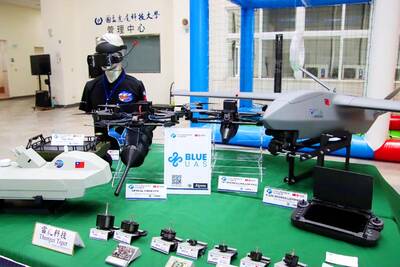
NON-RED SUPPLY: Boosting the nation’s drone industry is becoming increasingly urgent as China’s UAV dominance could become an issue in a crisis, an analyst said Taiwan’s drone exports to Europe grew 41.7-fold from 2024 to last year, with demand from Ukraine’s fight against Russian aggression the most likely driver of growth, a study showed. The Institute for Democracy, Society and Emerging Technology (DSET) in a statement on Wednesday said it found that many of Taiwan’s uncrewed aerial vehicle (UAV) sales were from Poland and the Czech Republic. These countries likely transferred the drones to Ukraine to aid it in its fight against the Russian invasion that started in 2022, it said. Despite the gains, Taiwan is not the dominant drone exporter to these markets, ranking second and fourth

Japanese Prime Minister Sanae Takaichi’s comment last year on Tokyo’s potential reaction to a Taiwan-China conflict has forced Beijing to rewrite its invasion plans, a retired Japanese general said. Takaichi told the Diet on Nov. 7 last year that a Chinese naval blockade or military attack on Taiwan could constitute a “survival-threatening situation” for Japan, potentially allowing Tokyo to exercise its right to collective self-defense. Former Japan Ground Self-Defense Force general Kiyofumi Ogawa said in a recent speech that the remark has been interpreted as meaning Japan could intervene in the early stages of a Taiwan Strait conflict, undermining China’s previous assumptions


 RSS
RSS