


The Chinese Nationalist Party (KMT) caucus yesterday accused the government of inaction following the alleged attack by a Japanese visitor on a comfort woman statue erected next to the party’s Tainan chapter offices.
Japanese Representative to Taiwan Mikio Numata must apologize for the incident, but the government has shied away from responding to the “intrusive and impudent” action of Mitsuhiko Fujii, a member of the Alliance for Truth About Comfort Women, KMT caucus deputy secretary-general Ko Chih-en (柯志恩) told a news conference in Taipei.
Fujii can allegedly be seen in surveillance footage kicking the statue on Thursday last week during a visit to Taiwan to deliver an invitation to the Tainan Alliance for Comfort Women’s Rights to a public debate on the comfort women issue.
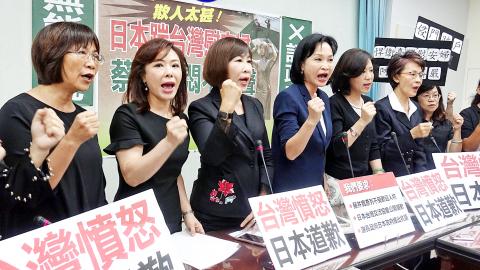
Photo: Liu Hsin-de, Taipei Times
Fujii lied when he accused the KMT of altering the footage and said he had only stretched his leg because he felt a “numbness” in it, Ko said.
The Ministry of the Interior must list Fujii as an unwelcome person and Representative to Japan Frank Hsieh (謝長廷) must lodge a formal protest with Tokyo over the incident, the caucus said.
Calling Fujii’s claims “pathetic and shameless,” KMT Legislator Alicia Wang (王育敏) said Fujii’s action had hurt the dignity of Taiwanese women and was intolerable.
As the nation’s first female leader, President Tsai Ing-wen’s (蔡英文) silence over the incident was disheartening, Wang said.
Wang said she has completed a draft amendment to protect the rights of former comfort women and their families, which the incident showed are in need of strengthening.
Her proposal stipulates a prison term of up to one year and a fine of up to NT$10,000 for people who hurt the dignity of former comfort women through discriminatory actions, which would include disrespecting statues, she said.
The UN Human Rights Committee in 1996 defined comfort women as girls and women from several Asian nations who were abducted and forced into sexual slavery prior to and during World War II by the Japanese Imperial Army, Hua Hsia Social Welfare Association director-general Jennifer Wang (王如玄) told the news conference.
Japan and South Korea signed an agreement on Dec. 28, 2015, to resolve the comfort women issue, with Japanese Prime Minister Shinzo Abe issuing an apology and Tokyo issuing compensation, but Taiwanese comfort women have not yet received the apology and compensation they are due, Wang said.
“I have often wondered: Are Taiwanese not as human as South Koreans?” she said.
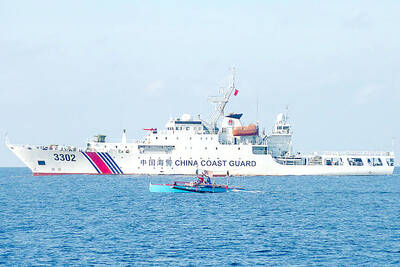
EXPANSIONIST: China deploys an average of 40 to 50 warships and coast guard vessels daily in the South China Sea, despite pledges not to militarize the region, an official said China is attempting to expand its influence across the First Island Chain and increase pressure on Japan by sending coast guard vessels into waters off of Taiwan under the pretext of maritime negotiations with Japan and the Philippines, a national security official said yesterday. China’s recent actions in the waters east of Taiwan and Japan and the Philippines’ exclusive economic zones (EEZ) are attempts to establish dominance in First Island Chain waters, said the official who declined to be named, adding that this is “expansion disguised as law enforcement.” Framing China’s actions solely as a cross-strait issue is a serious misjudgment that
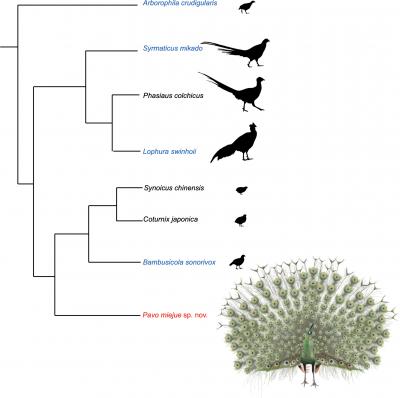
Through analyzing fossil evidence, a research team at National Taiwan University (NTU) discovered the largest endemic bird to have lived in Taiwan, naming it Pavo miejue, or extinct peafowl (滅絕孔雀). The Mikado pheasant, which is printed on the back of the NT$1,000 bank note, was previously believed to be the biggest endemic bird to Taiwan. The research team’s findings suggest that Pavo miejue lived during the Pleistocene epoch tens of thousands of years ago. It is the first endemic extinct bird species discovered and formally named in Taiwan. The study was coauthored by NTU Institute of Ecology and Evolutionary Biology professor Tsai Cheng-hsiu (蔡政修),
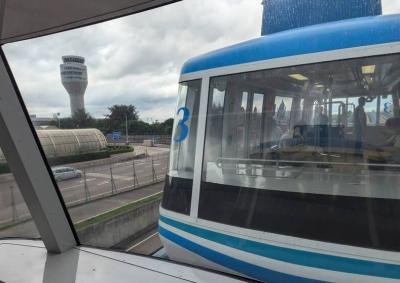
Taiwan Taoyuan International Airport is to suspend its automated Skytrain service connecting Terminal 1 and Terminal 2 starting on July 1 to facilitate connection works for the upcoming Terminal 3, the airport operator said today. Passengers and staff who need to travel between the two terminals after the suspension can instead use the Taoyuan MRT or the airport's 24-hour shuttle bus service, Taoyuan International Airport Corp said. The Taoyuan MRT Airport Line directly links the two terminals, while the shuttle buses are to operate around the clock, the company added. The Skytrain provides free transportation between the airport’s two terminals for travelers and
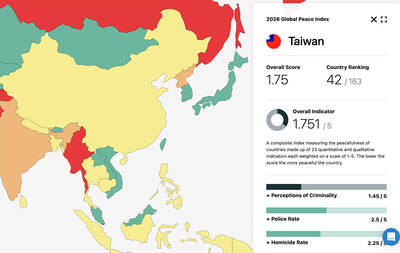
Taiwan ranked 42nd in terms of peacefulness among 163 countries, down five places from last year, according to this year’s Global Peace Index. With an overall score of 1.751, Taiwan dropped from 37th last year, the report published by the global Institute for Economics and Peace showed. The overall score measures a country’s level of peacefulness using 23 quantitative and qualitative indicators across three domains — ongoing domestic and international conflict, societal safety and security, and militarization. While Taiwan ranked 42nd worldwide, it was listed in ninth place among the 19 Asian-Pacific countries in the report, after New Zealand, Singapore, Japan, Malaysia,


 RSS
RSS