


A Democratic Progressive Party (DPP) legislator has drafted a legal amendment that would nullify the household registration of Taiwanese who obtain the new Chinese residency permit cards unveiled by Beijing last month.
DPP Legislator Wang Ding-yu (王定宇) yesterday said that he drafted the amendment, which has received the required number of signatures to propose amending the Act Governing Relations Between the People of the Taiwan Ara and the Mainland Area (臺灣地區與大陸地區人民關係條例).
Wang said one of the focuses of the proposed amendment is Article 9-1 of the act, which prohibits Republic of China citizens from having household registrations in China, or from holding passports issued by the Chinese government.
“My proposed amendment will extend the existing terms to people who register in China to obtain [the new] Chinese residency cards,” Wang said, “However, if they renounce their Chinese residency cards, they can restore their Taiwanese household registration and citizenship rights.”
Taiwanese who run companies or work in China might find it easier and more convenient to conduct business with the new residency card, Wang said.
“However, the Chinese government will able to track you, and record all of your activities and movements,” he said.
If the amendment is passed, Taiwanese in China could be caught between the laws of the two governments, Wang said.
“However, if we do not propose the amendment, this situation could cause serious problems for national security, so we should discuss it with all lawmakers and examine the ramifications,” he said.
Wang compared Beijing’s new policy to the US policy of issuing green cards to citizens of other nations and asked whether Beijing’s move proved that Taiwan and China are separate, distinct nations.
The proposed amendment is to be discussed at the first meeting of the legislature’s Internal Administration Committee when the new legislative session begins on Friday.
The DPP has invited Mainland Affairs Council Minister Chen Ming-tong (陳明通) to explain the agency’s response to China’s move to issue residency permit cards to people from Taiwan, Hong Kong and Macau.
New Power Party (NPP) Legislator Hsu Yung-ming (徐永明) said his party has also considered introducing amendments about the issue, which would require Taiwanese who have obtained Chinese residency cards to notify the government that they have done so when they return home.
“The NPP is considering whether to suspend these people’s household registration or to nullify them outright. Nullification would lead to changes in many areas, including running for public office, receiving social welfare benefits and other citizenship rights. Therefore we need more discussions. The NPP would come up with its own version [of an amendment proposal] within one or two weeks,” Hsu said.

LOUD AND PROUD Taiwan might have taken a drubbing against Australia and Japan, but you might not know it from the enthusiasm and numbers of the fans Taiwan might not be expected to win the World Baseball Classic (WBC) but their fans are making their presence felt in Tokyo, with tens of thousands decked out in the team’s blue, blowing horns and singing songs. Taiwanese fans have packed out the Tokyo Dome for all three of their games so far and even threatened to drown out home team supporters when their team played Japan on Friday. They blew trumpets, chanted for their favorite players and had their own cheerleading squad who dance on a stage during the game. The team struggled to match that exuberance on the field, with
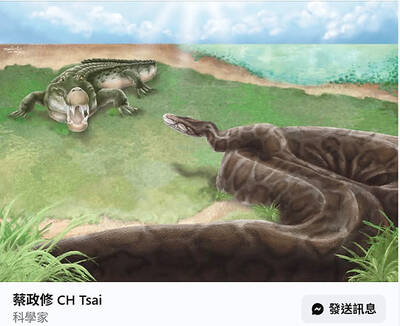
Taiwanese paleontologists have discovered fossil evidence that pythons up to 4m long inhabited Taiwan during the Pleistocene epoch, reporting their findings in the international scientific journal Historical Biology. National Taiwan University (NTU) Institute of Ecology and Evolutionary Biology associate professor Tsai Cheng-hsiu (蔡政修) led the team that discovered the largest snake fossil ever found in Taiwan. The single trunk vertebra was discovered in Tainan at the Chiting Formation, dated to between 400,000 and 800,000 years ago in the Middle Pleistocene, the paper said. The area also produced Taiwan’s first avian fossil, as well as crocodile, mammoth, saber-toothed cat and rhinoceros fossils, it said. Discoveries

Taiwanese paleontologists have discovered fossil evidence that pythons up to 4m long inhabited Taiwan during the Pleistocene epoch, reporting their findings in the international scientific journal Historical Biology. National Taiwan University (NTU) Institute of Ecology and Evolutionary Biology associate professor Tsai Cheng-hsiu (蔡政修) led the team that discovered the largest snake fossil ever found in Taiwan. A single trunk vertebra was discovered in Tainan at the Chiting Formation, dated to between 800,000 to 400,000 years ago in the Middle Pleistocene, the paper said. The area also produced Taiwan’s first avian fossil, as well as crocodile, mammoth, sabre-toothed cat and rhinoceros fossils, it said. Discoveries

Whether Japan would help defend Taiwan in case of a cross-strait conflict would depend on the US and the extent to which Japan would be allowed to act under the US-Japan Security Treaty, former Japanese minister of defense Satoshi Morimoto said. As China has not given up on the idea of invading Taiwan by force, to what extent Japan could support US military action would hinge on Washington’s intention and its negotiation with Tokyo, Morimoto said in an interview with the Liberty Times (sister paper of the Taipei Times) yesterday. There has to be sufficient mutual recognition of how Japan could provide


 RSS
RSS