


Taiwan’s loss of another diplomatic ally to China is the latest strike in a multi-pronged effort to isolate the nation, undermine its claims to sovereignty and render it invisible on the global stage.
As President Tsai Ing-wen (蔡英文) refuses to bend to Beijing’s demand that she recognize its “one China” principle, the Chinese government has stepped up its campaign to shrink the nation’s status.
Major international businesses, including airlines and hotels, have caved to pressure to list Taiwan as part of China on their Web sites. Taiwan has also been shut out of numerous high-profile global forums at Beijing’s request, and China has stepped up military drills around the nation.
Salvadoran President Sanchez Ceren on Tuesday said its decision to switch ties from Taipei to Beijing was part of the “inevitable trends of our day,” while Taiwan accused China of using “yuan diplomacy” to lure away its supporters.
Taiwan now has only 17 diplomatic allies, the vast majority of them small economies in the Pacific, Caribbean and Central America.
Five have jumped ship since Tsai took power in 2016, with three this year alone.
The allies might not punch much weight internationally, but chipping away at them has deep significance for Taiwan as it strives to hold on to any formal recognition of its legitimacy.
“If the ROC [Republic of China] is completely unrecognized, I believe Beijing’s calculation is that it will be easier to delegitimize the government in Taipei and prime demoralized Taiwanese and international society for unification,” said Jonathan Sullivan, director of China programs at the University of Nottingham in England.
Wooing El Salvador was also a warning shot to the US, said Fan Shih-ping (范世平), a political analyst at National Taiwan Normal University in Taipei.
The US is Taiwan’s most important informal ally and major arms supplier, despite having switched official diplomatic ties to Beijing in 1979.
Beijing last week protested when Tsai spoke publicly in Los Angeles — the first Taiwanese president to do so for 15 years — and has also complained about friendly overtures from the administration of US President Donald Trump, including a fresh commitment to support Taiwan militarily.
“It’s an indirect slap in Trump’s face as El Salvador is in the US’ backyard,” Fan said.
Chinese President Xi Jinping (習近平) is confident he can use both hard and soft power to pave the way for unification, National Chengchi University College of International Affairs vice dean Huang Kwei-bo (黃奎博) said.
“They now ignore stakeholders in Taiwan and unilaterally decide to do whatever they want,” Huang said. “This is quite worrying, as it means Beijing doesn’t have any willingness to communicate anymore.”
However, Sullivan said that if Taiwan loses all recognition from its allies, Beijing might unwittingly fuel calls from independence supporters to push for the nation to redefine itself as the Republic of Taiwan.
He also believes Taiwan’s unofficial ties ultimately outweigh its official ones.
“Taiwan’s informal relationships as a major trading economy with the US, Japan, the EU and pretty much every other country in the world are much more important to Taiwan’s vitality,” Sullivan said.

LOUD AND PROUD Taiwan might have taken a drubbing against Australia and Japan, but you might not know it from the enthusiasm and numbers of the fans Taiwan might not be expected to win the World Baseball Classic (WBC) but their fans are making their presence felt in Tokyo, with tens of thousands decked out in the team’s blue, blowing horns and singing songs. Taiwanese fans have packed out the Tokyo Dome for all three of their games so far and even threatened to drown out home team supporters when their team played Japan on Friday. They blew trumpets, chanted for their favorite players and had their own cheerleading squad who dance on a stage during the game. The team struggled to match that exuberance on the field, with
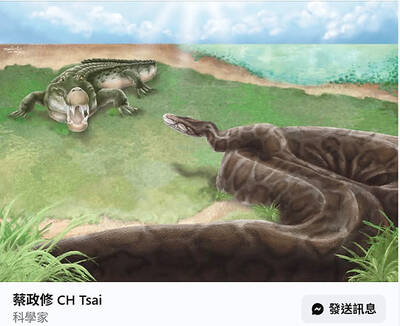
Taiwanese paleontologists have discovered fossil evidence that pythons up to 4m long inhabited Taiwan during the Pleistocene epoch, reporting their findings in the international scientific journal Historical Biology. National Taiwan University (NTU) Institute of Ecology and Evolutionary Biology associate professor Tsai Cheng-hsiu (蔡政修) led the team that discovered the largest snake fossil ever found in Taiwan. The single trunk vertebra was discovered in Tainan at the Chiting Formation, dated to between 400,000 and 800,000 years ago in the Middle Pleistocene, the paper said. The area also produced Taiwan’s first avian fossil, as well as crocodile, mammoth, saber-toothed cat and rhinoceros fossils, it said. Discoveries

Taiwanese paleontologists have discovered fossil evidence that pythons up to 4m long inhabited Taiwan during the Pleistocene epoch, reporting their findings in the international scientific journal Historical Biology. National Taiwan University (NTU) Institute of Ecology and Evolutionary Biology associate professor Tsai Cheng-hsiu (蔡政修) led the team that discovered the largest snake fossil ever found in Taiwan. A single trunk vertebra was discovered in Tainan at the Chiting Formation, dated to between 800,000 to 400,000 years ago in the Middle Pleistocene, the paper said. The area also produced Taiwan’s first avian fossil, as well as crocodile, mammoth, sabre-toothed cat and rhinoceros fossils, it said. Discoveries

Whether Japan would help defend Taiwan in case of a cross-strait conflict would depend on the US and the extent to which Japan would be allowed to act under the US-Japan Security Treaty, former Japanese minister of defense Satoshi Morimoto said. As China has not given up on the idea of invading Taiwan by force, to what extent Japan could support US military action would hinge on Washington’s intention and its negotiation with Tokyo, Morimoto said in an interview with the Liberty Times (sister paper of the Taipei Times) yesterday. There has to be sufficient mutual recognition of how Japan could provide


 RSS
RSS