


Opponents of a plan to build a coal-fired plant on the site of the old Shenao Power Plant (深澳電廠) yesterday filed an administrative appeal with the Executive Yuan, urging it to scrap the project for its potential to “cause air pollution and kill marine life.”
State-run Taiwan Power Co (Taipower), which plans to construct the plant in New Taipei City’s Rueifang District (瑞芳), received approval from the Environmental Protection Administration (EPA) in 2006.
However, the utility in May last year proposed a modified plan, which would replace two supercritical generators with ultra-supercritical generators and reduce capacity from 800 to 600 megawatts each, and said it would build a coal delivery harbor and breakwaters off the district’s Shenao Bay (深澳灣).
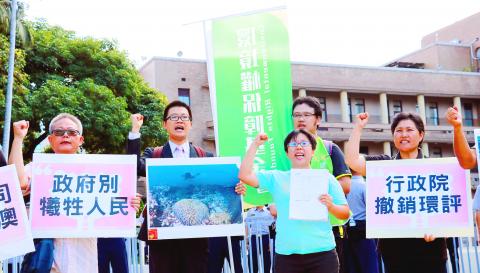
Photo: CNA
Saying that the utility had changed the scope of the project, the EPA conducted four environmental impact assessment (EIA) reviews before giving the utility its final approval in May, which sparked overwhelming criticism.
Environmental groups and Rueifang locals yesterday gathered in front of the Executive Yuan in Taipei, urging the Cabinet to revoke the EPA’s approval and scrap the project.
In granting its approval, the EPA only recommended that the utility provide a supplement to its ecological survey, Environmental Rights Foundation lawyer Kuo Hung-yi (郭鴻儀) said, adding that this was a flaw in the EIA procedure.
As the plant’s planned location overlaps with a conservation area off the bay for aquatic animals and plants, the utility should be required to obtain the city government’s approval before constructing a facility in the area, and the city government is opposed to the project, Kuo said.
The city government could refuse to issue coal-burning permits to Taipower, even if the plant’s construction is complete, he added.
Instead of answering questions from the public about the plant’s potential effect on air quality and human health, Premier William Lai (賴清德) chose to tell people that the plant would use “clean coal,” Anti-Shenao Plant Self-Help Group director Chen Chih-chiang (陳志強) said.
“This is a government that can do nothing but push people to file administrative appeals,” Chen said, adding that he wants to know what President Tsai Ing-wen (蔡英文) meant when she asked government officials to be more “humble.”
In touting development plans that could have a negative impact, the government often uses “feedback money” to sway local residents, but history has shown that no benefits guaranteed by government officials promote sustainable development, Chen said.
An online petition against the project has garnered more than 90,000 signatures in four months, Greenpeace Taiwan campaigner Chang Kai-ting (張凱婷) said, calling on the government to show its resolve to promote energy transformation by canceling the project.

NATIONAL SECURITY: Authorities are working to confirm the identities of the military personnel involved and investigating possible illegal conduct and regulatory violations Authorities are probing possible national security implications after Kinmen police and immigration officers on Sunday found a Chinese woman allegedly posing as a tourist while engaging in prostitution involving more than 10 military personnel. The woman, surnamed Chen (陳), has since been deported, authorities said, adding that investigators are still working to confirm the identities of those implicated, as the records only listed code names and aliases. The case stemmed from a report received by the Kinmen District Prosecutors’ Office on Friday last week from the Jinhu Precinct of the Kinmen County Police Bureau. On Sunday, police, along with the National Immigration

GLOBALGIVING: ‘ Caving to external pressure is not acceptable for an organization that has cultivated justice reform and human rights for 30 years,’ one NGO said A slew of non-government organizations (NGOs) have withdrawn from the GlobalGiving fundraising platform after it announced it would use “Chinese Taipei” instead of “Taiwan” from next month. The Taiwan Good Rice Association wrote on Facebook on Friday that it was informed on April 28 via a teleconference call of the change, which was made because the platform wanted to operate in China. Taiwan Good Rice is to terminate all cooperative relationships with GlobalGiving in response to the platform’s “unilateral and non-negotiable” decision to remove references to Taiwan, the NGO said. “Taiwan is in the official name of Taiwan Good Rice Association and the
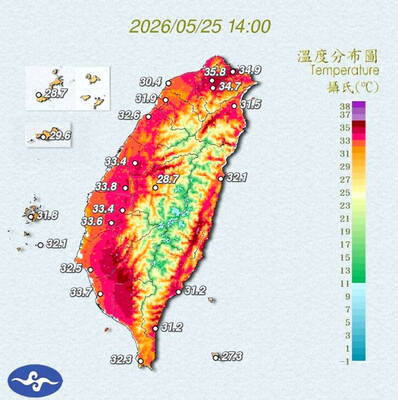
STAY COOL: The HPA recommended that people stay hydrated, use air-conditioning or fans while indoors, wear loose-fitting clothes and walk in the shade while outdoors Employers must implement measures such as installing cooling equipment, and providing drinking water and rest breaks for outdoor workers starting from Monday next week, the Taipei Department of Labor said on Sunday. Employers who fail to comply could face fines of NT$30,000 to NT$300,000 under the Occupational Safety and Health Act (職業安全衛生法), the department said. Businesses in Taipei employing fewer than 100 workers, as well as registered self-employed workers with labor insurance coverage, could receive on-site assessments and guidance from occupational safety consultants to help them apply for central government subsidies to implement or improve heat-protection measures, it said. Under the Ministry of

Chinese Nationalist Party (KMT) Chairwoman Cheng Li-wun (鄭麗文) yesterday briefed her party’s Central Standing Committee regarding her scheduled visit to the US between Monday next week and June 16, saying that her purpose would be to persuade the US that the Republic of China (ROC) Constitution was a “one China” constitution that would foster stable and peaceful cross-strait relations. The ROC Constitution is the most important defense for all Taiwanese citizens, as it upholds our democracy and has contributed to our robust economy, which aligns with international and US interests, she said. “We would not be troublemakers and drag the US under,”


 RSS
RSS