

Taiwanese start-up 100% Plants turns sugarcane byproducts into polymer raw materials that are used to make biodegradable straws, potentially opening new avenues for research into sustainable alternatives for plastic.
Simple chemical aggregation methods would be sufficient to render sugarcane by-products, or bagasse, into polymer raw materials, which could be used to manufacture biodegradable straws, 100% Plants founder Huang Chien-chung (黃千鐘) said on Friday.
Developing the processes was not without its challenges.

Photo: Chen Feng-li, Taipei Times
The first factory that they collaborated with complained that the materials were “unusable,” Huang said, adding that solutions necessitated modifying the factory’s machines.
After calibrations and tests, a product was produced that would not crack or splinter, even when subjected to temperatures of minus-20°C, Huang said.
The company is collaborating with National Taiwan Ocean University to determine the product’s rate of degradation when submerged in ocean water or in fish stomach acid, he said.
“We hope that the test results will prove that our product is environmentally friendly,” Huang said.
The Rural Development Foundation fully supports the start-up’s idea, foundation president Hsieh Chih-cheng (謝志誠) said, adding that using what would otherwise be considered agricultural waste as a substitute for polyethylene is practical and eco-friendly.
The start-up is researching using discarded bamboo to manufacture one-time utensils, with a prototype undergoing tests in the US and Australia, he said.
The company’s efforts have attracted the attention of several French tourist destinations, as France’s Energy Transition for Green Growth Act intends to ban plastic plates, cups and utensils by 2020, he added.
The start-up is in talks with the localities regarding the possibility of turning grape bagasse and barley pulp into useful products, Huang said.
The start-up has refused offers from more than 20 Chinese companies over the past two months wishing to buy its technology, he said.
“We do want to make money, but we give an even higher priority to working with the international community as a Taiwanese company,” Huang added.
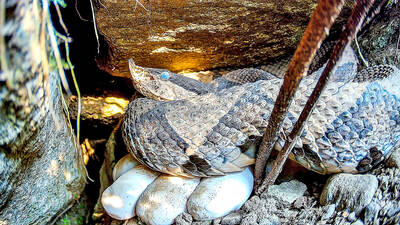
NATURE TAKES ITS COURSE: The agency’s head said he felt a sense of loss watching red-banded snakes eat the babies, as they had decided on non-intervention The Forestry and Nature Conservation Agency yesterday released a documentary on a hundred-pace viper that had incubated 16 eggs, all of which hatched, but only a baby viper escaped after they were attacked by red-banded snakes. The agency’s Taichung branch last year launched the viper reproduction monitoring project soon after forest rangers Lin Chun-yu (林俊佑) and Chou Chia-cheng (周家成) spotted a pregnant hundred-pace viper in a grass-covered burrow near a parking lot in Tbulan Village (松鶴部落). The Atayal village, in Taichung’s Heping District (和平), is headed by Ecyang Yapu, who was positive about the project and assisted in access control and power

The Coast Guard Administration (CGA) yesterday said that it had deployed vessels to “monitor” Chinese ships operating in waters off the east coast. The CGA said it dispatched vessels in response to a China Coast Guard announcement that it had carried out another “routine law-enforcement patrol” in waters off the east coast. “The CGA firmly rejects China’s cognitive warfare campaign of ‘law enforcement in name, jurisdictional expansion in practice,’” it said on X. As of 11am yesterday, two China Coast Guard ships were “loitering and drifting” about 105 nautical miles (195km) and 74 nautical miles east of Green Island (綠島) respectively, it said. It
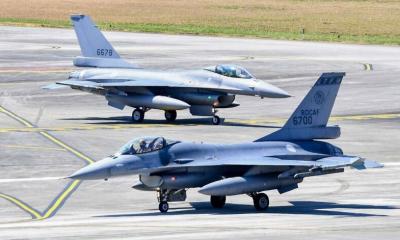
The first two F-16V Block 70 jets Taiwan purchased from the US were spotted unexpectedly turning back after departing from Hawaii yesterday, potentially further delaying delivery of the aircraft. Taiwan has purchased 66 of the F-16 C/D Block 70 jets to be deployed at Chihhang Air Base (志航基地) in Taitung County and operated by the air force's 7th Tactical Fighter Wing to defend Taiwan’s eastern region. Two single-seat jets, bearing serial No. 6727 and 6728, were spotted taking off from Hickam Field in Hawaii yesterday, observers said. Based on the precedent set during the delivery of Taiwan's older F-16 Block 20s, the new
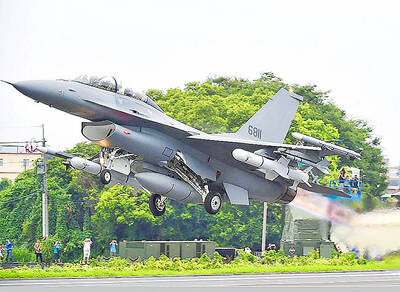
A sharp rise in compensation to be paid by air force officers who leave before completing their required service could indicate an increase in pilots leaving the military early, an analyst said on Friday, warning that the trend could worsen a shortage of experienced personnel. Chieh Chung (揭仲), a researcher at the Association for Strategic Foresight, issued the warning even though the number of volunteer military personnel is expected to increase next year. The planned headcount for volunteer military personnel, covering officers, noncommissioned officers (NCO) and enlisted soldiers, is 158,223 for next year, up 4,258 from 153,965 this year, Chieh said. The increase


 RSS
RSS