


If Taiwan wishes to find a balance in its relationship with the US and China, it should consider whether to adjust its cross-strait policy or make economic concessions to the US, former American Institute in Taiwan (AIT) chairman Richard Bush said in an interview that was broadcast yesterday.
Bush, who served as AIT chairman from 1997 to 2002, said in an interview with POP Radio that Taiwan needs to address some serious questions amid shifts in the fundamental reality of cross-strait relations.
“First of all, it seems that China will no longer rely so much on conservative political forces within Taiwan to advance its interests. It seems that Chinese power to intimidate Taiwan is growing. If that is true, which I believe is true, should Taiwan adjust its mainland policy to something significantly different from before? If so, in what way?” Bush said.

Photo: CNA
The second question Taiwan should address, Bush said, is whether the country should make necessary concessions on market access to Washington, which is its second-largest trading partner and No.1 security partner, if it aspires to improve its economic relationship with the US.
Bush said the solution to the second question is not necessarily to relax import restrictions on US beef and pork.
“I think one of the ways Taiwan can help itself is [by deregulating] the financial services industry to increase investment from outside,” he said.
Another question facing Taiwanese leaders is whether they should work harder to create a consensus among themselves, Bush said, particularly in light of how the nation’s polarized political system has made it difficult to pass critical legislation.
Turning to the cross-strait stalemate, Bush said that while some have blamed the situation on President Tsai Ing-wen’s (蔡英文) unwillingness to accept the so-called “1992 consensus,” it is his view that Tsai has addressed these issues, albeit in an ambiguous way.
“Ambiguity is often useful in managing differences and particularly in Chinese culture,” Bush said, adding that Tsai’s cautious and restrained cross-strait policies have actually won her praise from some US officials.
Since her inauguration in May 2016, Tsai has on several occasions said that she respects the fact that in 1992 a meeting occurred between both sides of the Taiwan Strait, but has not acknowledged the existence of a “1992 consensus.”
The “1992 consensus” — a term former Mainland Affairs Council chairman Su Chi (蘇起) admitted he had made up in 2000 — refers to a tacit understanding between the Chinese Nationalist Party (KMT) and Beijing that both sides of the Strait acknowledge there is “one China,” with each side having its own interpretation of what “China” means.
Bush said there was a window of opportunity to begin a cross-strait trust-building process after Tsai took office, but China was not willing to do so, presumably because it did not wish to coexist with the Tsai administration or legitimize her Democratic Progressive Party.
Bush also dismissed the possibility of Beijing replacing the “the one country, two systems” framework to make its ultimate unification agenda more appealing to Taiwanese.
Instead, Beijing would continue to pressure and squeeze Taiwan until it gets a leader who is more cooperative than Tsai or even former president Ma Ying-jeou (馬英九) of the KMT, he said.
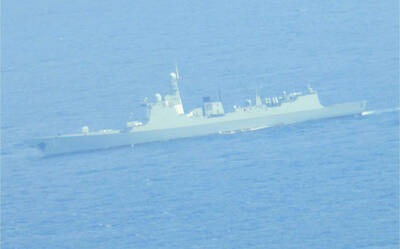
The military has spotted two Chinese warships operating in waters near Penghu County in the Taiwan Strait and sent its own naval and air forces to monitor the vessels, the Ministry of National Defense (MND) said. Beijing sends warships and warplanes into the waters and skies around Taiwan on an almost daily basis, drawing condemnation from Taipei. While the ministry offers daily updates on the locations of Chinese military aircraft, it only rarely gives details of where Chinese warships are operating, generally only when it detects aircraft carriers, as happened last week. A Chinese destroyer and a frigate entered waters to the southwest
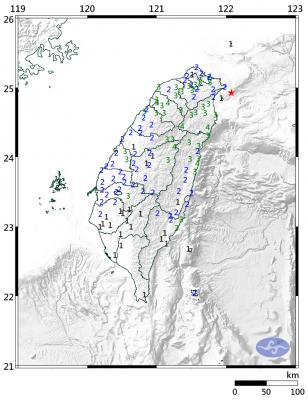
A magnitude 6.1 earthquake struck off the coast of Yilan County at 8:39pm tonight, the Central Weather Administration (CWA) said, with no immediate reports of damage or injuries. The epicenter was 38.7km east-northeast of Yilan County Hall at a focal depth of 98.3km, the CWA’s Seismological Center said. The quake’s maximum intensity, which gauges the actual physical effect of a seismic event, was a level 4 on Taiwan’s 7-tier intensity scale, the center said. That intensity level was recorded in Yilan County’s Nanao Township (南澳), Hsinchu County’s Guansi Township (關西), Nantou County’s Hehuanshan (合歡山) and Hualien County’s Yanliao (鹽寮). An intensity of 3 was

Japanese Prime Minister Sanae Takaichi’s comment last year on Tokyo’s potential reaction to a Taiwan-China conflict has forced Beijing to rewrite its invasion plans, a retired Japanese general said. Takaichi told the Diet on Nov. 7 last year that a Chinese naval blockade or military attack on Taiwan could constitute a “survival-threatening situation” for Japan, potentially allowing Tokyo to exercise its right to collective self-defense. Former Japan Ground Self-Defense Force general Kiyofumi Ogawa said in a recent speech that the remark has been interpreted as meaning Japan could intervene in the early stages of a Taiwan Strait conflict, undermining China’s previous assumptions
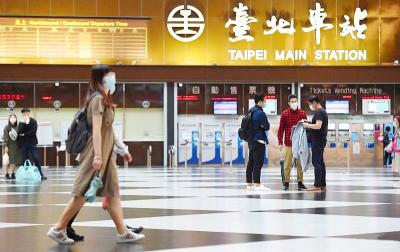
Taiwan Railways Corp (TRC) today announced that Shin Kong Mitsukoshi has been selected as the preferred bidder to operate the Taipei Railway Station shopping mall, replacing the current operator, Breeze Development Co Ltd. Among eight qualified firms that delivered presentations and were evaluated by a review committee, Shin Kong Mitsukoshi was ranked first, while Breeze was named the runner-up, the rail company said in a statement. Contract negotiations are to proceed in accordance with regulations, it said, adding that if negotiations with the top bidder fail, it could invite the second-ranked applicant to enter talks. Breeze in a statement today expressed doubts over


 RSS
RSS